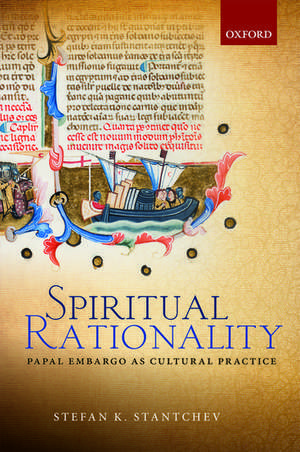
Spiritual Rationality: Papal Embargo as Cultural Practice
Autor Stefan K. Stantcheven Limba Engleză Hardback – 17 iul 2014
Preț: 930.87 lei
Preț vechi: 1354.57 lei
-31%
Puncte Express: 1396
Carte tipărită la comandă
Livrare economică 04-15 decembrie
Livrare prin curier în România Termenul estimat este afișat lângă disponibilitate.
Transport gratuit pentru acest produs Plată online sau ramburs, în funcție de opțiunile comenzii.
Retur gratuit în 14 zile Comandă securizată și suport în română.
Specificații
ISBN-13: 9780198704096
ISBN-10: 0198704097
Pagini: 256
Dimensiuni: 163 x 239 x 24 mm
Greutate: 0.54 kg
Editura: Oxford University Press
Colecția OUP Oxford
Locul publicării:Oxford, United Kingdom
ISBN-10: 0198704097
Pagini: 256
Dimensiuni: 163 x 239 x 24 mm
Greutate: 0.54 kg
Editura: Oxford University Press
Colecția OUP Oxford
Locul publicării:Oxford, United Kingdom
V-ar putea interesa
-
 A History of the CrusadesJonathan Riley-Smith-25%Preț: 139.15 lei186.16 lei
 -
 The Oxford Illustrated History of Medieval EuropeGeorge Holmes-16%Preț: 211.84 lei251.46 lei
 -
 -15%Preț: 606.29 lei713.29 lei
 -
 Preț: 405.63 lei
 -
 Barbarians to AngelsPeter S. WellsPreț: 129.05 lei
 -
 Preț: 390.14 lei
 -
 Preț: 478.74 lei
 -
 Medieval History for DummiesStephen BatchelorPreț: 155.33 lei
 -
 -26%Preț: 69.14 lei93.17 lei
 -
 Holy WarriorsJonathan PhillipsPreț: 125.02 lei
Recenzii
Stefan Stantchev has produced an exhaustively researched and interestingly conceptualized study of the history of papal prohibitions of trade with the enemies of Christendom in medieval and early modern times. The book is likely to remain a useful reference point for this history, but its greatest contribution is that the author reconceptualizes and rethinks the embargoes ... This is a real achievement that earns the author great praise.
Stefan Stantchev managed to astonish me with his book, whose topic and execution are remarkable ... it has managed to prove its originality. I strongly believe that mediaevalists of different fields will expect with interest the future studies of the author.
Stefan Stantchev managed to astonish me with his book, whose topic and execution are remarkable ... it has managed to prove its originality. I strongly believe that mediaevalists of different fields will expect with interest the future studies of the author.
Notă biografică
Stefan Stantchev earned his PhD in history at the University of Michigan in 2009, joining the faculty of Arizona State University's New College. His research interests focus mainly on the religious and economic factors that shaped human relations in the Mediterranean, c 1100 to c 1600. His work thus engages topics that are often treated separately, such as economic and church history, or foreign policy and religious identity. He has been offered fellowships and research grants from the Social Science Research Council, The Institute for the Humanities at the University of Michigan, the American Historical Association, and the Medieval Academy of America, among others.