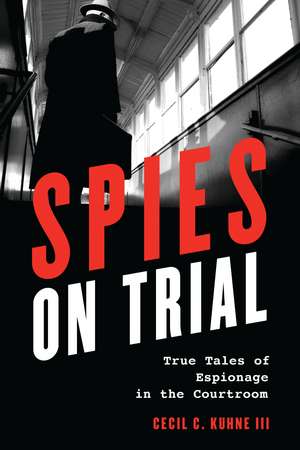
Spies on Trial: True Tales of Espionage in the Courtroom
Autor Cecil C. Kuhne IIIen Limba Engleză Hardback – 23 oct 2019
Cecil C. Kuhne III describes a number of historical, law changing judicial cases, well-publicized criminal trials of those accused of treason against the United States, as well as lawsuits concerning other unusual matters, such as the governmental restrictions on bugging and other surveillance devices that cannot be sold to the general public. The author successfullyexplores well known espionage cases, such as the Julius and Ethel Rosenberg and Morton Sobell trial of 1951, as well as more recent cases where the courts have dealt with the activities of the National Security Administration (NSA) as they monitor telephone communications in their efforts to apprehend terrorist organizations.
Spies on Trial brings the reader fast-paced stories of foreign spies engaged in daring deeds of sleuthing that undoubtedly have more than their fair share of intriguing moments. But nowhere is this suspense more intense than inside the courtroom, where the drama of intense covert activities is fully unfurled, offering fascinating glimpses into this vast and nefarious underground world of international espionage.
Preț: 260.38 lei
Preț vechi: 337.27 lei
-23%
Puncte Express: 391
Carte tipărită la comandă
Livrare economică 04-18 decembrie
Livrare prin curier în România Termenul estimat este afișat lângă disponibilitate.
Transport gratuit de la 400.00 lei Plată online sau ramburs, în funcție de opțiunile comenzii.
Retur gratuit în 14 zile Comandă securizată și suport în română.
Specificații
ISBN-13: 9781538131343
ISBN-10: 153813134X
Pagini: 184
Dimensiuni: 159 x 236 x 20 mm
Greutate: 0.52 kg
Editura: Bloomsbury Publishing
Colecția Rowman & Littlefield
Locul publicării:New York, United States
ISBN-10: 153813134X
Pagini: 184
Dimensiuni: 159 x 236 x 20 mm
Greutate: 0.52 kg
Editura: Bloomsbury Publishing
Colecția Rowman & Littlefield
Locul publicării:New York, United States
Recenzii
,
,
,
Attorney Kuhne (Sherlock Holmes for Lawyers) recounts 16 spy trials in fascinating detail. He begins with the 1951 trial of Julius and Ethel Rosenberg, the first U.S. citizens to be tried, convicted, and executed for espionage during peacetime. More recent trials include that of Greg Chung, a Boeing engineer accused of funneling secret documents pertaining to the space shuttle to China in 2006, and the ACLU trial against the U.S. government over the telephone metadata collections leaked by Edward Snowden. One of the most unusual trials is that of "Jane" and "John Doe," foreign spies for the CIA who retired to America with the promise of financial and personal security for life. But when the husband was laid off from his American job in 1997, the CIA wouldn't pay them. The court ruled against the couple, citing that the contract was secret and therefore could not be used as evidence in court. Six appendices cite the U.S. espionage laws that define and complicate these cases. Readers interested in the legal aspects of prosecuting spies will be rewarded.
Illustrating times when "the dark shadows of the clandestine backroom are suddenly exchanged for the bright lights of the open courtroom," this collection by lawyer and author Kuhne features cases spanning from WWII to the present. Some are well known: Edward Snowden leaking classified documents about the NSA's global surveillance program, Julius and Ethel Rosenberg sending top-secret intelligence about the U.S. atomic-bomb program to the Soviet Union. Other cases will be new and interesting to most readers, like a Soviet agent getting caught after his dry cleaner found papers containing information about espionage activities in his coat pocket. The author inserts
helpful supplemental documents throughout, including excerpts of Supreme Court opinions, the Espionage Act, the Foreign Intelligence Surveillance Act, and other legislation related to the cases featured in the book. . . . [Kuhne] manages to distill sprawling and often dense legal proceedings into plain English that fans of geopolitical intrigue will enjoy.
Mr. Kuhne's focus on the applicable laws used to promote the acts of Espionage discussed in his book is a unique approach. He tells the interesting story of where spying and jurisprudence have met in the courtroom. Both fans of nonfiction espionage literature and of timely legal issues should find it an interesting read.
The practice of intelligence in democratic societies is by definition inextricably linked with the system of law. This is something that students -alas, even practitioners- of intelligence often forget. Kuhne skillfully reminds us in this book, by revisiting some of the most decisive intelligence- and espionage-related legal cases in American history. The cases he discusses are neither pedantic nor obscure -they have made history in both the world of law and the world of intelligence. This book is invaluable for those who wish to truly comprehend the connections between them.
,
,
Attorney Kuhne (Sherlock Holmes for Lawyers) recounts 16 spy trials in fascinating detail. He begins with the 1951 trial of Julius and Ethel Rosenberg, the first U.S. citizens to be tried, convicted, and executed for espionage during peacetime. More recent trials include that of Greg Chung, a Boeing engineer accused of funneling secret documents pertaining to the space shuttle to China in 2006, and the ACLU trial against the U.S. government over the telephone metadata collections leaked by Edward Snowden. One of the most unusual trials is that of "Jane" and "John Doe," foreign spies for the CIA who retired to America with the promise of financial and personal security for life. But when the husband was laid off from his American job in 1997, the CIA wouldn't pay them. The court ruled against the couple, citing that the contract was secret and therefore could not be used as evidence in court. Six appendices cite the U.S. espionage laws that define and complicate these cases. Readers interested in the legal aspects of prosecuting spies will be rewarded.
Illustrating times when "the dark shadows of the clandestine backroom are suddenly exchanged for the bright lights of the open courtroom," this collection by lawyer and author Kuhne features cases spanning from WWII to the present. Some are well known: Edward Snowden leaking classified documents about the NSA's global surveillance program, Julius and Ethel Rosenberg sending top-secret intelligence about the U.S. atomic-bomb program to the Soviet Union. Other cases will be new and interesting to most readers, like a Soviet agent getting caught after his dry cleaner found papers containing information about espionage activities in his coat pocket. The author inserts
helpful supplemental documents throughout, including excerpts of Supreme Court opinions, the Espionage Act, the Foreign Intelligence Surveillance Act, and other legislation related to the cases featured in the book. . . . [Kuhne] manages to distill sprawling and often dense legal proceedings into plain English that fans of geopolitical intrigue will enjoy.
Mr. Kuhne's focus on the applicable laws used to promote the acts of Espionage discussed in his book is a unique approach. He tells the interesting story of where spying and jurisprudence have met in the courtroom. Both fans of nonfiction espionage literature and of timely legal issues should find it an interesting read.
The practice of intelligence in democratic societies is by definition inextricably linked with the system of law. This is something that students -alas, even practitioners- of intelligence often forget. Kuhne skillfully reminds us in this book, by revisiting some of the most decisive intelligence- and espionage-related legal cases in American history. The cases he discusses are neither pedantic nor obscure -they have made history in both the world of law and the world of intelligence. This book is invaluable for those who wish to truly comprehend the connections between them.