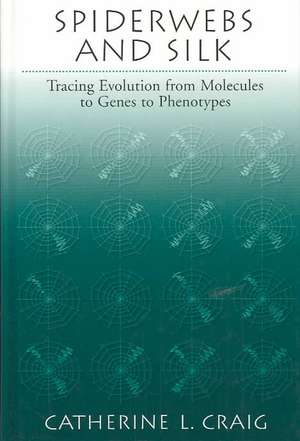
Spiderwebs and Silk: Tracing Evolution From Molecules to Genes to Phenotypes
Autor Catherine L. Craigen Limba Engleză Hardback – 11 sep 2003
Preț: 269.62 lei
Preț vechi: 306.73 lei
-12%
Puncte Express: 404
Carte tipărită la comandă
Livrare economică 04-09 decembrie
Livrare prin curier în România Termenul estimat este afișat lângă disponibilitate.
Transport gratuit de la 400.00 lei Plată online sau ramburs, în funcție de opțiunile comenzii.
Retur gratuit în 14 zile Comandă securizată și suport în română.
Specificații
ISBN-13: 9780195129168
ISBN-10: 0195129164
Pagini: 256
Ilustrații: numerous halftones and line figures
Dimensiuni: 242 x 165 x 21 mm
Greutate: 0.56 kg
Editura: Oxford University Press
Colecția OUP USA
Locul publicării:New York, United States
ISBN-10: 0195129164
Pagini: 256
Ilustrații: numerous halftones and line figures
Dimensiuni: 242 x 165 x 21 mm
Greutate: 0.56 kg
Editura: Oxford University Press
Colecția OUP USA
Locul publicării:New York, United States
V-ar putea interesa
-
 Biology of Ticks Volume 1Daniel E. Sonenshine-33%Preț: 1484.04 lei2212.59 lei
 -
 Biology of Ticks Volume 2Daniel E. Sonenshine-33%Preț: 1483.50 lei2212.26 lei
 -
 Biology and Conservation of Horseshoe CrabsJohn T. Tanacredi-25%Preț: 1165.67 lei1563.28 lei
 -
 The Genus Rhipicephalus (Acari, Ixodidae)Jane B. Walker-11%Preț: 584.35 lei656.57 lei
 -
 -11%Preț: 493.64 lei554.64 lei
 -
 Spider BehaviourMarie Elisabeth Herberstein-5%Preț: 519.35 lei546.68 lei
 -
 Predator upon a Flower – Life History and Fitness in a Crab SpiderDouglass H Morse-23%Preț: 463.04 lei601.34 lei
 -
 A Manual of Acarology: Third EditionG. W. Krantz-18%Preț: 1068.28 lei1302.77 lei
 -
 -18%Preț: 1284.25 lei1566.15 lei
 -
 Ticks and Tick-Borne PathogensW. Reuben Kaufman-18%Preț: 1262.88 lei1540.10 lei
 -
 Aquatic Mites from Genes to CommunitiesHeather Proctor-15%Preț: 663.81 lei780.95 lei
 -
 Spider EcophysiologyWolfgang Nentwig-18%Preț: 1280.17 lei1561.18 lei
Recenzii
[Craig] gives a fascinating and vivid account of evolution of spider silks ... The book is a well-written, informative spider silk monograph ... will stimulate further research efforts in artificial silk synthesis ... will serve as an important source of information on all aspects of spider silk proteins.
Craigs 'Spider Webs and Silks' brings a fascinating and important subject to a potentially broad audience. And it might even turn some arachnophobes into arachnophiles.
Craigs 'Spider Webs and Silks' brings a fascinating and important subject to a potentially broad audience. And it might even turn some arachnophobes into arachnophiles.
Cuprins
- Preface
- 1: Breaking down silk proteins and their evolutionary pathways
- 2: The comparative architecture of silks, fibrous proteins and their encoding genes in insects and spiders
- 3: The mechanical functions of silk and their correlated structural properties
- 4: Insect spatial vision is potential selective factor on the evolution of silk achromatic properties and web architecture
- 5: Insect color vision is a potential selective factor on the evolution of silk chromatic properties and web design
- 6: Insect learning capacity is a potential selective factor in the evolution of silk color and the decorative silk patterns spun by spiders
- 7: Inter-gland competition for amino acids and the ATP costs of silk synthesis
- 8: One-dimensional developmental system and life-long silk synthesis may preclude the evolution of high eusociality in spiders
- 9: Conclusions and looking forward
- Bibliography
- Index