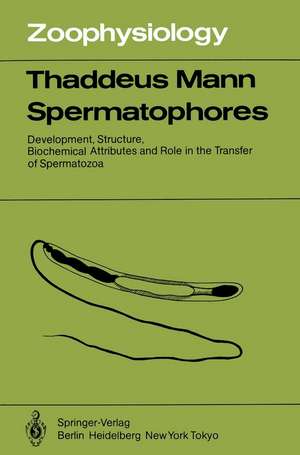
Spermatophores: Zoophysiology, cartea 15
Autor T. Mannen Limba Engleză Paperback – 20 noi 2013
Din seria Zoophysiology
- 15%
 Preț: 652.46 lei
 - 15%
 Preț: 621.42 lei
 - 15%
 Preț: 620.98 lei
 - 15%
 Preț: 624.23 lei
 - 15%
 Preț: 610.33 lei
 - 15%
 Preț: 619.58 lei
 - 15%
 Preț: 623.74 lei
 - 15%
 Preț: 618.18 lei
 - 15%
 Preț: 640.86 lei
 - 15%
 Preț: 623.74 lei
 -
 Preț: 374.64 lei
 - 15%
 Preț: 639.78 lei
 - 15%
 Preț: 620.98 lei
 - 15%
 Preț: 618.03 lei
 - 15%
 Preț: 617.23 lei
 - 15%
 Preț: 625.71 lei
 - 18%
 Preț: 971.78 lei
 - 15%
 Preț: 642.59 lei
 - 15%
 Preț: 621.16 lei
 - 15%
 Preț: 634.70 lei
 - 15%
 Preț: 621.16 lei
 - 15%
 Preț: 620.13 lei
 - 15%
 Preț: 620.35 lei
 - 15%
 Preț: 695.90 lei
 - 15%
 Preț: 642.16 lei
 -
 Preț: 374.38 lei
 - 15%
 Preț: 635.22 lei
 - 15%
 Preț: 668.34 lei
 -
 Preț: 392.33 lei
 - 18%
 Preț: 915.75 lei
 - 18%
 Preț: 919.12 lei
 - 15%
 Preț: 635.64 lei
 - 15%
 Preț: 615.13 lei
 - 15%
 Preț: 623.53 lei
 - 15%
 Preț: 627.24 lei
 - 15%
 Preț: 625.63 lei
Preț: 374.76 lei
Puncte Express: 562
Carte tipărită la comandă
Livrare economică 30 noiembrie-14 decembrie
Livrare prin curier în România Termenul estimat este afișat lângă disponibilitate.
Transport gratuit de la 400.00 lei Plată online sau ramburs, în funcție de opțiunile comenzii.
Retur gratuit în 14 zile Comandă securizată și suport în română.
Specificații
ISBN-13: 9783642823107
ISBN-10: 3642823106
Pagini: 236
Ilustrații: XII, 220 p. 40 illus. in color.
Dimensiuni: 170 x 244 x 13 mm
Greutate: 0.42 kg
Ediția:Softcover reprint of the original 1st ed. 1984
Editura: Springer
Colecția Zoophysiology
Seria Zoophysiology
Locul publicării:Berlin, Heidelberg, Germany
ISBN-10: 3642823106
Pagini: 236
Ilustrații: XII, 220 p. 40 illus. in color.
Dimensiuni: 170 x 244 x 13 mm
Greutate: 0.42 kg
Ediția:Softcover reprint of the original 1st ed. 1984
Editura: Springer
Colecția Zoophysiology
Seria Zoophysiology
Locul publicării:Berlin, Heidelberg, Germany
V-ar putea interesa
-
 Cell Physiology Source Book: Essentials of Membrane BiophysicsNicholas Sperelakis-24%Preț: 794.77 lei1051.23 lei
 -
 The Cell: A Very Short IntroductionTerence Allen-20%Preț: 56.65 lei70.82 lei
 -
 Physical Biology of the CellRob Phillips-9%Preț: 847.96 lei931.82 lei
 -
 Stem Cells in Craniofacial Development and RegenerationGeorge T J Huang-9%Preț: 1091.25 lei1199.18 lei
 -
 AtherosclerosisHong Wang-9%Preț: 1236.92 lei1359.25 lei
 -
 Cytogenetic AbnormalitiesZneimer-9%Preț: 856.84 lei941.59 lei
 -
 Secrets of Your CellsSondra BarrettPreț: 117.42 lei
 -
 Studies on Renal DisordersToshio Miyata-18%Preț: 1851.81 lei2258.31 lei
 -
 Recombinant Gene ExpressionPaulina Balbas-18%Preț: 959.38 lei1169.98 lei
 -
 mTORThomas Weichhart-18%Preț: 1001.50 lei1221.33 lei
 -
 Osteoclasts: Cell Biology, Functions & Related DiseasesCecelia Reeves-27%Preț: 997.66 lei1361.20 lei
Public țintă
ResearchCuprins
1. General Considerations.- 1.1 Beginnings.- 1.2 Definitions.- 1.3 Spermatophore as Repository and Transport Vehicle for Spermatozoa. Certain Similarity to Epididymis.- 1.4 Direct and Indirect Insemination Routes.- 1.5 Role of Spermatophore in Fertilization and Nutrition.- 1.6 Common Features of Spermatophore, Copulatory Plug, and Sphragis.- 1.7 Conflicting Views on the Origin and Purpose of Spermatophores.- 2. Platyhelminthes, Aschelminthes, and Phoronida.- 2.1 Early Observations on the Attachment of Spermatophores to the Skin of Turbellaria.- 2.2 Mechanisms of Sperm Transfer in Turbellaria and Monogenea.- 2.3 Hypodermic Impregnation in Rotifera and Other Aschelminthes.- 2.4 Spermatophores of Phoronis vancouverensis and Phoronopsis harmeri, and the Role of Lophophoral Organs in Phoronida.- 3. Mollusca.- 3.1 Gastropoda: Prosobranchia, Opisthobranchia, and Pulmonata.- 3.2 Cephalopoda: Main Features of Male Reproductive Function in Nautiloidea, Decapoda, Vampyromorpha, and Octopoda.- 3.3 Nautiloidea: Nautilus pompilius and Nautilus macromphalus.- 3.4 Decapoda: Loligo pealii, Rossia macrosoma, Rossia pacifica, Sepiola rondeletii, and Sepia officinalis.- 3.5 Small Octopoda: Octopus vulgaris, Octopus hummelincki, Octopus bimaculatus, Other Small Octopuses, Eledone moschata, and Eledone cirrhosa.- 3.6 The Giant Octopus of the North Pacific, Octopus dofleini martini.- 3.7 Biochemistry of the Giant Octopus Spermatophore.- 4. Annelida.- 4.1 Polychaeta, Including Myzostomaria, and Archiannelida.- 4.2 Oligochaeta.- 4.3 Hirudinea.- 5. Onychophora and Myriapoda.- 5.1 Dermal Copulation and Spermatophores in Onychophora.- 5.2 Production of Spermatophores in Pauropoda.- 5.3 Direct and Indirect Transfer of Spermatozoa in Diplopoda.- 5.4 Peculiar Ring Structure of Spermatophores and Indirect Sperm Transfer in Chilopoda.- 5.5 External Fertilization in Symphyla.- 6. Insecta.- 6.1 Insemination Routes and Sperm-Encompassing Devices.- 6.2 Male Genital System.- 6.3 Relationships Between Sperm-Cysts, Sperm-Bundles, Spermatodesms, Spermatozeugmata, Droplet Spermatophores, and Typical Spermatophores.- 6.4 Role of Male Accessory Secretions in the Production of Spermatophores.- 6.5 Some Unusual Chemical Constituents of Male Accessory Secretions, and Their Passage into the Semen and Spermatophores: Indolalkyl Amine, Fructose, Glucose, and Trehalose, Pyrophosphate, Uric Acid, Cyclic Guanosine 3?,5?-Monophosphate, and Prostaglandin Synthetase.- 6.6 Gustatory and Aphrodisiac Attributes of Male Secretory Products and Spermatophores.- 6.7 Droplet Spermatophores in Apterygotan Insects: Collembola, Diplura, and Thysanura.- 6.8 Typical Spermatophores and Different Mechanisms of Their Assembly in Pterygotan Insects.- 6.9 Mating Flights of Ephemeroptera and Odonata.- 6.10 Spermatophores of Orthopteroid Insects: Blattidae, Mantoidea, Phasmida, Gryllidae, Tettigoniidae, and Acrididae.- 6.11 Spermatophores of Hemiptera, Neuroptera, Coleoptera, Mecoptera, Trichoptera, Lepidoptera, Diptera, and Hymenoptera.- 7. Crustacea.- 7.1 Ostracoda.- 7.2 Copepoda: Harpacticoida, Calanoida, Cyclopoida, and Caligoida.- 7.3 Malacostraca: Isopoda, Cumacea, Mysidacea, Euphausiacea, and Decapoda.- 8. Arachnida.- 8.1 Spermatophores and Sperm Transfer Mechanisms in Arachnids.- 8.2 Scorpiones.- 8.3 Pseudoscorpiones.- 8.4 Uropygi — Thelyphonida — Holopeltidia.- 8.5 Amblypygi — Phrynichidea.- 8.6 Araneae.- 8.7 Acari: Water Mites (Hydrachnidae); Terrestrial Mites (Trombiculidae, Trombidiformes, Oribatei, and Eriophyidae); Ticks (Ixodidae and Argasidae).- 8.8 Triggering of SpermatophoricReaction in Ticks by Carbon Dioxide.- 8.9 Occurrence of Spermine in Tick Spermatophores.- 9. Chaetognatha and Pogonophora.- 9.1 Exchange of Spermatophores in Hermaphroditic Chaetognatha.- 9.2 Special Features of Spermatophore Function in Pogonophora.- 10. Sporadic Occurrence of Spermatophores and Spermatozeugmata in Vertebrata.- 10.1 The Difficulty of Naming Correctly Various Forms of Sperm-Aggregates.- 10.2 Chondrichthyes.- 10.3 Viviparous and Ovo-Viviparous Teleosti.- 10.4 Amphibia.- Concluding Remarks.