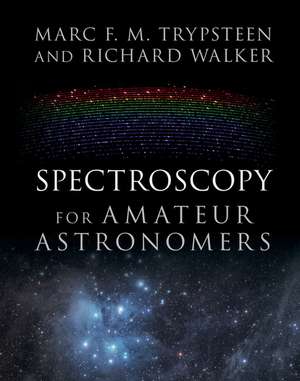
Spectroscopy for Amateur Astronomers
Autor Marc F. M. Trypsteen, Richard Walkeren Limba Engleză Hardback – 4 dec 2018
Observăm că Spectroscopy for Amateur Astronomers se impune ca o resursă fundamentală, fiind concepută special pentru a oferi baza teoretică necesară utilizării atlaselor spectrale. Această ediție în format hardback de la Cambridge University Press reușește să sintetizeze conceptele astrofizice esențiale, făcându-le accesibile celor care dețin echipamente de nivel amator, dar aspiră la rigoarea colaborărilor profesionale. Comparabil cu Spectroscopy: The Key to the Stars în ceea ce privește rigurozitatea, volumul scris de Marc F. M. Trypsteen și Richard Walker este însă actualizat pentru era digitală, punând un accent mai mare pe procesarea software a datelor și pe tranziția de la observație vizuală la analiză științifică. Structura cărții urmărește o progresie logică, deosebit de utilă pentru auto-educare. Primele trei capitole pun bazele fizice și cuantice, explicând formarea spectrelor și tranzițiile electronice. Urmează o secțiune tehnică dedicată elementelor dispersive și tipurilor de spectrografe, esențială pentru configurarea corectă a instrumentarului. Remarcăm faptul că autorii alocă spații generoase nu doar înregistrării, ci și calibrării și analizei propriu-zise. Ultimele capitole transformă teoria în practică astronomică pură, abordând măsurarea temperaturii, luminozității, rotației și compoziției chimice pentru o varietate de obiecte cerești, de la stele și planete până la nebuloase de emisie. Cele 129 de ilustrații și schițe servesc drept ancoră vizuală pentru un domeniu care, fără un astfel de ghid, ar putea părea intimidant prin natura sa matematică.
Preț: 491.45 lei
Carte tipărită la comandă
Livrare economică 20 noiembrie-04 decembrie
Specificații
ISBN-10: 1107166187
Pagini: 166
Ilustrații: 129 b/w illus.
Dimensiuni: 221 x 286 x 14 mm
Greutate: 0.69 kg
Editura: Cambridge University Press
Locul publicării:New York, United States
V-ar putea interesa
-
 The AlchemistPaulo CoelhoPreț: 56.85 lei
 -
 -19%Preț: 74.61 lei92.59 lei
 -
 Panel Reports--New Worlds, New Horizons in Astronomy and AstrophysicsNational Research CouncilPreț: 356.24 lei
 -
 The Female SoldierRichard WalkerPreț: 57.03 lei
 -
 Preț: 336.73 lei
 -
 -15%Preț: 994.69 lei1165.77 lei
 -
 Salt, Sugar, FatMichael Moss-28%Preț: 96.91 lei133.69 lei
 -
 -19%Preț: 132.53 lei164.49 lei
 -
 A Student's Guide to the Mathematics of AstronomyDaniel FleischPreț: 199.11 lei
 -
 Lectures on AstrophysicsSteven WeinbergPreț: 383.98 lei
 -
 The Mystery Unveiled, And The ReclaimedRichard WalkerPreț: 186.80 lei
 -
 Solar Image Analysis and VisualizationJack Ireland-20%Preț: 609.32 lei761.66 lei
 -
 The Human Body BookRichard WalkerPreț: 278.80 lei
 -
 -18%Preț: 1231.48 lei1501.80 lei
 -
 Theory of OrbitsDino Boccaletti-15%Preț: 708.98 lei834.10 lei
 -
 Towards Quantum GravityJerzy Kowalski-Glikman-15%Preț: 631.52 lei742.97 lei
 -
 Small Bodies in Planetary SystemsIngrid MannPreț: 421.83 lei
 -
 Nonlinear Cosmic Ray Diffusion TheoriesAndreas Shalchi-15%Preț: 639.42 lei752.25 lei
 -
 Cosmology in Scalar-Tensor GravityValerio Faraoni-18%Preț: 911.65 lei1111.78 lei
De ce să citești această carte
Recomandăm această lucrare oricărui pasionat de astronomie care dorește să treacă dincolo de simpla observare a obiectelor cerești. Cititorul câștigă capacitatea de a descifra 'codul de bare' al luminii stelare, înțelegând compoziția și dinamica universului prin echipamente accesibile. Este puntea ideală între hobby și cercetarea științifică, oferind instrumentele necesare pentru a contribui la proiecte de tip Pro-Am, într-un format dens dar extrem de clar.
Despre autor
Marc F. M. Trypsteen și Richard Walker sunt experți recunoscuți în comunitatea astronomiei de amatori, dedicați educației și popularizării tehnicilor avansate de observație. Walker este cunoscut în special pentru contribuția sa la cartografierea spectrală, fiind autorul unor ghiduri de referință utilizate la nivel global. Colaborarea lor pentru acest volum publicat de Cambridge University Press reflectă o experiență vastă în utilizarea spectrografelor comerciale și în prelucrarea datelor astrofizice, transformând concepte academice complexe în proceduri practice pentru observatorii dedicați.
Descriere scurtă
Cuprins
Recenzii
'… most professional astronomers using optical telescopes devote the majority of their observing time to spectroscopy rather than imaging. The reason is simple: spectroscopic data provide far more information about an astronomical object than an image, such as its velocity, temperature, chemical composition, and magnetic field strength. In this volume, [the authors] present a hands-on guide to spectroscopy - one that equips amateur astronomers with both the theoretical and the technical knowledge necessary to progress from imaging to spectroscopy. The text first covers the basic physics behind spectral lines formation at a level appropriate for sophomore-level atomic physics courses, using mainly high school geometry and algebra … Next follows the heart of the book, which provides readers with a guide to the optical designs of various types of spectrometers, including … information on commercially available units. Finally, the text discusses the many research opportunities open to amateurs with a small telescope and spectrometer …' R. L. Mutel, Choice
'Cambridge University Press boasts a strong line of books on astronomy, and with the recent release of two books on amateur spectroscopy, the collection has grown only stronger. … If you're looking for a new observing challenge, or know someone who is, look to CUP for help getting started in with spectroscopy. … If you're a motivated amateur, this book will help you choose a spectrograph, guide you through your first recording, offer advice on processing the recorded spectra, and show you how to analyze it - all with amateur equipment. Pair this book with Richard Walker's Spectral Atlas for Amateur Astronomers and you'll have a comprehensive package on spectroscopy.' S. N. Johnson-Roehr, Sky & Telescope: The Essential Guide to Astronomy