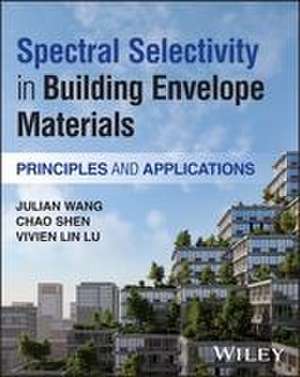
Spectral Selectivity in Building Envelope Materials
Autor Julian Wang, Chao Shen, Vivien Lin Luen Limba Engleză Hardback – 2 noi 2026
Materials that selectively absorb, reflect, or transmit solar radiation by wavelength offer significant potential for reducing building energy consumption. Spectral Selectivity in Building Envelope Materials: Principles and Applications provides a rigorous treatment of these materials, connecting fundamental building science and engineering principles with real-world implementation across diverse climate zones and building types.
Detailed case studies demonstrate how spectrally selective paints, coatings, and glazing systems manage heat and light transfer across building envelopes, reducing cooling loads in summer and heating demands in winter. Dedicated sections address integration with renewable energy systems, including photovoltaic and radiative cooling applications. Future research directions identify emerging opportunities for next-generation material development.
Readers will also find:
- Methods for characterizing transmittance, reflectance, and absorptance properties of envelope materials across relevant wavelength ranges in laboratory settings
- Strategies for specifying spectrally selective coatings and glazing in both new construction and retrofit building projects
- Analysis of thermal comfort improvements achievable through wavelength-dependent solar radiation management in residential and commercial buildings
- Discussion of environmental performance metrics linking material selection to measurable reductions in operational energy use and carbon footprint
- Guidance on evaluating material durability, cost-effectiveness, and lifecycle performance for long-term spectrally selective envelope applications
Preț: 656.61 lei
Preț vechi: 852.75 lei
-23% Precomandă
Puncte Express: 985
Carte nepublicată încă
Livrare prin curier în România Precomanda se expediază când titlul devine disponibil.
Transport gratuit pentru acest produs Plată online sau ramburs, în funcție de opțiunile comenzii.
Retur gratuit în 14 zile Comandă securizată și suport în română.
Doresc să fiu notificat când acest titlu va fi disponibil:
Se trimite...
Specificații
V-ar putea interesa
-
 Pipe Trades Pocket ManualMcGraw-HillPreț: 293.95 lei
 -
 Why Buildings Stand UpMario SalvadoriPreț: 119.77 lei
 -
 Managing Construction TechnologyKurt Maldovan-19%Preț: 458.22 lei565.70 lei
 -
 Barry's Construction TechnologyStephen EmmittPreț: 379.66 lei
 -
 Preț: 88.93 lei
 -
 -32%Preț: 196.97 lei291.53 lei
 -
 The Ontario CottageLynne D DiStefanoPreț: 197.37 lei
 -
 Beyond the EnvelopeTom VerebesPreț: 386.61 lei
 -
 -24%Preț: 896.69 lei1179.85 lei
 -
 Green Building EnvelopesSibylle Kramer-19%Preț: 254.80 lei315.81 lei
 -
 -14%Preț: 997.98 lei1160.44 lei
 -
 Preț: 440.17 lei
 -
 Circular MaterialsJoe GibbsPreț: 280.67 lei
 -
 Sustainable Coloration Techniques in TextilesSaptarshi Maiti-18%Preț: 1158.76 lei1413.12 lei
 -
 -20%Preț: 538.36 lei668.89 lei
Notă biografică
JULIAN WANG, PhD, is an Associate Professor in the Department of Architectural Engineering at Penn State University. His research centers on spectrally selective materials and sustainable building practices, with over 120 published journal papers advancing the field of energy-efficient building design and envelope performance.
CHAO SHEN is a Professor in the Department of Building Technology at Harbin Institute of Technology. His work focuses on advanced building materials and their role in optimizing energy performance, thermal regulation, and occupant comfort within the built environment.
VIVIEN LIN LU is a Professor in the Department of Building Environment and Energy Engineering at Hong Kong Polytechnic University. Her research encompasses building energy systems and environmental engineering, contributing to advances in sustainable design and thermal performance of building envelopes across diverse climatic conditions.
CHAO SHEN is a Professor in the Department of Building Technology at Harbin Institute of Technology. His work focuses on advanced building materials and their role in optimizing energy performance, thermal regulation, and occupant comfort within the built environment.
VIVIEN LIN LU is a Professor in the Department of Building Environment and Energy Engineering at Hong Kong Polytechnic University. Her research encompasses building energy systems and environmental engineering, contributing to advances in sustainable design and thermal performance of building envelopes across diverse climatic conditions.
Cuprins
Preface xi
1 Fundamentals of Spectral Selectivity in Envelope Materials 1
1.1 Introduction to Spectral Selectivity 1
1.1.1 Spectral Selectivity in Energy-Efficient Building Design 2
1.1.2 Role in Thermal and Optical Energy Management 2
1.1.3 Indoor Comfort, Human Experience, and Passive Performance 3
1.1.4 Sustainability, Decarbonization, and Renewable Energy Alignment 3
1.1.5 Shortwave and Longwave Spectral Selectivity: A Unified Design Framework 4
1.2 Photometric and Radiometric Basics 5
1.2.1 Photometric-Radiometric Conversion Framework 5
1.2.2 Paired Radiometric and Photometric Quantities 10
1.2.3 Radiometric Measurement in the Built Environment 19
1.2.4 Metrics and Measurement Techniques in Spectral Selectivity in Building Envelopes 23
2 Mechanisms and Fundamental Principles of Spectral Control 29
2.1 Theoretical Foundations of Spectral Selectivity 29
2.1.1 Electromagnetic Wave Theory and Optical Interactions 29
2.1.2 Mie Theory for Scattering in Nanostructures 37
2.1.3 Kirchhoff's Law in Spectral Selectivity 41
2.2 Intrinsic Material Properties and Spectral Selectivity 42
2.2.1 Intrinsic Materials for Shortwave Spectral Selectivity 43
2.2.2 Intrinsic Materials for Longwave Spectral Selectivity 45
2.3 Thin-film Coatings 49
2.3.1 General Theoretical Framework for Thin-film Coatings 49
2.3.2 Thin-film Coatings for Shortwave Spectral Selectivity 51
2.3.3 Thin-film Coatings for Longwave Spectral Selectivity 56
2.3.4 Multilayer Structures for Spectral Selectivity 58
2.3.5 Thin-film Deposition Techniques for Spectral Selectivity 60
3 Energy Performance of Spectrally Selective Materials in Building Envelopes 71
3.1 Shortwave Control and Energy Performance 71
3.1.1 Reflection-Based Shortwave Spectral Control 75
3.1.2 Absorption-Based Shortwave Spectral Control 78
3.1.3 Summary of Shortwave Spectral Control and Energy Performance 100
3.2 Longwave Control and Energy Performance 101
3.2.1 Heat Transfer Mechanisms in the Longwave Spectrum 101
3.2.2 Energy Benefits of Longwave Spectral Selectivity 106
3.2.3 Case Studies and Simulated Performance Evaluations 108
3.2.4 Summary of Longwave Spectral Control and Energy Performance 118
4 Photovoltaic Integration with Spectrally Selective Materials 125
4.1 Fundamental Relationship Between PV and Spectral Selectivity 125
4.2 Shortwave Spectral Selectivity for PV Performance 127
4.2.1 Spectrally Selective Coatings for PV Enhancement 127
4.2.2 Transparent BIPVs 134
4.2.3 Case Studies and Experimental Studies of Spectrally Selective PVs 140
4.3 Longwave Spectral Selectivity for PV Thermal Management 144
4.3.1 Thermal Challenges in PV Systems 147
4.3.2 Longwave Solutions for PV Cooling and Stability 148
4.3.3 Case Studies and Experimental Validation 151
4.4 PV-PT Dual Mode for Spectral Optimization 162
4.4.1 Working Principle 163
4.4.2 Experimental Verification 163
4.4.3 Energy-saving Simulations Setup 165
4.4.4 Windows' Surface Temperatures 167
4.4.5 Total Energy-consumption Analysis 170
4.5 Case Study of Emerging Semi-transparent Solar Cells in Building Sectors 174
4.6 Summary 181
5 Spectral-Selective Surfaces for Human Comfort, Health, and Environmental Sustainability 189
5.1 Spectrally Selective Surfaces for Indoors 190
5.1.1 General Framework for Spectral Selective Envelope Analysis on IEQ 190
5.1.2 Thermal Effects 191
5.1.3 Visual and Circadian Effects 203
5.2 Spectrally Selective Surfaces for Outdoors 219
5.2.1 Spectral-based Method to Quantify Thermal Effects 221
5.2.2 Façade Reflectance Impacts on Outdoor Thermal Environments 230
5.2.3 Façade Reflectance Impacts on District-Level Energy use Intensity 233
5.2.4 Optimization of Façade's Solar Reflectance 237
5.3 Summary: Spectral Selectivity as a Human-Environment Interface 238
6 Challenges, Opportunities, and Future Directions of Spectrally Selective Building Envelopes 243
6.1 Technical and Practical Challenges in Deploying Spectrally Selective Envelopes 244
6.1.1 Scale Translation: From Material Spectra to Building Performance 245
6.1.2 Durability and Long-term Spectral Stability 245
6.1.3 Metric-workflow Misalignment 247
6.2 Emerging Opportunities Through System-level and Cross-domain Integration 250
6.3 Future Research Directions and the Evolving Role of Spectral Selectivity 252
References 253
Index 255
1 Fundamentals of Spectral Selectivity in Envelope Materials 1
1.1 Introduction to Spectral Selectivity 1
1.1.1 Spectral Selectivity in Energy-Efficient Building Design 2
1.1.2 Role in Thermal and Optical Energy Management 2
1.1.3 Indoor Comfort, Human Experience, and Passive Performance 3
1.1.4 Sustainability, Decarbonization, and Renewable Energy Alignment 3
1.1.5 Shortwave and Longwave Spectral Selectivity: A Unified Design Framework 4
1.2 Photometric and Radiometric Basics 5
1.2.1 Photometric-Radiometric Conversion Framework 5
1.2.2 Paired Radiometric and Photometric Quantities 10
1.2.3 Radiometric Measurement in the Built Environment 19
1.2.4 Metrics and Measurement Techniques in Spectral Selectivity in Building Envelopes 23
2 Mechanisms and Fundamental Principles of Spectral Control 29
2.1 Theoretical Foundations of Spectral Selectivity 29
2.1.1 Electromagnetic Wave Theory and Optical Interactions 29
2.1.2 Mie Theory for Scattering in Nanostructures 37
2.1.3 Kirchhoff's Law in Spectral Selectivity 41
2.2 Intrinsic Material Properties and Spectral Selectivity 42
2.2.1 Intrinsic Materials for Shortwave Spectral Selectivity 43
2.2.2 Intrinsic Materials for Longwave Spectral Selectivity 45
2.3 Thin-film Coatings 49
2.3.1 General Theoretical Framework for Thin-film Coatings 49
2.3.2 Thin-film Coatings for Shortwave Spectral Selectivity 51
2.3.3 Thin-film Coatings for Longwave Spectral Selectivity 56
2.3.4 Multilayer Structures for Spectral Selectivity 58
2.3.5 Thin-film Deposition Techniques for Spectral Selectivity 60
3 Energy Performance of Spectrally Selective Materials in Building Envelopes 71
3.1 Shortwave Control and Energy Performance 71
3.1.1 Reflection-Based Shortwave Spectral Control 75
3.1.2 Absorption-Based Shortwave Spectral Control 78
3.1.3 Summary of Shortwave Spectral Control and Energy Performance 100
3.2 Longwave Control and Energy Performance 101
3.2.1 Heat Transfer Mechanisms in the Longwave Spectrum 101
3.2.2 Energy Benefits of Longwave Spectral Selectivity 106
3.2.3 Case Studies and Simulated Performance Evaluations 108
3.2.4 Summary of Longwave Spectral Control and Energy Performance 118
4 Photovoltaic Integration with Spectrally Selective Materials 125
4.1 Fundamental Relationship Between PV and Spectral Selectivity 125
4.2 Shortwave Spectral Selectivity for PV Performance 127
4.2.1 Spectrally Selective Coatings for PV Enhancement 127
4.2.2 Transparent BIPVs 134
4.2.3 Case Studies and Experimental Studies of Spectrally Selective PVs 140
4.3 Longwave Spectral Selectivity for PV Thermal Management 144
4.3.1 Thermal Challenges in PV Systems 147
4.3.2 Longwave Solutions for PV Cooling and Stability 148
4.3.3 Case Studies and Experimental Validation 151
4.4 PV-PT Dual Mode for Spectral Optimization 162
4.4.1 Working Principle 163
4.4.2 Experimental Verification 163
4.4.3 Energy-saving Simulations Setup 165
4.4.4 Windows' Surface Temperatures 167
4.4.5 Total Energy-consumption Analysis 170
4.5 Case Study of Emerging Semi-transparent Solar Cells in Building Sectors 174
4.6 Summary 181
5 Spectral-Selective Surfaces for Human Comfort, Health, and Environmental Sustainability 189
5.1 Spectrally Selective Surfaces for Indoors 190
5.1.1 General Framework for Spectral Selective Envelope Analysis on IEQ 190
5.1.2 Thermal Effects 191
5.1.3 Visual and Circadian Effects 203
5.2 Spectrally Selective Surfaces for Outdoors 219
5.2.1 Spectral-based Method to Quantify Thermal Effects 221
5.2.2 Façade Reflectance Impacts on Outdoor Thermal Environments 230
5.2.3 Façade Reflectance Impacts on District-Level Energy use Intensity 233
5.2.4 Optimization of Façade's Solar Reflectance 237
5.3 Summary: Spectral Selectivity as a Human-Environment Interface 238
6 Challenges, Opportunities, and Future Directions of Spectrally Selective Building Envelopes 243
6.1 Technical and Practical Challenges in Deploying Spectrally Selective Envelopes 244
6.1.1 Scale Translation: From Material Spectra to Building Performance 245
6.1.2 Durability and Long-term Spectral Stability 245
6.1.3 Metric-workflow Misalignment 247
6.2 Emerging Opportunities Through System-level and Cross-domain Integration 250
6.3 Future Research Directions and the Evolving Role of Spectral Selectivity 252
References 253
Index 255