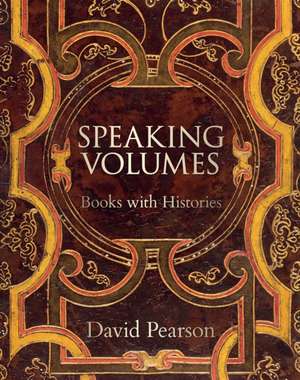
Speaking Volumes
Autor David Pearsonen Limba Engleză Hardback – 4 noi 2022
În volumul Speaking Volumes, observăm o abordare interdisciplinară care îmbină istoria socială, bibliografia materială și studiile culturale pentru a redefini cartea nu doar ca suport de text, ci ca obiect arheologic. Găsim în această lucrare o analiză metodică a modului în care interacțiunea umană lasă urme fizice asupra volumelor, transformându-le în martori unici ai epocilor trecute. Reținem că valoarea de cercetare a unui exemplar nu rezidă doar în cuvintele autorului, ci în „biografia” sa: însemnări pe margini, desene ale studenților din secolul al XVI-lea sau mărci de proprietate care reflectă gradul de alfabetizare al epocii. Această lucrare reprezintă o alternativă la The Reader in the Book pentru cursurile de istoria cărții, cu avantajul unei perspective vizuale mult mai bogate, oferite de cele 180 de planșe color. În timp ce Stephen Orgel se concentrează pe sociologia marginilor, David Pearson extinde analiza către întreaga structură fizică, inclusiv legături de lux sau volume deteriorate de război. Cartea se poziționează ca o continuare firească a operei sale anterioare, Provenance Research in Book History, rafinând metodologiile de identificare a proprietarilor și de urmărire a parcursului istoric al exemplarelor. Structura este organizată tematic și cronologic, debutând cu însemnările de proprietate și evoluând spre capitole dedicate intervențiilor editoriale (adăugiri și eliminări) și „accidentelor” istorice, precum volumele salvate din apă sau foc. Progresia narativă ne conduce până la capitolul final dedicat erei digitale, oferind o privire de ansamblu asupra modului în care percepem astăzi materialitatea textului. Tonul este unul precis și informativ, evitând speculațiile și ancorând fiecare observație în exemple concrete extrase din colecții publice și private.
Preț: 338.85 lei
Carte disponibilă
Livrare economică 14-28 noiembrie
Livrare express 03-07 noiembrie pentru 70.47 lei
Specificații
ISBN-10: 1851245626
Pagini: 240
Ilustrații: 180 color plates
Dimensiuni: 198 x 249 x 27 mm
Greutate: 1.1 kg
Editura: Bodleian Library
De ce să citești această carte
Recomandăm această carte cercetătorilor și studenților la istorie sau litere care doresc să înțeleagă manuscrisul și tipăritura ca obiecte de patrimoniu. Cititorul câștigă o metodologie clară de „citire” a urmelor lăsate de timp și proprietari, transformând orice volum vechi într-o sursă bogată de date istorice. Este un ghid vizual esențial pentru oricine vrea să vadă dincolo de text, apreciind unicitatea fiecărui exemplar supraviețuitor.
Despre autor
David Pearson este un expert recunoscut în domeniul bibliografiei și al istoriei cărții, având o experiență vastă ca editor și cercetător. Lucrările sale anterioare, precum ediția revizuită a Provenance Research in Book History, au devenit texte de referință în domeniu, stabilind standarde pentru identificarea mărciilor de proprietate și a ex-libris-urilor. Deși aria sa de expertiză acoperă subiecte diverse, de la istorie bisericească la ornitologie, contribuția sa principală rămâne în zona studiului material al cărții, unde îmbină rigoarea academică cu o capacitate rară de a face istoria bibliografică accesibilă publicului larg.
Descriere scurtă
Scholars increasingly recognize that the cultural and research value of books lies not just in their printed contents, but in their value as historical artifacts. An individual book can tell us many things about the ways books have been used, read, and regarded throughout the years.
Within these pages, you will find books damaged by bullets or graffiti, recovered from fire or water, or even disguised as completely different texts for protection in dangerous times. Marks of ownership—be it a rich treasure binding or a humble family inscription—shine a light on social history and literacy, while student doodles from the sixteenth century and a variety of pithy annotations give us a sense of readers through the ages.
Generously illustrated with examples from the early Middle Ages to the present day, Speaking Volumes presents a fascinating selection of books in both public and private collections whose individual histories tell surprising and illuminating stories, encouraging us to look at and appreciate books in new and non-traditional ways.
Notă biografică
Extras
The belief that books do matter in this way is firmly ingrained in every literate human society, and it has created an infrastructure which we largely take for granted. Books are integrally connected with agendas for education and wellbeing, and a belief in the importance of ensuring access for everyone led to the development of public library networks from the late nineteenth century onwards. The idea that we need libraries as storehouses of knowledge is of course much older. That core function of books as containers of content that we might want to read both today and tomorrow, that can be organized and preserved so as to create ongoing access, has been respected for many centuries. The Library of Alexandria, founded around 300 bce, is famous as the greatest library of the classical world, holding the written output of those civilizations in maybe half a million scrolls, before war and political change brought about decline and destruction. It was, however, only one of many, and both public and private libraries were spread across the Roman Empire.
Across medieval Europe, libraries were widely established in universities, monasteries and other religious institutions, and although many of the latter were dispersed between the sixteenth and nineteenth centuries, many of those books came to be redistributed across a web of academic and national libraries whose steady growth has been part of our post-Reformation world. They may have reached their current homes via private hands – between the sixteenth and eighteenth centuries, many of the largest libraries belonged to individuals rather than institutions – but the nineteenth and twentieth centuries saw changing patterns, when a selling-off of family libraries was matched with huge investment in institutional ones. There are exceptions, but our landscape today is one where we have a worldwide framework of libraries, often in universities or major cities, all supported by public or charitable funding, where we have placed the responsibility for preserving and developing our documentary heritage. These are the libraries that we go to for serious work, that support higher-level education and industrial research, where we expect to find the rare and the special, the deep and rich seams of accumulated knowledge or ideas.
The founding rationale of all these libraries is summarized in the late-eighteenth-century image of ‘History resisting Time from destroying a Column of Books’. The record of the past – from Creation to the present time, as the engraving has it – is preserved in books and we are dependent on their survival for access to that heritage. If the books were lost – as Time, left to its own devices, would bring about – we would lose it all; our attempts to survey human history would face a blank wall. That idea has sustained, over many centuries, the ongoing development of great libraries, whose growth has transcended the merely functional. Many of them are housed in spaces whose elegance or imposing nature helps to reflect that critical importance, to inspire awe as well as respect, making them endlessly suitable for handsome illustrated books and calendars of the world’s great libraries. Duke Humfrey’s Library in Oxford is a much-loved example; every year, millions of people visit the Long Room in Trinity College, Dublin, or admire the painted cases and ceiling of the Vatican Library’s Sistine Hall. Great libraries play a variety of roles in today’s society, as vibrant cultural institutions supporting all kinds of education or events, but they are rooted in their huge collections. ‘How many books?’ is a vital statistic which will almost invariably be found on any research or national library website.
Looking at it from the opposite angle, the way to eradicate a civilization is to destroy its library and records, as the first Chinese emperor recognized in the third century bce when he ordered the burning of all historical books before his time, and the execution of scholars who might remember them. Over two millennia later, his successors undertook a similar exercise in Tibet, where it is estimated that 85 per cent of the written materials and documents were destroyed during purgation in the 1960s and 1970s. Modern times have seen many such incidents, including the destruction of the National Library of Cambodia in the 1970s by the Khmer Rouge, the shelling of the National Library of Bosnia-Herzegovina during the Siege of Sarajevo in 1992, and the partial burning of the manuscripts of the Ahmed Baba Institute in Timbuktu by an Islamist militia. The murder of Jewish people is the defining horror of the Holocaust, but it is less well known that one of its facets was an organized effort to gather up and destroy their archives and libraries across Europe. It has been estimated that over 100 million books were deliberately destroyed by the Nazis. At Sarajevo, where the library took three days to burn after being deliberately targeted with incendiary shells, around 2 million printed books and half a million metres of archives and manuscripts were lost, collections which had been carefully developed to constitute the memory and record of Bosnian culture.
There is no doubting, therefore, that we think books and libraries are important. I entirely agree with that, and my aim here is to widen our traditional ideas as to why they matter, and the answers to that question about cultural value.
Cuprins
Preface
Chapter 1: Introduction
Chapter II: Insights from ownership
Chapter III: Notes on the side
Chapter IV Adding things in, and cutting them out
Chapter V: Outsides of books
Chapter VI: Accidents, incidents, and talismans
Chapter VII: A digital age
Further reading
Picture references
Index