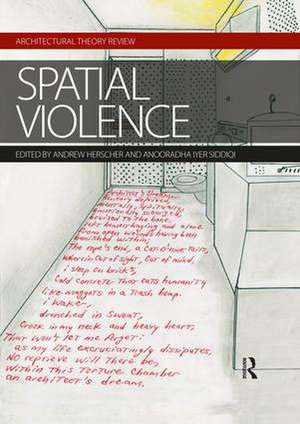
Spatial Violence
Editat de Andrew Herscher, Anooradha Siddiqien Limba Engleză Paperback – 11 ian 2019
Preț: 436.22 lei
Puncte Express: 654
Carte disponibilă
Livrare economică 02-16 noiembrie
Livrare express 17-23 octombrie pentru 20.70 lei
Livrare prin curier în România Termenul estimat este afișat lângă disponibilitate.
Transport gratuit pentru acest produs Plată online sau ramburs, în funcție de opțiunile comenzii.
Retur gratuit în 14 zile Comandă securizată și suport în română.
Specificații
ISBN-13: 9780367028787
ISBN-10: 0367028786
Pagini: 162
Dimensiuni: 174 x 246 x 9 mm
Greutate: 0.12 kg
Ediția:1
Editura: Taylor & Francis
Colecția Routledge
Locul publicării:Oxford, United Kingdom
ISBN-10: 0367028786
Pagini: 162
Dimensiuni: 174 x 246 x 9 mm
Greutate: 0.12 kg
Ediția:1
Editura: Taylor & Francis
Colecția Routledge
Locul publicării:Oxford, United Kingdom
V-ar putea interesa
-
 -18%Preț: 1008.04 lei1229.31 lei
 -
 -18%Preț: 1130.16 lei1378.24 lei
 -
 Temples, Tombs, And Monuments Of Ancient Greece And RomeWilliam Davenport AdamsPreț: 191.65 lei
 -
 Preț: 85.53 lei
 -
 Halle und die SaaleChristoph OhligPreț: 338.68 lei
 -
 GörlitzFrank HöhlerPreț: 125.19 lei
 -
 Le Génie militaire français et production des villes colonialesKhedidja Boufenara-23%Preț: 763.80 lei991.95 lei
 -
 -9%Preț: 386.75 lei422.80 lei
Public țintă
Postgraduate and UndergraduateCuprins
1. Spatial Violence 2. On "Revolutionary Vandalism" 3. Architecture During Wartime: The Mostra d’Oltremare and Esposizione Universale di Roma 4. Sentenced: Architecture of Solitary Confinement 5. The Economy of Fear: Oscar Newman Launches Crime Prevention through Urban Design (1969 – 197x) 6. New Belgrade After 1999: Spatial Violence as De-Socialisation, De-Romanisation, and De-Historisation 7. Mud, Dust, and Marouge´: Precarious Construction in a Congolese Refugee Camp 8. Encampments: Spatial Taxonomies of Sri Lanka’s Civil War
Notă biografică
Andrew Herscher is an Associate Professor at the University of Michigan, USA with appointments in the Taubman College of Architecture and Planning, Department of Art History, and Department of Slavic Languages and Literatures.
Anooradha Iyer Siddiqi is Assistant Professor and Faculty Fellow in the Gallatin School, New York University, USA. She writes and teaches in the history and theory of art, architecture, and urbanism, focusing on modern Africa and South Asia, spatial practice across borders, and aesthetics and politics of heritage and emergency.
Anooradha Iyer Siddiqi is Assistant Professor and Faculty Fellow in the Gallatin School, New York University, USA. She writes and teaches in the history and theory of art, architecture, and urbanism, focusing on modern Africa and South Asia, spatial practice across borders, and aesthetics and politics of heritage and emergency.
Descriere
This book poses "spatial violence" as a means to explore histories of and through architecture at sites across the world. Regarding space and violence as co-constitutive, the book’s collected 3 essays critique modernization and capitalist accumulation as naturalized modes for the extraction of violence from everyday life.