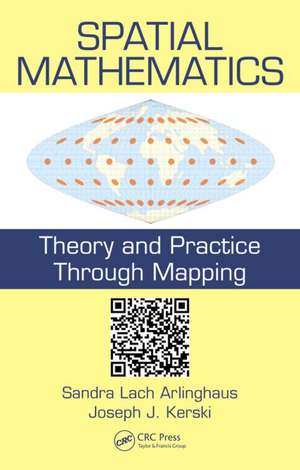
Spatial Mathematics: Theory and Practice through Mapping
Autor Sandra Lach Arlinghaus, Joseph J. Kerskien Limba Engleză Hardback – 26 iun 2013
Includes QR Codes Linked to Animated Maps, a Mapping Activity Site, or to an Interactive Webpage, Creating an Interactive Resource That Stays Relevant
The book integrates competing philosophical views of the world: synthesis and analysis. These two approaches yield different results and employ different tools. This book considers both approaches to looking at real-world issues that have mathematics as a critical, but often unseen, component. This approach shows readers how to use mathematics to consider the broad problem at hand and to explore diverse realms in the worlds of geography and mathematics and in their interface.
A truly interdisciplinary text, the book bridges the worlds of mathematics and geography and demonstrates how they are inextricably linked. It takes advantage of the convergence in citizen science, STEM education, and mapping that help readers become critical consumers of data—understanding its content, quality, limitations, and benefits. It provides thorough grounding in the analytical, statistical, and computational skills required for working in any field that uses geospatial technologies—not just surveyors and remote sensing analysts.
Preț: 1012.58 lei
Preț vechi: 1234.85 lei
-18%
Puncte Express: 1519
Carte tipărită la comandă
Livrare economică 07-21 decembrie
Livrare prin curier în România Termenul estimat este afișat lângă disponibilitate.
Transport gratuit pentru acest produs Plată online sau ramburs, în funcție de opțiunile comenzii.
Retur gratuit în 14 zile Comandă securizată și suport în română.
Specificații
ISBN-13: 9781466505322
ISBN-10: 146650532X
Pagini: 300
Ilustrații: 208 black & white illustrations, 4 black & white tables
Dimensiuni: 156 x 234 x 18 mm
Greutate: 0.72 kg
Ediția:New.
Editura: CRC Press
Colecția CRC Press
ISBN-10: 146650532X
Pagini: 300
Ilustrații: 208 black & white illustrations, 4 black & white tables
Dimensiuni: 156 x 234 x 18 mm
Greutate: 0.72 kg
Ediția:New.
Editura: CRC Press
Colecția CRC Press
V-ar putea interesa
-
 Schaum's Outline of Numerical AnalysisFrancis Scheid-16%Preț: 232.79 lei277.34 lei
 -
 Error-Correcting Codes and Finite FieldsOliver Pretzel-27%Preț: 522.40 lei718.55 lei
 -
 A Smoother Pebble: Mathematical ExplorationsDonald C. Benson-20%Preț: 360.75 lei448.96 lei
 -
 Introduction to IntegrationH. A. Priestley-18%Preț: 388.83 lei473.09 lei
 -
 An Introduction to Numerical Methods in C++Brian H. Flowers-38%Preț: 808.08 lei1313.74 lei
 -
 Time Series: A Biostatistical IntroductionPeter J. Diggle-26%Preț: 444.39 lei598.56 lei
 -
 -28%Preț: 449.54 lei621.26 lei
 -
 Preț: 118.95 lei
 -
 Further Mathematics for the Physical SciencesMichael TinkerPreț: 549.35 lei
 -
 Rarefied Gas DynamicsCarlo Cercignani-8%Preț: 437.84 lei475.91 lei
 -
 Handbook of Applied CryptographyAlfred J. Menezes-18%Preț: 1333.53 lei1626.26 lei
 -
 An Introduction to Stochastic Processes with Applications to BiologyLinda J. S. Allen-18%Preț: 861.33 lei1050.39 lei
 -
 College Geometry: A Unified DevelopmentDavid C. Kay-18%Preț: 924.93 lei1127.96 lei
 -
 Elements of Heat TransferEthirajan Rathakrishnan-18%Preț: 936.38 lei1141.93 lei
Public țintă
Professionals and graduate students working in geography, specifically GIS, remote sensing, and GPS; undergraduate and graduate students in environmental sciences, social sciences, and engineering; math educators; and students studying to be teachers of any discipline involving mathematics.Cuprins
Geometry of the Sphere. Location, Trigonometry, and Measurement of the Sphere. Transformations: Analysis and Raster/Vector Formats. Replication of Results: Color and Number. Scale. Partitioning of Data: Classification and Analysis. Visualizing Hierarchies. Distribution of Data: Selected Concepts
Map Projections. Integrating Past, Present, and Future Approaches. Glossary. References, Further Reading, and Related Materials.
Map Projections. Integrating Past, Present, and Future Approaches. Glossary. References, Further Reading, and Related Materials.
Notă biografică
Sandra Lach Arlinghaus is an American educator who is Adjunct Professor in the School of Natural Resources and Environment at the University of Michigan.
Recenzii
"…this book does not contain any equations or math, as one would expect from the title… As such, this book will be of use to those who want to start out with an effort to learn GIS, without having to struggle through the actual mathematics behind it all."
—Harold Schuch, GeoCounsel, Inc., Littleton, Colorado, USA
"this colourful book should be useful for complementing technical geography lectures using Google Earth and Esri’s software explorations in view of attracting high-school and general science students to spatial geography and computer mapping."
—Rod Blais, GEOMATICA, Vol. 67, No. 4, 2013
"In this important work, Drs. Arlinghaus and Kerski fill an important need in the geospatial literature with their accessible introduction to spatial mathematics. … this book frames concepts in a way that is accessible to new learners who may not have an advanced math background. This accessibility should not be confused with simplicity, however. In successive chapters, the authors build an intellectually challenging description of the math underlying geospatial analysis. Throughout, easy-to-follow activities help make the concepts clear and relevant. If we are to build a generation of spatial thinkers (and not just people trained in GIS and GPS), we need foundational understanding like this book supports. Highly recommended!"
—Bob Coulter, Missouri Botanical Garden
"Two ancient texts had a profound and lasting impact on the literate world. … Now, in this book, additional insight for the mathematical solution of geographical tasks is provided. The pedagogical orientation is especially worthy of comment."
—Waldo Tobler, Professor Emeritus of Geography, University of California at Santa Barbara
"If a picture is worth a thousand words, then a map is worth exponentially more. Underneath the colors of a modern electronic map is an enormous amount of math and science, from how to represent a three dimensional globe on a two dimensional surface to how to produce and represent color itself in a way to communicate meaning and make sense of complex data. This book is both all about the map and all about the math behind the map, using what has become ubiquitous on our smart phones and in our vehicles as a vehicle itself to teach complex math concepts in accessible ways. The book’s use of modern, socially pressing issues as the basis of understanding spatial math further augments its goal to make complex concepts accessible, meaningful, and useful for students."
—Marc Schlossberg, Professor of Planning, Public Policy & Management, University of Oregon
"Teaching mathematics can be tough but here is a book that is a gentle introduction to the mathematics of the spatial world through the medium of mapping. The use of QR codes to access additional map-based material is clever and innovative, and provides a nice link to the very technologies that this mathematics supports."
—Michael Batty, University College London
"An excellent textbook mainstreaming geoinformation perspectives through mathematical education, Spatial Mathematics has a clearly developed theoretical approach with great exercises and practical hands-on activities."
—Karl Donert, President, European Association of Geographers (EUROGEO)
"… timely and welcome. The wealth of practical examples and the enthusiasm of its authors will fill an important niche in a mapping literature that often underplays the importance and relevance of mathematics. … particularly refreshing to see the book begin with the mathematics of the Earth’s curved surface, and deal only later with the complexities of flattening the Earth through the use of map projections. … Google Earth did much to restructure our view of the Earth when it was released in 2005; this book will without doubt make another step in that direction."
—Michael F. Goodchild, University of California, Santa Barbara
"… sets the standard for explaining the relationship between mathematics, geography, and GIS technologies. … A benchmark book for interdisciplinary teaching and learning."
—Mark C. Hogrebe, Washington University in St. Louis
"… this book is worth reading by anyone interested in overlaps of geography and mathematics. It contributes to the progress of quantitative geography and GIScience by melding together appropriate topics from geography and mathematics that focus on cartographic themes. … It succeeds in using the visualization capabilities of a GIS to motivate readers to familiarize themselves with and explore formal mathematical subject matter that interfaces with geography."
—The AAG Review OF BOOKS
"The form of the book (theoretical analysis, examples, and exercises) and the extent of its contents provide a useful reference for scientists, engineers, and the general public regarding entry level GIS concepts. A big congratulation to the authors."
—Photogrammetric Engineering & Remote Sensing, October 2016
—Harold Schuch, GeoCounsel, Inc., Littleton, Colorado, USA
"this colourful book should be useful for complementing technical geography lectures using Google Earth and Esri’s software explorations in view of attracting high-school and general science students to spatial geography and computer mapping."
—Rod Blais, GEOMATICA, Vol. 67, No. 4, 2013
"In this important work, Drs. Arlinghaus and Kerski fill an important need in the geospatial literature with their accessible introduction to spatial mathematics. … this book frames concepts in a way that is accessible to new learners who may not have an advanced math background. This accessibility should not be confused with simplicity, however. In successive chapters, the authors build an intellectually challenging description of the math underlying geospatial analysis. Throughout, easy-to-follow activities help make the concepts clear and relevant. If we are to build a generation of spatial thinkers (and not just people trained in GIS and GPS), we need foundational understanding like this book supports. Highly recommended!"
—Bob Coulter, Missouri Botanical Garden
"Two ancient texts had a profound and lasting impact on the literate world. … Now, in this book, additional insight for the mathematical solution of geographical tasks is provided. The pedagogical orientation is especially worthy of comment."
—Waldo Tobler, Professor Emeritus of Geography, University of California at Santa Barbara
"If a picture is worth a thousand words, then a map is worth exponentially more. Underneath the colors of a modern electronic map is an enormous amount of math and science, from how to represent a three dimensional globe on a two dimensional surface to how to produce and represent color itself in a way to communicate meaning and make sense of complex data. This book is both all about the map and all about the math behind the map, using what has become ubiquitous on our smart phones and in our vehicles as a vehicle itself to teach complex math concepts in accessible ways. The book’s use of modern, socially pressing issues as the basis of understanding spatial math further augments its goal to make complex concepts accessible, meaningful, and useful for students."
—Marc Schlossberg, Professor of Planning, Public Policy & Management, University of Oregon
"Teaching mathematics can be tough but here is a book that is a gentle introduction to the mathematics of the spatial world through the medium of mapping. The use of QR codes to access additional map-based material is clever and innovative, and provides a nice link to the very technologies that this mathematics supports."
—Michael Batty, University College London
"An excellent textbook mainstreaming geoinformation perspectives through mathematical education, Spatial Mathematics has a clearly developed theoretical approach with great exercises and practical hands-on activities."
—Karl Donert, President, European Association of Geographers (EUROGEO)
"… timely and welcome. The wealth of practical examples and the enthusiasm of its authors will fill an important niche in a mapping literature that often underplays the importance and relevance of mathematics. … particularly refreshing to see the book begin with the mathematics of the Earth’s curved surface, and deal only later with the complexities of flattening the Earth through the use of map projections. … Google Earth did much to restructure our view of the Earth when it was released in 2005; this book will without doubt make another step in that direction."
—Michael F. Goodchild, University of California, Santa Barbara
"… sets the standard for explaining the relationship between mathematics, geography, and GIS technologies. … A benchmark book for interdisciplinary teaching and learning."
—Mark C. Hogrebe, Washington University in St. Louis
"… this book is worth reading by anyone interested in overlaps of geography and mathematics. It contributes to the progress of quantitative geography and GIScience by melding together appropriate topics from geography and mathematics that focus on cartographic themes. … It succeeds in using the visualization capabilities of a GIS to motivate readers to familiarize themselves with and explore formal mathematical subject matter that interfaces with geography."
—The AAG Review OF BOOKS
"The form of the book (theoretical analysis, examples, and exercises) and the extent of its contents provide a useful reference for scientists, engineers, and the general public regarding entry level GIS concepts. A big congratulation to the authors."
—Photogrammetric Engineering & Remote Sensing, October 2016
Descriere
Spatial mathematics and analysis, two different approaches to scholarship, yield different results and employ different tools. This book explores both approaches to looking at real world issues that have mathematics as a critical, but often unseen, component. Readers learn the mathematics required to consider the broad problem at hand, rather than learning mathematics according to the determination of a (perhaps) artificial curriculum. This format motivates readers to explore diverse realms in the worlds for geography and mathematics and in their interfaces.