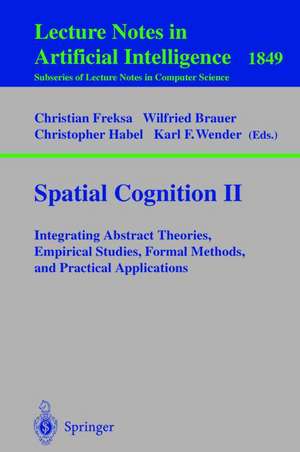
Spatial Cognition II
Editat de Christian Freksa, Wilfried Brauer, Christopher Habel, Karl F. Wenderen Limba Engleză Paperback – 24 mai 2000
Preț: 345.41 lei
Preț vechi: 431.77 lei
-20%
Puncte Express: 518
Carte tipărită la comandă
Livrare economică 07-21 decembrie
Livrare prin curier în România Termenul estimat este afișat lângă disponibilitate.
Transport gratuit de la 400.00 lei Plată online sau ramburs, în funcție de opțiunile comenzii.
Retur gratuit în 14 zile Comandă securizată și suport în română.
Specificații
ISBN-13: 9783540675846
ISBN-10: 3540675841
Pagini: 440
Ilustrații: XII, 424 p.
Dimensiuni: 155 x 235 x 27 mm
Greutate: 0.74 kg
Ediția:2000
Editura: Springer
Locul publicării:Berlin, Heidelberg, Germany
ISBN-10: 3540675841
Pagini: 440
Ilustrații: XII, 424 p.
Dimensiuni: 155 x 235 x 27 mm
Greutate: 0.74 kg
Ediția:2000
Editura: Springer
Locul publicării:Berlin, Heidelberg, Germany
V-ar putea interesa
-
 -19%Preț: 92.35 lei114.22 lei
 -
 Finite Element Modeling for Materials Engineers Using MATLAB®Oluleke Oluwole-41%Preț: 527.66 lei887.91 lei
 -
 Computer VisionSimon J. D. Prince-20%Preț: 582.72 lei728.39 lei
 -
 Machine LearningPeter Flach-20%Preț: 386.84 lei483.55 lei
 -
 Multi-Agent Machine LearningH M Schwartz-20%Preț: 675.81 lei844.77 lei
 -
 Wavelet Neural NetworksAntonios K Alexandridis-20%Preț: 634.18 lei792.72 lei
 -
 Practical Introduction to CompDawson-Howe-20%Preț: 518.21 lei647.76 lei
 -
 Machine Learning: An Algorithmic Perspective, Second EditionStephen Marsland-20%Preț: 625.22 lei781.53 lei
 -
 Natural Language Processing and Computational LinguisticsMohamed Zakaria Kurdi-9%Preț: 1021.06 lei1122.04 lei
 -
 Multidisciplinary Approaches to Language ProductionChristopher Habel-23%Preț: 1172.45 lei1522.65 lei
 -
 Räumliche Konzepte und sprachliche StrukturenChristiane Von Stutterheim-23%Preț: 1122.55 lei1457.86 lei
 -
 -20%Preț: 408.14 lei510.17 lei
 -
 Logic and Algebra of SpecificationFriedrich L. Bauer-20%Preț: 1032.69 lei1290.86 lei
 -
 Preț: 317.00 lei
 -
 User-Centric Technologies and Applications: Proceedings of the CONTEXTS 2011 WorkshopJosé Manuel Molina López-20%Preț: 940.88 lei1176.10 lei
 -
 -20%Preț: 1225.08 lei1531.36 lei
 -
 -20%Preț: 1217.83 lei1522.29 lei
 -
 -20%Preț: 1230.51 lei1538.14 lei
 -
 Soft Computing in Industrial ApplicationsAntónio Gaspar-Cunha-20%Preț: 1230.19 lei1537.74 lei
 -
 Computational Optimization, Methods and AlgorithmsSlawomir Koziel-20%Preț: 954.82 lei1193.53 lei
 -
 Dependable Computer SystemsWojciech Zamojski-20%Preț: 1223.51 lei1529.39 lei
 -
 Believable BotsPhilip Hingston-20%Preț: 676.70 lei845.88 lei
 -
 GI Gesellschaft für Informatik e. V.Wilfried Brauer-20%Preț: 309.14 lei386.42 lei
Public țintă
ResearchCuprins
Maps and Diagrams.- Cognitive Zoom: From Object to Path and Back Again.- Monitoring Change: Characteristics of Dynamic Geo-spatial Phenomena for Visual Exploration.- The Use of Maps, Images and “Gestures” for Navigation.- Schematizing Maps: Simplification of Geographic Shape by Discrete Curve Evolution.- Schematic Maps as Wayfinding Aids.- Some Ways that Maps and Diagrams Communicate.- Spatial Communication with Maps: Defining the Correctness of Maps Using a Multi-Agent Simulation.- Schematic Maps for Robot Navigation.- Motion and Spatial Reference.- From Motion Observation to Qualitative Motion Representation.- Lexical Specifications of Paths.- Visual Processing and Representation of Spatio-temporal Patterns.- Orienting and Reorienting in Egocentric Mental Models.- Investigating Spatial Reference Systems through Distortions in Visual Memory.- Spatial Relations and Spatial Inference.- Towards Cognitive Adequacy of Topological Spatial Relations.- Interactive Layout Generation with a Diagrammatic Constraint Language.- Inference and Visualization of Spatial Relations.- A Topological Calculus for Cartographic Entities.- The Influence of Linear Shapes on Solving Interval-Based Configuration Problems.- Navigation in Real and Virtual Spaces.- Transfer of Spatial Knowledge from Virtual to Real Environments.- Coarse Qualitative Descriptions in Robot Navigation.- Oblique Angled Intersections and Barriers: Navigating through a Virtual Maze.- Modelling Navigational Knowledge by Route Graphs.- Using Realistic Virtual Environments in the Study of Spatial Encoding.- Navigating Overlapping Virtual Worlds: Arriving in One Place and Finding that You’re Somewhere Else.- Spatial Memory.- Influences of Context on Memory for Routes.- Preparing a Cup of Tea and Writing a Letter: DoScript-Based Actions Influence the Representation of a Real Environment?.- Action Related Determinants of Spatial Coding in Perception and Memory.- Investigation of Age and Sex Effects in Spatial Cognitions as Assessed in a Locomotor Maze and in a 2-D Computer Maze.