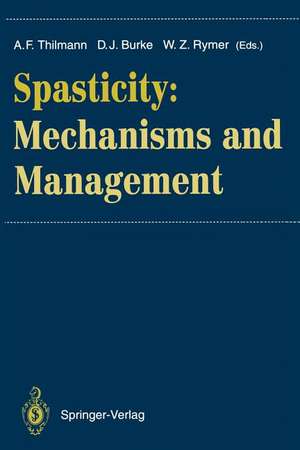
Spasticity
Editat de Alfred F. Thilmann, David J. Burke, William Z. Rymeren Limba Engleză Paperback – 30 dec 2011
Preț: 730.25 lei
Preț vechi: 768.68 lei
-5%
Puncte Express: 1095
Carte tipărită la comandă
Livrare economică 05-19 decembrie
Livrare prin curier în România Termenul estimat este afișat lângă disponibilitate.
Transport gratuit pentru acest produs Plată online sau ramburs, în funcție de opțiunile comenzii.
Retur gratuit în 14 zile Comandă securizată și suport în română.
Specificații
ISBN-13: 9783642783692
ISBN-10: 3642783694
Pagini: 480
Ilustrații: XIV, 463 p.
Dimensiuni: 155 x 235 x 26 mm
Greutate: 0.72 kg
Ediția:Softcover reprint of the original 1st ed. 1993
Editura: Springer
Locul publicării:Berlin, Heidelberg, Germany
ISBN-10: 3642783694
Pagini: 480
Ilustrații: XIV, 463 p.
Dimensiuni: 155 x 235 x 26 mm
Greutate: 0.72 kg
Ediția:Softcover reprint of the original 1st ed. 1993
Editura: Springer
Locul publicării:Berlin, Heidelberg, Germany
V-ar putea interesa
-
 Fundamental NeuroscienceLarry Squire-30%Preț: 592.97 lei851.46 lei
 -
 The New Executive Brain: Frontal Lobes in a Complex WorldElkhonon GoldbergPreț: 166.16 lei
 -
 Introduction to NeuropsychopharmacologyLeslie Iversen, PhD-30%Preț: 470.28 lei667.42 lei
 -
 Sensory Cue IntegrationJulia Trommershauser-32%Preț: 961.20 lei1417.61 lei
 -
 -30%Preț: 627.80 lei891.45 lei
 -
 Auditory PerceptionRichard M. Warren-11%Preț: 469.85 lei527.93 lei
 -
 Metabolic Basis of ObesityRexford S. Ahima-5%Preț: 759.35 lei799.31 lei
 -
 -15%Preț: 680.05 lei800.07 lei
 -
 Natural Image StatisticsAapo Hyvärinen-18%Preț: 1163.61 lei1419.05 lei
 -
 -18%Preț: 986.57 lei1203.13 lei
Public țintă
Professional/practitionerCuprins
Spasticity: History, Definitions, and Usage of the Term.- I Descending Control of Movement.- Organisation of Cortico-motoneuronal Projections from the Primary Motor Cortex: Evidence for Task-Related Function in Monkey and in Man.- Investigation of Descending Motor Pathways in Man.- Propriospinal Transmission of Voluntary Movement in Humans.- The Site of Activation of the Corticospinal System by Transcranial Magnetic and Electrical Stimulation of the Human Mortor Cortex.- Plasticity of the Human Motor Cortex.- Discussion Summary.- Discussion Summary.- II Disturbance of Voluntary Movement.- The Role of the Corticospinal Tract in Spasticity Studied by Magnetic Brain Stimulation.- Do Rapidly Conducting Ipsilateral Corticospinal Pathways Contribute to Recovery in Adult Hemiplegia?.- Strength Changes in Hemiparesis: Measurements and Mechanisms.- Factors Underlying Abnormal Posture and Movement in Spastic Hemiparesis.- Disturbances of Voluntary Arm Movement in Human Spasticity: The Relative Importance of Paresis and Muscle Hypertonia.- Spastic Movement Disorder: Similarities and Differences in Children and Adults.- Hyper-reflexia and Disordered Voluntary Movement.- Discussion Summary.- Discussion Summary.- III Spinal Pathophysiology: Animal Models.- Regulated Properties of Motoneurons and Primary Afferents: New Aspects on Possible Spinal Mechanisms Underlying Spasticity.- Functional Properties of the Neuromuscular System and Force Gradation.- Development of an Animal Model for the Study of Spinal Spasticity.- Monoaminergic Inhibitory Control of Spinal Interneurons.- Discussion Summary.- IV Reflex Disturbances in Spasticity: Movement Studies.- Pathological Changes in Spastic Muscle Reflexes Evoked by Passive Stretch or Tendon Taps.- Spastic Paresis: Reflex Activity and Muscle Tone in Elbow Muscles During Passive and Active Motor Tasks.- Discussion Summary.- V Reflex Disturbances in Spasticity: Electrophysiological Studies.- Methodological Problems in the Hoffmann Reflex Study of Spasticity.- Signs of the Upper Motoneuron Syndrome in Relation to Soleus Hoffmann Reflex Tests.- Pathophysiological Mechanisms of Spasticity at the Spinal Cord Level.- Dynamics of Reflex Excitability Following Intrathecal Baclofen Administration in Patients with Severe Spastic Syndromes.- Task-Dependent Spinal Inhibition in Spastic Hemiplegia.- Late Flexion Reflex in Paraplegic Patients: Evidence for a Spinal Stepping Generator.- Kinematics of the Cat Hindlimb After Spinal Cord Hemisection.- Discussion Summary.- Discussion Summary.- VI Treatment and Rehabilitation.- Spasticity of the Lower Urinary Tract: Therapeutic Strategies.- New Developments in the Medical Treatment of Spasticity.- Muscle Relaxant Action of Excitatory Amino Acid Antagonists.- Effect of Intrathecal Baclofen on Monosynaptic Reflex in Man.- Comparison of Cyproheptadine, Clonidine and Baclofen on the Modulation of Gait Pattern in Subjects with Spinal Cord Injury.- Neurophysiological Mechanisms of Spasticity Modification by Physiotherapy.- Is Rehabilitation Effective in Spastic Syndromes?.- Discussion Summary.