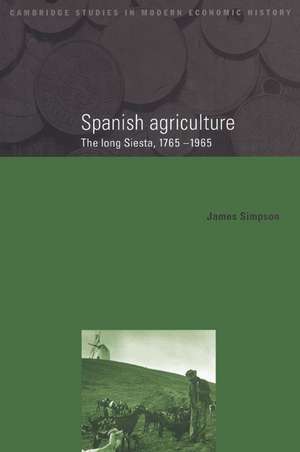
Spanish Agriculture
Autor James Simpson, Simpson James Editat de Charles Feinsteinen Limba Engleză Paperback – 17 iun 2002
Preț: 441.35 lei
Puncte Express: 662
Carte tipărită la comandă
Livrare economică 04-18 decembrie
Livrare prin curier în România Termenul estimat este afișat lângă disponibilitate.
Transport gratuit pentru acest produs Plată online sau ramburs, în funcție de opțiunile comenzii.
Retur gratuit în 14 zile Comandă securizată și suport în română.
Specificații
ISBN-13: 9780521525169
ISBN-10: 0521525160
Pagini: 340
Ilustrații: 15 maps 71 tables
Dimensiuni: 152 x 229 x 20 mm
Greutate: 0.55 kg
Editura: Cambridge University Press
Locul publicării:Cambridge, United Kingdom
ISBN-10: 0521525160
Pagini: 340
Ilustrații: 15 maps 71 tables
Dimensiuni: 152 x 229 x 20 mm
Greutate: 0.55 kg
Editura: Cambridge University Press
Locul publicării:Cambridge, United Kingdom
V-ar putea interesa
-
 The Victorian HouseJudith FlandersPreț: 122.93 lei
 -
 Littlejohns Lost WorldRichard LittlejohnPreț: 122.39 lei
 -
 The Paper TrailAlexander MonroPreț: 116.72 lei
 -
 -33%Preț: 1325.58 lei1977.04 lei
 -
 -15%Preț: 439.95 lei517.58 lei
 -
 The Great Cities in HistoryJohn Julius Norwich-18%Preț: 75.52 lei92.63 lei
 -
 Preț: 242.96 lei
 -
 Call The Midwife: A True Story Of The East End In The 1950sJennifer Worth-25%Preț: 59.94 lei80.02 lei
 -
 Food Words: Essays in Culinary CulturePeter Jackson-16%Preț: 214.29 lei254.63 lei
 -
 Reynard the FoxJames SimpsonPreț: 166.49 lei
 -
 Imagined SovereigntiesKevin Olson-11%Preț: 567.40 lei637.53 lei
 -
 From Hometown to Battlefield in the Civil War EraTimothy R Mahoney-11%Preț: 473.43 lei531.93 lei
 -
 Grand Strategy and Military AlliancesWilliamson Murray-14%Preț: 789.10 lei917.56 lei
 -
 The Garden of IgnoranceMarion CranPreț: 365.46 lei
 -
 Memoirs and MemoriesMaria Theresa Villiers EarlePreț: 367.21 lei
 -
 Landlords and AllotmentsWilliam Hillier OnslowPreț: 204.65 lei
 -
 FootballFrancis MarshallPreț: 477.13 lei
 -
 Last Words to GirlsMaria Georgina Shirreff GreyPreț: 339.14 lei
 -
 -19%Preț: 599.07 lei739.59 lei
 -
 Making of HomeJudith FlandersPreț: 108.79 lei
Cuprins
1. The relative backwardness of Spanish agriculture; 2. Traditional technologies and market opportunities, 1765–1880; 3. The limits to technical change, 1880–1936; 4. Markets and institutions, 1880–1936; 5. The state and the end of traditional agriculture; 6. Spanish agriculture in a European context.
Recenzii
"Simpson's book is an important addition to the new historiography." Richard Herr, Journal of Interdisciplinary History
Notă biografică
Growing up in the aftermath of the Video Nasties, during the late eighties and early nineties, James Simpson is from a small town in the North East of England where talking about grisly horror flicks was the norm in his school playground. For the last few years, he has written about cult cinema for several magazines and websites as well as running his own-now-defunct site: Infernal Cinema. He has interviewed horror stars Emily Booth, Barbie Wilde, and the legendary Lloyd Kaufman, amongst others, during this time. He appears in the Jason Impey documentary: VIPCO: The Untold Story. This is his first book. His favourite VIPCO movie is Spookies.
Descriere
A detailed analysis of Spanish agricultural history,first published in 1996, explaining why it changed so slowly.