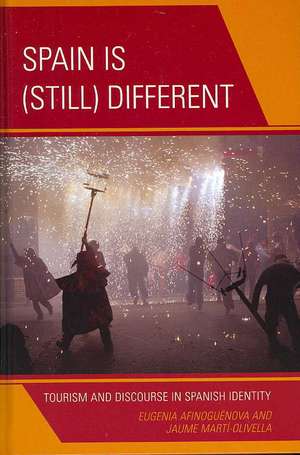
Spain Is (Still) Different: Tourism and Discourse in Spanish Identity
Editat de Eugenia Afinoguénova, Jaume Martí-Olivella Contribuţii de Alberto Medina, Joseba Gabilondo, Daniela Flesler, Adrián Pérez Melgosa, Justin Crumbaugh, John K. Walton, María Bolaños, Benjamin R. Fraser, Patricia Hart, Annabel Martínen Limba Engleză Hardback – 28 feb 2008
The main body of contributions comes from the area of cultural studies. In the introduction, Afinoguénova and Martí-Olivella provide a comprehensive overview of the problematic of tourism in Spain and of diverse approaches to the study of tourism in its relation to Spanish culture. Unlike other collections on tourism studies, this book is aimed to bridge the gap between the social sciences and the humanities. It is structured to provide an example of how experts in different fields can use each other's work in order to achieve a multi-faceted understanding of the phenomenon of tourism and its implications.
Preț: 742.97 lei
Preț vechi: 1149.25 lei
-35%
Puncte Express: 1114
Carte tipărită la comandă
Livrare economică 03-17 decembrie
Livrare prin curier în România Termenul estimat este afișat lângă disponibilitate.
Transport gratuit pentru acest produs Plată online sau ramburs, în funcție de opțiunile comenzii.
Retur gratuit în 14 zile Comandă securizată și suport în română.
Specificații
ISBN-13: 9780739124017
ISBN-10: 0739124013
Pagini: 290
Dimensiuni: 163 x 240 x 26 mm
Greutate: 0.62 kg
Editura: Bloomsbury Publishing
Colecția Lexington Books
Locul publicării:New York, United States
ISBN-10: 0739124013
Pagini: 290
Dimensiuni: 163 x 240 x 26 mm
Greutate: 0.62 kg
Editura: Bloomsbury Publishing
Colecția Lexington Books
Locul publicării:New York, United States
V-ar putea interesa
-
 White Men's Magic: Scripturalization as SlaveryVincent L. Wimbush-21%Preț: 373.50 lei473.89 lei
 -
 -11%Preț: 326.16 lei365.84 lei
 -
 On the UniversalFrançois JullienPreț: 186.71 lei
 -
 The Sociology of WorkDarren NixonPreț: 369.20 lei
 -
 Understanding Children¿s Development 6eHelen Cowie-19%Preț: 463.97 lei572.80 lei
 -
 Handbook of Intercultural Discourse and CommunicationChristina Bratt PaulstonPreț: 365.03 lei
 -
 The Handbook of Conversation AnalysisJack SidnellPreț: 404.60 lei
 -
 Companion to Moral AnthropologDidier FassinPreț: 451.30 lei
 -
 The FutureMarc AugePreț: 110.77 lei
 -
 Global Warming and Other BollocksStanley FeldmanPreț: 116.83 lei
 -
 The Civilization of Perpetual MovementNick Mcdonell-17%Preț: 134.41 lei162.19 lei
 -
 Preț: 181.15 lei
Cuprins
Part 1 Introduction: A Nation under Tourists' Eyes: Tourism and Identity Discourses in Spain
Part 2 Part I. Spanish Identity and Tourism Discourses
Chapter 3 1. Emptying the Nation: Performing Spanishness in Cadalso's Moroccan Letters
Chapter 4 2. On the Inception of Western Sex as Orientalist Theme Park: Tourism and Desire in Nineteenth-Century Spain (On Carmen and Don Juan as Femme Fatale and Latin Lover)
Chapter 5 3. Marketing Convivencia: Contemporary Tourist Appropriations of Spain's Jewish Past
Chapter 6 4. Reading Rural Tourism: On the Recreational Nature of Basque Heritage
Part 7 Part II. Consuming History
Chapter 8 5. Tourism and Consumption in Urban Spain, 1876-1975
Chapter 9 6. Modern Art Museums under Franco: Routines, Isolation, and Some Exceptions
Chapter 10 7. A Snapshot of Barcelona from Montjuïc: Juan Goytisolo's Señas de identidad, Tourist Landscapes as Process, and the Photographic Mechanism of Thought
Part 11 Part III. Spaces of (In)Difference
Chapter 12 8. Toppling the Xenolith: The Reconquest of Spain from the "Tourist Invader" in Iberian Film since World War II
Chapter 13 9. Miniskirts, Polka Dots, and Real Estate: What Lies under the Sun?
Chapter 14 10. Touristic Trades and Neo-Colonial Subjects: Subplotting/Sexploiting Women
Part 2 Part I. Spanish Identity and Tourism Discourses
Chapter 3 1. Emptying the Nation: Performing Spanishness in Cadalso's Moroccan Letters
Chapter 4 2. On the Inception of Western Sex as Orientalist Theme Park: Tourism and Desire in Nineteenth-Century Spain (On Carmen and Don Juan as Femme Fatale and Latin Lover)
Chapter 5 3. Marketing Convivencia: Contemporary Tourist Appropriations of Spain's Jewish Past
Chapter 6 4. Reading Rural Tourism: On the Recreational Nature of Basque Heritage
Part 7 Part II. Consuming History
Chapter 8 5. Tourism and Consumption in Urban Spain, 1876-1975
Chapter 9 6. Modern Art Museums under Franco: Routines, Isolation, and Some Exceptions
Chapter 10 7. A Snapshot of Barcelona from Montjuïc: Juan Goytisolo's Señas de identidad, Tourist Landscapes as Process, and the Photographic Mechanism of Thought
Part 11 Part III. Spaces of (In)Difference
Chapter 12 8. Toppling the Xenolith: The Reconquest of Spain from the "Tourist Invader" in Iberian Film since World War II
Chapter 13 9. Miniskirts, Polka Dots, and Real Estate: What Lies under the Sun?
Chapter 14 10. Touristic Trades and Neo-Colonial Subjects: Subplotting/Sexploiting Women
Recenzii
This is an innovative and enlightening volume that offers highly valuable insights on the crucial role played by the discourses and practices of tourism in the construction of modern Spanish identity. Its focus and approach is on the cutting edge area of Hispanic cultural studies. The essays included provide a careful examination of the contexts and political uses of tourism in the collective self-imagining of the nation. It will be an invaluable tool for scholars and students interested in the political and cultural ramifications of tourism in a global context.
Spain is (Still) Different provides several essays on film that go beyond tourism to raise questions about Spanish reflections and identities as well.
Spanish exceptionality is a centuries-old topic, but the ideology of Spanish difference as it pertains both to Spain's internal and external identity has never received a more thoroughgoing critical examination as in these intelligent and lucid essays. As a group they set new standards for debates concerning the discursive relationship between Spain's tourist industry, economic structures, and cultural production and identity in the modern era.
Spain is (Still) Different provides several essays on film that go beyond tourism to raise questions about Spanish reflections and identities as well.
Spanish exceptionality is a centuries-old topic, but the ideology of Spanish difference as it pertains both to Spain's internal and external identity has never received a more thoroughgoing critical examination as in these intelligent and lucid essays. As a group they set new standards for debates concerning the discursive relationship between Spain's tourist industry, economic structures, and cultural production and identity in the modern era.