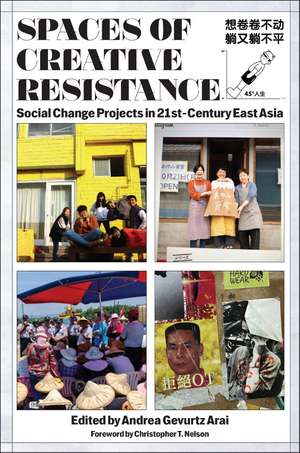
Spaces of Creative Resistance: Social Change Projects in Twenty-First-Century East Asia
Editat de Andrea Gevurtz Arai Cuvânt înainte de Christopher T. Nelson Contribuţii de Yeonjung Ahn, Miriam Timson, Hyein Chae, Chor-See Chan, Summer Xuan Dai, Liling Huang, Jeff Hou, Hidehiko Ishibashi, Hsiu Fan Lin, Yuyu Liu, Yumi Matsubara, Keisuke Sugano, Jinyue Xu, Yue Wuen Limba Engleză Paperback – 17 iun 2025 – vârsta ani
Preț: 234.07 lei
Puncte Express: 351
Carte indisponibilă temporar
Doresc să fiu notificat când acest titlu va fi disponibil:
Se trimite...
Specificații
ISBN-13: 9781978842496
ISBN-10: 197884249X
Pagini: 198
Ilustrații: 28 B-W images
Dimensiuni: 156 x 235 x 15 mm
Greutate: 0.34 kg
Editura: Rutgers University Press
Colecția Rutgers University Press
ISBN-10: 197884249X
Pagini: 198
Ilustrații: 28 B-W images
Dimensiuni: 156 x 235 x 15 mm
Greutate: 0.34 kg
Editura: Rutgers University Press
Colecția Rutgers University Press
Notă biografică
ANDREA GEVURTZ ARAI is a cultural anthropologist and acting assistant professor in The Henry M Jackson School of International Studies at the University of Washington. She is the author of The Strange Child: Education and the Psychology of Patriotism in Recessionary Japan and the coeditor of Global Futures in East Asia: Youth, Nation, and the New Economy in Uncertain Times and Spaces of Possibility: In, Between, and Beyond Korea and Japan.
CHRISTOPHER T. NELSON is a cultural anthropologist at the University of North Carolina at Chapel Hill. He is the author of Dancing with the Dead: Memory, Performance, and Everyday Life in Okinawa and the forthcoming When the Bones Speak: The Living, the Dead, and the Sacrifice of Okinawa.
CHRISTOPHER T. NELSON is a cultural anthropologist at the University of North Carolina at Chapel Hill. He is the author of Dancing with the Dead: Memory, Performance, and Everyday Life in Okinawa and the forthcoming When the Bones Speak: The Living, the Dead, and the Sacrifice of Okinawa.
Recenzii
"Expand[s] our understanding of both the conditions of oppression and the small yet tangible responses in contemporary East Asia. Scholars and students in the humanities and social sciences will find in this volume rich ethnographic material and conceptual tools for thinking about youth, precarity, and alternative futures; activists and educators interested in community engagement and place-making will likewise gain suggestive models and cautionary tales."
"The force of this volume lies as much in the collection of essays as a whole as it does in the individual arguments; diverse, sometimes uncertain, they present a true politics of the everyday. Above all, it insists on the endurance of particularity—of a potentiality not defined by, or contained by, the seemingly totalizing ubiquity of global capital; these are stories of our time."
"Spaces of Creative Resistance is a refreshing book about social critique that does more than just critique dominant structures and systems—it shows how communities in Asia have created social change in daily life. The book masterfully illustrates how the everyday has been regenerated as a site of contestation and social renewal and therefore provides fresh insights on the tension between authority and counter-authority."
Descriere
This edited volume brings together an exciting cross-regional inter-disciplinary group of scholars, scholar activists, artists and others. Each chapter focuses on a different form of “creative resistance” to the last two decades of social disconnection, increased income disparity and new burdens placed on reproductive labor and the environment taking place in China, Japan, Taiwan, Hong Kong, and South Korea. Each chapter demonstrates how individuals and communities across East Asia are making their stands in the everyday--focused on making more liveable presents and more possible futures.