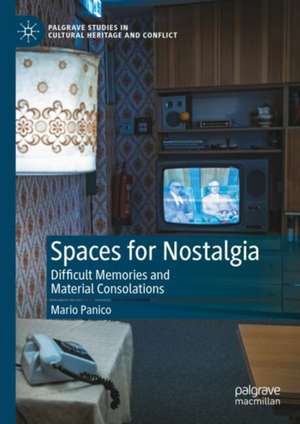
Spaces for Nostalgia: Palgrave Studies in Cultural Heritage and Conflict
Autor Mario Panicoen Limba Engleză Hardback – 22 sep 2024
Studies of nostalgia have long illustrated the emotional dynamics which condition our desire to go back to a time and a space that belong to the past. This book addresses this condition from an innovative perspective, by over-exposing the spatial dimension of nostalgia. Doing so unveils alternative and complementary ways of thinking through how this emotion is activated: in particular, how space – unlike time – can be recreated in the present, even in a different location, with the deliberate aim of consoling this bittersweet sensation. The volume defines this re-creation as a “space for nostalgia”.
In this book, this concept is applied within the context of cultural heritage and difficult memories. As a further step, then, the volume questions the modalities through which nostalgia can interact with and permeate a space of memory, therefore influencing collective understandings and the emotional re-writings of our shared pasts. Through case studies relating to challenging nostalgias for troubled pasts in Western Europe, the book examines how the furnishing and use of space, the discourses that surround it, and the objects that become synecdoche of it provide a terrain where even unlikely or troubling forms of nostalgia can grow and blossom.
Din seria Palgrave Studies in Cultural Heritage and Conflict
- 15%
 Preț: 672.28 lei
 - 15%
 Preț: 565.48 lei
 -
 Preț: 405.96 lei
 - 18%
 Preț: 919.68 lei
 -
 Preț: 367.22 lei
 - 18%
 Preț: 792.20 lei
 - 18%
 Preț: 732.10 lei
 -
 Preț: 224.41 lei
 - 18%
 Preț: 755.00 lei
 -
 Preț: 485.67 lei
 - 18%
 Preț: 755.18 lei
 - 18%
 Preț: 861.49 lei
 - 18%
 Preț: 923.81 lei
 - 18%
 Preț: 921.47 lei
 - 15%
 Preț: 609.53 lei
 - 18%
 Preț: 708.37 lei
 - 18%
 Preț: 810.41 lei
 - 18%
 Preț: 706.68 lei
 -
 Preț: 467.07 lei
 - 18%
 Preț: 760.45 lei
 - 18%
 Preț: 759.04 lei
 - 15%
 Preț: 674.03 lei
 - 18%
 Preț: 915.93 lei
 - 18%
 Preț: 761.65 lei
 - 9%
 Preț: 897.05 lei
 -
 Preț: 374.38 lei
 - 15%
 Preț: 567.64 lei
 -
 Preț: 401.25 lei
 - 15%
 Preț: 607.24 lei
Preț: 676.08 lei
Preț vechi: 795.38 lei
-15%
Puncte Express: 1014
Carte tipărită la comandă
Livrare economică 21 noiembrie-05 decembrie
Livrare prin curier în România Termenul estimat este afișat lângă disponibilitate.
Transport gratuit pentru acest produs Plată online sau ramburs, în funcție de opțiunile comenzii.
Retur gratuit în 14 zile Comandă securizată și suport în română.
Specificații
ISBN-13: 9783031629280
ISBN-10: 3031629280
Pagini: 216
Ilustrații: Approx. 250 p. 10 illus. in color.
Dimensiuni: 153 x 216 x 17 mm
Greutate: 0.4 kg
Ediția:2024
Editura: Palgrave MacMillan
Colecția Palgrave Studies in Cultural Heritage and Conflict
Seria Palgrave Studies in Cultural Heritage and Conflict
Locul publicării:Cham, Switzerland
ISBN-10: 3031629280
Pagini: 216
Ilustrații: Approx. 250 p. 10 illus. in color.
Dimensiuni: 153 x 216 x 17 mm
Greutate: 0.4 kg
Ediția:2024
Editura: Palgrave MacMillan
Colecția Palgrave Studies in Cultural Heritage and Conflict
Seria Palgrave Studies in Cultural Heritage and Conflict
Locul publicării:Cham, Switzerland
Cuprins
1. Introduction.- 2. Semiotics of Nostalgia.- 3. Emotion and Spatial Consolation.- 4. Memory and Imagination.- 5. Reconstruction of the Past and Authenticity.- 6. Fascist Legacy and Conflict Heritage.- 7. Musealisation and the Re-enactment of Nostalgia.- 8. Conclusion: What a culture lost.
Textul de pe ultima copertă
"With the publication of Spaces for Nostalgia, Mario Panico signs the first book that offers an intersection between semiotics, heritage, nostalgia and memory and is a more than welcoming piece to build on for scholars who are interested in how nostalgia can function as a filter and consolation for traumatic historical experiences all by tackling the potential of dangerous forgetting." - Katharina Niemeyer is a professor at the Université du Québec à Montréal, Canada, and co-founder of the International Media and Nostalgia Network.
How is nostalgia expressed through space?
Studies of nostalgia have long illustrated the emotional dynamics which condition our desire to go back to a time and a space that belong to the past. This book addresses this condition from an innovative perspective, by over-exposing the spatial dimension of nostalgia. Doing so unveils alternative and complementary ways of thinking through how this emotion is activated: in particular, how space – unlike time – can be recreated in the present, even in a different location, with the deliberate aim of consoling this bittersweet sensation. The volume defines this re-creation as a “space for nostalgia”.
In this book, this concept is applied within the context of cultural heritage and difficult memories. As a further step, then, the volume questions the modalities through which nostalgia can interact with and permeate a space of memory, therefore influencing collective understandings and the emotional re-writings of our shared pasts. Through case studies relating to challenging nostalgias for troubled pasts in Western Europe, the book examines how the furnishing and use of space, the discourses that surround it, and the objects that become synecdoche of it provide a terrain where even unlikely or troubling forms of nostalgia can grow and blossom.
Mario Panico is a lecturer and a postdoctoral fellow at the University of Amsterdam and a member of the Amsterdam School for Heritage, Memory and Material Culture (AHM). His research deals with difficult cultural heritage, postmemory, nostalgia and the representation and mediation of perpetrators in trauma sites, memory museums and visual culture.
How is nostalgia expressed through space?
Studies of nostalgia have long illustrated the emotional dynamics which condition our desire to go back to a time and a space that belong to the past. This book addresses this condition from an innovative perspective, by over-exposing the spatial dimension of nostalgia. Doing so unveils alternative and complementary ways of thinking through how this emotion is activated: in particular, how space – unlike time – can be recreated in the present, even in a different location, with the deliberate aim of consoling this bittersweet sensation. The volume defines this re-creation as a “space for nostalgia”.
In this book, this concept is applied within the context of cultural heritage and difficult memories. As a further step, then, the volume questions the modalities through which nostalgia can interact with and permeate a space of memory, therefore influencing collective understandings and the emotional re-writings of our shared pasts. Through case studies relating to challenging nostalgias for troubled pasts in Western Europe, the book examines how the furnishing and use of space, the discourses that surround it, and the objects that become synecdoche of it provide a terrain where even unlikely or troubling forms of nostalgia can grow and blossom.
Mario Panico is a lecturer and a postdoctoral fellow at the University of Amsterdam and a member of the Amsterdam School for Heritage, Memory and Material Culture (AHM). His research deals with difficult cultural heritage, postmemory, nostalgia and the representation and mediation of perpetrators in trauma sites, memory museums and visual culture.
Caracteristici
Analyses the dynamics of longing for the past with a cultural semiotic perspective Proposes novel, theoretical perspectives on the study of nostalgia. Offers new toolkit to analyse & design memory spaces Introduces the concept of the “space for nostalgia” to the memory studies and post-conflict studies lexicon