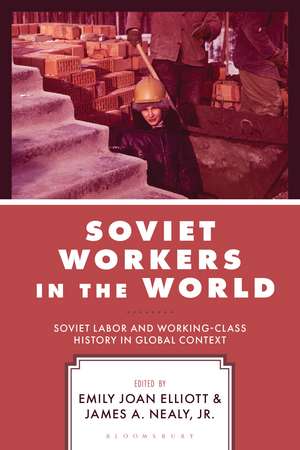
Soviet Workers in the World: Soviet Labor and Working-Class History in Global Context
Editat de James A. Nealy, Emily Joan Elliotten Limba Engleză Hardback – 10 ian 2026
Soviet Workers in the World: Soviet Labor and Working-Class History in Global Context addresses Soviet labor and working-class history in a global context. The volume's multigenerational collection of authors argues that, insofar as it relies on assumptions about the sui generis nature of Soviet socialism, scholarly understanding of Soviet labor and working-class history remains fundamentally flawed. Focusing on topics as varied as migration, gender, sports, unfree labor, automation, and many others besides, they demonstrate that, notwithstanding the specificity of the Soviet system, Soviet labor and working-class history is indicative of broader trends that affected working people all over the world. The result is an exciting collection of essays that is crucial reading for anyone interested in the history of socialism and labor in the twentieth century.
Preț: 652.69 lei
Preț vechi: 962.49 lei
-32% Precomandă
Puncte Express: 979
Carte nepublicată încă
Livrare prin curier în România Precomanda se expediază când titlul devine disponibil.
Transport gratuit pentru acest produs Plată online sau ramburs, în funcție de opțiunile comenzii.
Retur gratuit în 14 zile Comandă securizată și suport în română.
Doresc să fiu notificat când acest titlu va fi disponibil:
Se trimite...
Specificații
ISBN-13: 9781666946406
ISBN-10: 1666946400
Pagini: 446
Ilustrații: 2 b/w photos
Dimensiuni: 152 x 229 mm
Editura: Bloomsbury Publishing
Colecția Bloomsbury Academic
Locul publicării:New York, United States
ISBN-10: 1666946400
Pagini: 446
Ilustrații: 2 b/w photos
Dimensiuni: 152 x 229 mm
Editura: Bloomsbury Publishing
Colecția Bloomsbury Academic
Locul publicării:New York, United States
Cuprins
Introduction by Lewis H. Siegelbaum
Chapter 1: The Soviet Labor Process Under Stalin and the Genesis of the Soviet Union's Long-term Decline by Donald Filtzer
Chapter 2: Toward a War Economy: The Battle for the Shop Floor and Industrial District in Sormovo by Patrick Brown
Chapter 3: German Prisoners of War and Soviet Forced Laborers: Understudied Members of the Soviet Working Class by Susan C.I. Grunewald
Chapter 4: The Mobilization of Labor in Soviet Industry and the Problems of its Effectiveness during the Second World War by Sergey Filippovich Volodin (Translated and edited by James A. Nealy, Jr.
Chapter 5: Looking for Class in the Postwar Soviet Union by Anna Krylova
Chapter 6: "Socialist" Labor in the Age of the Automatic Factory by Andrew Sloin
Chapter 7: Strain for Grain: Transcarpathian Rural Women's Engagement in Seasonal Work in the Changing Soviet Countryside (1950-1980s) by Kateryna Burkush
Chapter 8: Soviet Female Industrial Workers and Social Accommodations in the 1970s by James A. Nealy
Chapter 9: "Workers of the Second World, Unite!" Bulgarian-Soviet Economic Integration and Guestworker Initiatives, 1967-1994 by Brian LaPierre
Chapter 10: Romancing Labor - or Why Shabashniki Worked Harder than the Soviet Union Allowed by Alexandra Oberländer
Chapter 11: The Soviet Dream and the Lake Placid Archipelago: Labor and Mobility in the 1980 Olympics by Emily Joan Elliott
Chapter 12: Producing (Post)Soviet Labor Collective: The Shop against the Top at the Karelian Isthmus Pulp and Paper Mills by Mikhail Piskunov
Chapter 13: Soviet Labor at the End of State Socialism by Ronald Grigor Suny
Conclusion: Links on the Chain of Soviet Labor History by Wendy Z. Goldman
Chapter 1: The Soviet Labor Process Under Stalin and the Genesis of the Soviet Union's Long-term Decline by Donald Filtzer
Chapter 2: Toward a War Economy: The Battle for the Shop Floor and Industrial District in Sormovo by Patrick Brown
Chapter 3: German Prisoners of War and Soviet Forced Laborers: Understudied Members of the Soviet Working Class by Susan C.I. Grunewald
Chapter 4: The Mobilization of Labor in Soviet Industry and the Problems of its Effectiveness during the Second World War by Sergey Filippovich Volodin (Translated and edited by James A. Nealy, Jr.
Chapter 5: Looking for Class in the Postwar Soviet Union by Anna Krylova
Chapter 6: "Socialist" Labor in the Age of the Automatic Factory by Andrew Sloin
Chapter 7: Strain for Grain: Transcarpathian Rural Women's Engagement in Seasonal Work in the Changing Soviet Countryside (1950-1980s) by Kateryna Burkush
Chapter 8: Soviet Female Industrial Workers and Social Accommodations in the 1970s by James A. Nealy
Chapter 9: "Workers of the Second World, Unite!" Bulgarian-Soviet Economic Integration and Guestworker Initiatives, 1967-1994 by Brian LaPierre
Chapter 10: Romancing Labor - or Why Shabashniki Worked Harder than the Soviet Union Allowed by Alexandra Oberländer
Chapter 11: The Soviet Dream and the Lake Placid Archipelago: Labor and Mobility in the 1980 Olympics by Emily Joan Elliott
Chapter 12: Producing (Post)Soviet Labor Collective: The Shop against the Top at the Karelian Isthmus Pulp and Paper Mills by Mikhail Piskunov
Chapter 13: Soviet Labor at the End of State Socialism by Ronald Grigor Suny
Conclusion: Links on the Chain of Soviet Labor History by Wendy Z. Goldman
Recenzii
"A fresh take on the enduring problem of labor relations under socialism, this volume conceptualizes coerced and free labor, migration, gender, technology, empire, discipline, solidarity, and class. The authors raise important and provocative questions about the central role of workers during the last fifty years of the Soviet experiment."
"Workers, labor, and class matter for any comprehensive understanding of the history of the Soviet Union! This timely volume reveals both unexpected gains in the global history of twentieth-century labor and the challenges posed by state-socialist pasts for emancipatory class politics. Breathing vitality into a recently neglected realm of inquiry, it enlightens readers about the complicated and evolving experiences of Soviet workers in the world."
"Labor history is back. Every chapter of this book brilliantly demonstrates how deeply we must rethink our images of socialism and planned economy, gender and class, state and enterprise, technologies and science - if we take labor as a focal point."
"This compelling volume takes Soviet social and labor history in new and exciting directions. Its authors show how new technologies, spaces of informality and transnational encounters fundamentally revised relationships between citizen and state after the Second World War."
"Workers, labor, and class matter for any comprehensive understanding of the history of the Soviet Union! This timely volume reveals both unexpected gains in the global history of twentieth-century labor and the challenges posed by state-socialist pasts for emancipatory class politics. Breathing vitality into a recently neglected realm of inquiry, it enlightens readers about the complicated and evolving experiences of Soviet workers in the world."
"Labor history is back. Every chapter of this book brilliantly demonstrates how deeply we must rethink our images of socialism and planned economy, gender and class, state and enterprise, technologies and science - if we take labor as a focal point."
"This compelling volume takes Soviet social and labor history in new and exciting directions. Its authors show how new technologies, spaces of informality and transnational encounters fundamentally revised relationships between citizen and state after the Second World War."