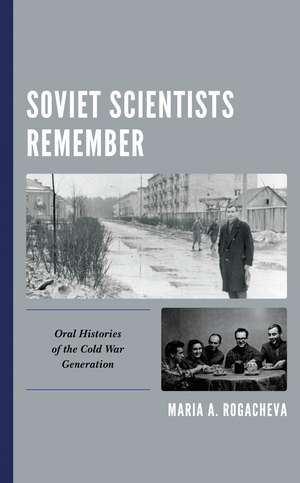
Soviet Scientists Remember: Oral Histories of the Cold War Generation
Autor Maria A. Rogachevaen Limba Engleză Hardback – 21 noi 2019
Preț: 550.60 lei
Preț vechi: 816.02 lei
-33%
Puncte Express: 826
Carte tipărită la comandă
Livrare economică 28 noiembrie-12 decembrie
Livrare prin curier în România Termenul estimat este afișat lângă disponibilitate.
Transport gratuit pentru acest produs Plată online sau ramburs, în funcție de opțiunile comenzii.
Retur gratuit în 14 zile Comandă securizată și suport în română.
Specificații
ISBN-13: 9781498574341
ISBN-10: 1498574343
Pagini: 182
Dimensiuni: 160 x 233 x 21 mm
Greutate: 0.47 kg
Editura: Bloomsbury Publishing
Colecția Lexington Books
Locul publicării:New York, United States
ISBN-10: 1498574343
Pagini: 182
Dimensiuni: 160 x 233 x 21 mm
Greutate: 0.47 kg
Editura: Bloomsbury Publishing
Colecția Lexington Books
Locul publicării:New York, United States
Cuprins
Chapter: 1 "My life, my family's life is the typical story of millions of Soviet families"
Rimma Nikolaevna Liubovskaia (née Stepanova)
Chapter: 2 "I was only ten years old when my father was arrested"
Vladimir Karlovich Enman
Chapter: 3 "After winning such a devastating war we believed that we could do anything" Georgii Borisovich Manelis
Chapter: 4 "I have always embraced collectivism and had little tolerance for individualism"
Lev Nikolaevich Vashin
Chapter: 5 "I began to critically evaluate Soviet life after I met Kronid" ?
Rustem Bronislavovich Liubovskii
Chapter: 6 "Individuals, not the party or society, should be responsible for their own education"
Oleg Nikolaevich Efimov
Rimma Nikolaevna Liubovskaia (née Stepanova)
Chapter: 2 "I was only ten years old when my father was arrested"
Vladimir Karlovich Enman
Chapter: 3 "After winning such a devastating war we believed that we could do anything" Georgii Borisovich Manelis
Chapter: 4 "I have always embraced collectivism and had little tolerance for individualism"
Lev Nikolaevich Vashin
Chapter: 5 "I began to critically evaluate Soviet life after I met Kronid" ?
Rustem Bronislavovich Liubovskii
Chapter: 6 "Individuals, not the party or society, should be responsible for their own education"
Oleg Nikolaevich Efimov
Recenzii
This book is a good contribution to the library of the research on the everyday life of different social groups in the USSR. Moreover, this book is a nice guide for scholars who study different Soviet social groups, elites, and scholarly life; it would make a useful companion for example to the various series of notes and books about sociologists of that time that have been published in Russia and abroad. More broadly, it will have appeal for everyone who is interested in the history of Soviet everyday life and Soviet science in particular.
Touching on issues ranging from housing and personal life to culture and politics, these interviews paint a rich picture of life and work of the inhabitants of Chernogolovka, a home town for a branch of the Academy of Science's Institute of Chemical Physics and several other research institutes near Moscow, from its founding in 1956 to the post-Soviet times. This collection is a valuable source not only for the history of Soviet science and technology, but also for the study of Soviet citizens' daily life.
Maria A. Rogacheva's Soviet Scientists Remember provides a glance behind the still-existing curtain of secrecy surrounding one closed Soviet city, Chernogolovka. In a series of oral interviews, Rogacheva shows the hopes, dreams, and disappointments in the everyday lives of postwar scientists, arguably the most inscrutable segment of Soviet society.
Influential, highly educated, and critically minded, Soviet scientists represented an elite cohort in the Soviet Union after World War II, yet their lived experiences under a system that exacted total loyalty remain woefully understudied. Drawing on oral history methodologies, Maria A. Rogacheva helps fill this gaping hole in the literature with this fine collection of illuminating personal narratives. These stories aid us in comprehending not only how big science functioned in the Soviet Union during the Cold War, but also how individuals' personal encounters with Soviet power shaped their attitudes toward critical social, political, and economic issues. Wide-ranging, their views reflect the Soviet state's capacity to empower-and to constrain. Soviet Scientists Remember: Oral Histories of the Cold War Generation is a must-read for anyone interested in the Soviet intelligentsia, science, and daily life under late socialism and afterward.
In her series of detailed, in-depth interviews with scientists, Rogacheva puts together a rich picture of life and work in a highly classified research community during the late Soviet decades. Prompted by Rogacheva's intelligent questions, eminent Soviet researchers reflect on what it meant to survive and remember World War II, to have family members arrested and killed, to live through Stalin's death, to hear (about) Khrushchev's Secret Speech, to read and discuss dissenting literature during the Brezhnev years, to breathe the air of Gorbachev's reforms, to go on the street during the August 1991 coup, and to see a superpower collapse before your very own eyes. On many occasions in their lives, these people had to make momentous choices-whether to speak up or to keep silent, whether to leave or to stay in their country. The book thus offers no less than a collective oral history of the entire late Soviet epoch, remembered by some of its most sophisticated and eloquent eyewitnesses. Rogacheva deserves high praise for this achievement.
Touching on issues ranging from housing and personal life to culture and politics, these interviews paint a rich picture of life and work of the inhabitants of Chernogolovka, a home town for a branch of the Academy of Science's Institute of Chemical Physics and several other research institutes near Moscow, from its founding in 1956 to the post-Soviet times. This collection is a valuable source not only for the history of Soviet science and technology, but also for the study of Soviet citizens' daily life.
Maria A. Rogacheva's Soviet Scientists Remember provides a glance behind the still-existing curtain of secrecy surrounding one closed Soviet city, Chernogolovka. In a series of oral interviews, Rogacheva shows the hopes, dreams, and disappointments in the everyday lives of postwar scientists, arguably the most inscrutable segment of Soviet society.
Influential, highly educated, and critically minded, Soviet scientists represented an elite cohort in the Soviet Union after World War II, yet their lived experiences under a system that exacted total loyalty remain woefully understudied. Drawing on oral history methodologies, Maria A. Rogacheva helps fill this gaping hole in the literature with this fine collection of illuminating personal narratives. These stories aid us in comprehending not only how big science functioned in the Soviet Union during the Cold War, but also how individuals' personal encounters with Soviet power shaped their attitudes toward critical social, political, and economic issues. Wide-ranging, their views reflect the Soviet state's capacity to empower-and to constrain. Soviet Scientists Remember: Oral Histories of the Cold War Generation is a must-read for anyone interested in the Soviet intelligentsia, science, and daily life under late socialism and afterward.
In her series of detailed, in-depth interviews with scientists, Rogacheva puts together a rich picture of life and work in a highly classified research community during the late Soviet decades. Prompted by Rogacheva's intelligent questions, eminent Soviet researchers reflect on what it meant to survive and remember World War II, to have family members arrested and killed, to live through Stalin's death, to hear (about) Khrushchev's Secret Speech, to read and discuss dissenting literature during the Brezhnev years, to breathe the air of Gorbachev's reforms, to go on the street during the August 1991 coup, and to see a superpower collapse before your very own eyes. On many occasions in their lives, these people had to make momentous choices-whether to speak up or to keep silent, whether to leave or to stay in their country. The book thus offers no less than a collective oral history of the entire late Soviet epoch, remembered by some of its most sophisticated and eloquent eyewitnesses. Rogacheva deserves high praise for this achievement.