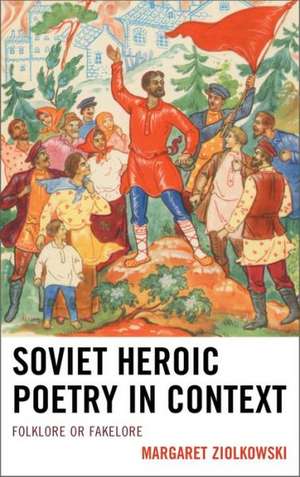
Soviet Heroic Poetry in Context: Folklore or Fakelore
Autor Margaret Ziolkowskien Limba Engleză Hardback – 15 aug 2013
| Toate formatele și edițiile | Preț | Express |
|---|---|---|
| Paperback (1) | 327.21 lei 6-8 săpt. | |
| Bloomsbury Publishing – 27 mar 2017 | 327.21 lei 6-8 săpt. | |
| Hardback (1) | 565.70 lei 6-8 săpt. | |
| Bloomsbury Publishing – 15 aug 2013 | 565.70 lei 6-8 săpt. |
Preț: 565.70 lei
Preț vechi: 854.91 lei
-34%
Puncte Express: 849
Preț estimativ în valută:
100.12€ • 117.01$ • 86.92£
100.12€ • 117.01$ • 86.92£
Carte tipărită la comandă
Livrare economică 20 februarie-06 martie
Preluare comenzi: 021 569.72.76
Specificații
ISBN-13: 9781611494563
ISBN-10: 1611494567
Pagini: 238
Dimensiuni: 159 x 235 x 23 mm
Greutate: 0.5 kg
Ediția:New.
Editura: Bloomsbury Publishing
Colecția University of Delaware Press
Locul publicării:New York, United States
ISBN-10: 1611494567
Pagini: 238
Dimensiuni: 159 x 235 x 23 mm
Greutate: 0.5 kg
Ediția:New.
Editura: Bloomsbury Publishing
Colecția University of Delaware Press
Locul publicării:New York, United States
Cuprins
Preface
Chapter 1: Tampering with the Folkloric Evidence: Famous and Infamous European Precedents
Chapter 2: Oral Composition: Early Russian Observations and Assumptions
Chapter 3: Engaging with the Folk in Pre-Revolutionary Russia
Chapter 4: The Making of the Noviny
Chapter 5: The Poetics and Politics of the Noviny
Chapter 6: Devaluing the Noviny
Chapter 7: Late and Post-Soviet Folkloristic Assessment of the Noviny
Conclusion
Selected Bibliography
About the Author
Chapter 1: Tampering with the Folkloric Evidence: Famous and Infamous European Precedents
Chapter 2: Oral Composition: Early Russian Observations and Assumptions
Chapter 3: Engaging with the Folk in Pre-Revolutionary Russia
Chapter 4: The Making of the Noviny
Chapter 5: The Poetics and Politics of the Noviny
Chapter 6: Devaluing the Noviny
Chapter 7: Late and Post-Soviet Folkloristic Assessment of the Noviny
Conclusion
Selected Bibliography
About the Author
Recenzii
The present volume looks at the study and collection of Soviet epic songs from the 1930s and 1940s; these songs were called noviny, following in the tradition of the Russian epic bylyny songs of the past. The majority of the book summarizes and analyzes the politics and methodologies among folklorists compiling and interpreting bylyny and noviny from the pre-revolutionary period to the late- and post-Soviet eras. Chapter 1 provides a history of folklore in eighteenth- and nineteenth-century Europe; chapters 2, 3, and 4 are devoted to the theory and practice behind the gathering of folklore in the pre-revolutionary and Stalinist periods. In chapter 5, the author looks at the poetics and politics of the noviny; it will be most useful to those interested in concrete examples from Soviet heroic poetry. Ziokowski asserts that the bylyny represent a diverse collection of narratives with varied concerns and argues that the diversity of these folk poems was especially neglected in the early twentieth century in favor of a patriotic Soviet narrative. Through a close reading of selections from different noviny in chapter 5, the author demonstrates how poetics and politics operated together at the textual level of the poems. Summing Up: Recommended. Graduate students, researchers, faculty.
In a masterful and accessible treatment, Margaret Ziolkowski lays out the pre-history and history of the noviny. This book will be of value to a range of scholars, from investigators of Russian folklore or the history of folkloristic research to those considering more specific topics, such as the notion of authenticity or the textualization of oral traditions. ... Ziolkowski provides a great service in illuminating not only the byliny and the noviny but also the people behind them and the Russian scholarly reactions to the noviny. Few Western researchers will have had access to this material before. In addition, Ziolkowski helpfully articulates how the discussion of the noviny was really a discussion about matters that remain of interest to many folklorists.
Growing up in the USSR, we were constantly bombarded by a stream of 'folk' music glorifying labour and patriotism in epic terms. We always wondered about how much of the material was truly folklore, and how much simple propaganda emulating it. Now, Margaret Ziolkowski, a scholar of Russian history and literature addresses the question head on. Subtitled 'Folklore or Fakelore', this volume analyzes the distinction, concentrating primarily on the Soviet epic compositions under Stalin before the Second World War. It looks at the earlier European precedents of tampering with folk compositions and art, from Macpherson's wholesale invention to Grimm brothers romanticizing tendencies, to methodological and compilation problems of Lönnrot and Karadzic and applies the results to the analysis of Russian 'noviny', their rise and fall, concluding with a look at the post-Soviet reappraisal of the genre. Of interest to students of folklore in general and specifically to those studying Russian and Soviet art-forms.
In a masterful and accessible treatment, Margaret Ziolkowski lays out the pre-history and history of the noviny. This book will be of value to a range of scholars, from investigators of Russian folklore or the history of folkloristic research to those considering more specific topics, such as the notion of authenticity or the textualization of oral traditions. ... Ziolkowski provides a great service in illuminating not only the byliny and the noviny but also the people behind them and the Russian scholarly reactions to the noviny. Few Western researchers will have had access to this material before. In addition, Ziolkowski helpfully articulates how the discussion of the noviny was really a discussion about matters that remain of interest to many folklorists.
Growing up in the USSR, we were constantly bombarded by a stream of 'folk' music glorifying labour and patriotism in epic terms. We always wondered about how much of the material was truly folklore, and how much simple propaganda emulating it. Now, Margaret Ziolkowski, a scholar of Russian history and literature addresses the question head on. Subtitled 'Folklore or Fakelore', this volume analyzes the distinction, concentrating primarily on the Soviet epic compositions under Stalin before the Second World War. It looks at the earlier European precedents of tampering with folk compositions and art, from Macpherson's wholesale invention to Grimm brothers romanticizing tendencies, to methodological and compilation problems of Lönnrot and Karadzic and applies the results to the analysis of Russian 'noviny', their rise and fall, concluding with a look at the post-Soviet reappraisal of the genre. Of interest to students of folklore in general and specifically to those studying Russian and Soviet art-forms.