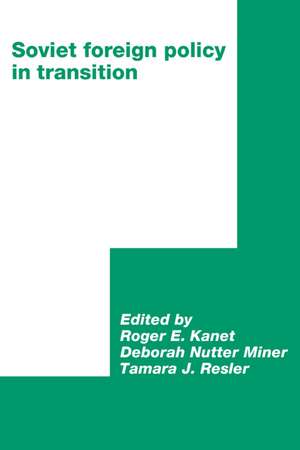
Soviet Foreign Policy in Transition
Editat de Roger E. Kanet, Deborah Nutter Miner, Tamara J. Resleren Limba Engleză Paperback – mar 2008
Preț: 286.49 lei
Puncte Express: 430
Carte tipărită la comandă
Livrare economică 30 noiembrie-14 decembrie
Livrare prin curier în România Termenul estimat este afișat lângă disponibilitate.
Transport gratuit de la 400.00 lei Plată online sau ramburs, în funcție de opțiunile comenzii.
Retur gratuit în 14 zile Comandă securizată și suport în română.
Specificații
ISBN-13: 9780521063418
ISBN-10: 0521063418
Pagini: 328
Dimensiuni: 152 x 229 x 19 mm
Greutate: 0.53 kg
Editura: Cambridge University Press
Locul publicării:Cambridge, United Kingdom
ISBN-10: 0521063418
Pagini: 328
Dimensiuni: 152 x 229 x 19 mm
Greutate: 0.53 kg
Editura: Cambridge University Press
Locul publicării:Cambridge, United Kingdom
V-ar putea interesa
-
 Hegemony or SurvivalNoam Chomsky-19%Preț: 62.95 lei77.82 lei
 -
 Failed StatesNoam Chomsky-26%Preț: 62.72 lei84.58 lei
 -
 Imperial AmbitionsNoam ChomskyPreț: 114.24 lei
 -
 Fairness in International Law and InstitutionsThomas M. Franck-28%Preț: 536.65 lei746.12 lei
 -
 Central and Eastern Europe: The Challenge of TransitionRegina Cowen Karp-20%Preț: 308.41 lei383.57 lei
 -
 Conceiving Cosmopolitanism: Theory, Context, and PracticeSteven Vertovec-31%Preț: 557.33 lei807.64 lei
 -
 The Global Covenant: Human Conduct in a World of StatesRobert Jackson-28%Preț: 398.73 lei551.27 lei
 -
 Preț: 134.08 lei
 -
 Moral Movements and Foreign PolicyJoshua W. BusbyPreț: 303.95 lei
 -
 Deadlocks in Multilateral NegotiationsAmrita NarlikarPreț: 290.80 lei
 -
 Problem Representation in Foreign Policy Decision MakingDonald A. SylvanPreț: 294.67 lei
 -
 The Retreat of the StateSusan StrangePreț: 210.73 lei
 -
 The Right War?Gary RosenPreț: 231.81 lei
 -
 Understanding Foreign Policy Decision MakingAlex MintzPreț: 347.63 lei
 -
 From War to DemocracyAnna K. JarstadPreț: 289.29 lei
 -
 After BushTimothy J. LynchPreț: 333.26 lei
 -
 Machiavelli in BrusselsRinus Van SchendelenPreț: 199.72 lei
Cuprins
List of tables; Preface; Introduction; Part I. The Soviet Union and the International Political System: 1. Soviet reform in international perspective; Part II. The Soviet Union And Europe: 2. The changing Soviet-East European relationship; 3. Soviet-Nordic relations in the era of perestroika and new thinking; 4. Soviet signals to the mordic countries during the Lithuanian crisis of 1990; 5. Neutrality and new thinking; Part III. The Soviet Union and the Developing World: Global Trends: 6. From new thinking to the fragmentation of consensus in Soviet foreign policy: the USSR and the developing world; 7. Soviet new thinking on national liberation movements: continuity and change; Part IV. The Soviet Union and the Developing World: Regional and Country Case Studies: 8. Soviet policy in Central America during the Gorbachev period; 9. The Soviet reassessment of socialist orientation and the African response; 10. Soviet policy in the Middle East: Gorbachev's imprint; 11. The implications of perestroika for the Third World, particularly Asia; 12. The Soviet Union and Indochina; 13. Gorbachev's Southeast Asia policy: new thinking for a new era?; 14. The impact of Gorbachev's new thinking on Soviet policy toward South Korea; Part V. Conclusion: 15. The paradox in new political thinking in Soviet foreign policy; Index.
Descriere
The late twentieth century witnessed remarkable changes in Soviet domestic and foreign policy.