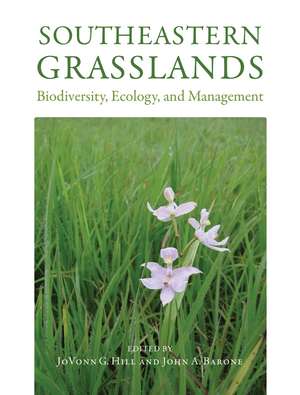
Southeastern Grasslands: Biodiversity, Ecology, and Management
Editat de JoVonn G. Hill, John A. Barone Contribuţii de Charles Allen, Brent T. Baker, Gail Barton, Patrick J. Bohlen, Elizabeth H. Boughton, Bruno Borsari, Edwin L. Bridges, Nicholas Brown, L. Wes Burger, Jr., J. J. N. Campbell, Jolie Goldenetz Dollar, S. Lee Echols, Edward David Entsminger, Thomas L. Foti, Toby Gray, Dr. John W. Guyton, III, Raymond B. Iglay, Jeanne C. Jones, Lisa McInnis, Dr. Reed F. Noss Ph.D., Steve L. Orzell, Marc G. Pastorek, Evan Peacock, Samuel K. Riffell, Jennifer L. Seltzer, W.R. Seymour Jr., Timothy J. Schauwecker, Jason R. Singhurst, Reggie E. Thackston, James W. Tomberlin, J. Morgan Varner, Malcolm F. Vidrine, Matt White, C. Theo Witsell, Wendy B. Zomleferen Limba Engleză Hardback – 6 noi 2018 – vârsta ani
A holistic approach to analyzing distinct grassland habitats that integrates ecological, historical, and archaeological data
Today the southeastern United States is a largely rural, forested, and agricultural landscape interspersed with urban areas of development. However, two centuries ago it contained hundreds of thousands of acres of natural grasslands that stretched from Florida to Texas. Now more than 99 percent of these prairies, glades, and savannas have been plowed up or paved over, lost to agriculture, urban growth, and cattle ranching. The few remaining grassland sites are complex ecosystems, home to hundreds of distinct plant and animal species, and worthy of study.
Southeastern Grasslands: Biodiversity, Ecology, and Management brings together the latest research on southeastern prairie systems and species, provides a complete picture of an increasingly rare biome, and offers solutions to many conservation biology queries. Editors JoVonn G. Hill and John A. Barone have gathered renowned experts in their fields from across the region who address questions related to the diversity, ecology, and management of southeastern grasslands, along with discussions of how to restore sites that have been damaged by human activity.
Over the last twenty years, both researchers and the public have become more interested in the grasslands of the Southeast. This volume builds on the growing knowledge base of these remarkable ecosystems with the goal of increasing appreciation for them and stimulating further study of their biota and ecology. Topics such as the historical distribution of grasslands in the South, the plants and animals that inhabit them, as well as assessments of several techniques used in their conservation and management are covered in-depth. Written with a broad audience in mind, this book will serve as a valuable introduction and reference for nature enthusiasts, scientists, and land managers.
Preț: 423.82 lei
Puncte Express: 636
Carte disponibilă
Livrare economică 10-24 decembrie
Livrare express 26 noiembrie-02 decembrie pentru 103.53 lei
Livrare prin curier în România Termenul estimat este afișat lângă disponibilitate.
Transport gratuit pentru acest produs Plată online sau ramburs, în funcție de opțiunile comenzii.
Retur gratuit în 14 zile Comandă securizată și suport în română.
Specificații
ISBN-13: 9780817319885
ISBN-10: 0817319883
Pagini: 344
Ilustrații: 41 color figures - 38 B&W figures - 18 color maps - 21 B&W maps - 35 tables
Dimensiuni: 222 x 292 x 33 mm
Greutate: 2.0099999999999998 kg
Ediția:First Edition
Editura: University Of Alabama Press
Colecția University Alabama Press
ISBN-10: 0817319883
Pagini: 344
Ilustrații: 41 color figures - 38 B&W figures - 18 color maps - 21 B&W maps - 35 tables
Dimensiuni: 222 x 292 x 33 mm
Greutate: 2.0099999999999998 kg
Ediția:First Edition
Editura: University Of Alabama Press
Colecția University Alabama Press
V-ar putea interesa
-
 A Lakeside CompanionTed J. RulsehPreț: 143.20 lei
-
 -8%Preț: 644.75 lei700.82 lei
-
 -18%Preț: 1431.78 lei1746.07 lei
-
 -18%Preț: 1173.48 lei1431.07 lei
-
 -18%Preț: 1004.66 lei1225.20 lei
-
 Bread for the PeopleDavid Williams-9%Preț: 901.24 lei990.38 lei
-
 Preț: 125.66 lei
-
 Exploring Southeastern ArchaeologyPatricia Galloway-23%Preț: 682.07 lei885.81 lei
-
 -23%Preț: 1325.55 lei1721.50 lei
Notă biografică
JoVonn G. Hill is an assistant research professor with the Mississippi Entomological Museum at Mississippi State University and is currently serving as editor of Transactions of the American Entomological Society. Hill is a founding member of the Black Belt Prairie Restoration Initiative, a flagship project of the U.S. Fish & Wildlife Service’s East Gulf Coastal Plain Joint Venture.
John A. Barone is a professor of biology at Columbus State University in Georgia. He has written several book chapters and has published articles in Castanea, Journal of Tropical Ecology, Biological Conservation, and Annual Review of Ecology and Systematics.
John A. Barone is a professor of biology at Columbus State University in Georgia. He has written several book chapters and has published articles in Castanea, Journal of Tropical Ecology, Biological Conservation, and Annual Review of Ecology and Systematics.
Recenzii
"This book provides valuable information to graduate students, researchers, and faculty teaching advanced courses on prairies and grassland biology and management, particularly in the southeastern US. It should also interest regional naturalists and botanists and natural history museum staff. Recommended.
—CHOICE
“Southeastern Grasslands offers a good representation of the biological significance bestowed upon these systems and the efforts currently underway to restore and maintain them for future generations to know and appreciate.”
—Alfred R. Schotz, botanist and community ecologist with the Alabama Natural Heritage Program (ALNHP) at Auburn University
“An excellent and thorough account, past and present, of the grasslands of the southeastern United States. The information included in this volume will be of interest to anyone studying grasslands, whether in the southeastern United States or elsewhere.”
—Robert H. Mohlenbrock, author of Vascular Flora of Illinois: A Field Guide and This Land: A Guide to Eastern National Forests
—Robert H. Mohlenbrock, author of Vascular Flora of Illinois: A Field Guide and This Land: A Guide to Eastern National Forests
Cuprins
- Preface by JoVonn G. Hill and John A. Barone
- Chapter 1. A Synopsis of Southeastern Blackland Prairies by S. Lee Echols and Wendy B. Zomlefer
- Chapter 2. Historical Distribution of Prairies in Arkansas by John A. Barone
- Chapter 3. The Use of General Land Office Survey Notes to Locate Prairie Patches in the Jackson Prairie Region by Toby Gray and Timothy J. Schauwecker
- Chapter 4. Eastern Texas Prairie Landscapes by Jason R. Singhurst and Matt White
- Chapter 5. Floristics of the Louisiana Cajun and Inland Prairies by Charles Allen
- Chapter 6. The Native Flora of Grasslands and Associated Woodlands in the Grand Prairie Ecoregion of Eastern Arkansas by C. Theo Witsell, Thomas L. Foti, and Brent T. Baker
- Chapter 7. Vegetation and Flora on Lowlands in the Central Black Belt of Mississippi—How Low Did the Original Prairie Go? by J. J. N. Campbell and W. R. Seymour Jr.
- Chapter 8. An Alternative Natural Distribution for Osage Orange, Maclura pomifera, Including the Prairies of the Southeast by Jennifer L. Seltzer
- Chapter 9. Prehistoric Molluscan Faunas of the Mississippi Black Prairie by Evan Peacock
- Chapter 10. The Grasshopper Fauna of Southeastern Grasslands: A Preliminary Investigation by JoVonn G. Hill
- Chapter 11. Encroachment and Persistence of Trees in Southeastern Grasslands by J. Morgan Varner
- Chapter 12. Experimental Removal of Eastern Redcedar to Restore Black Belt Prairie Remnants: Effects on Plant, Ant, and Grasshopper Communities by John A. Barone, JoVonn G. Hill, and Lisa McInnis
- Chapter 13. Conservation and Management of Subtropical Grasslands in South-Central Florida by Elizabeth H. Boughton, Patrick J. Bohlen, Steve L. Orzell, Edwin L. Bridges, and Reed F. Noss
- Chapter 14. Effects of Landscape History on Plant Communities in Semi-natural Grassland Buffers by Jolie G. Dollar, Timothy J. Schauwecker, Samuel K. Riffell, and L. Wes Burger Jr.
- Chapter 15. Ground Cover Assessment of CRP Conservation Practice 36 in Georgia by James W. Tomberlin, Nicholas Brown, and Reggie E. Thackston
- Chapter 16. Forb Community Response to Management of Grassland Buffers by Jolie G. Dollar, Timothy J. Schauwecker, Samuel K. Riffell, and L. Wes Burger Jr.
- Chapter 17. Highway Right-of-Way Mowing Regimens in Northeastern Mississippi: Effects on Native Prairie Plant Species by Edward D. Entsminger, John W. Guyton, Raymond B. Iglay, and Jeanne C. Jones
- Chapter 18. Reconstructing Prehistoric Prairie Habitat Types Using Archaeological Data by Jennifer L. Seltzer and Evan Peacock
- Chapter 19. A Preliminary Study of Learning about Prairie Restoration Ecology: A Comparison between Biology Major and Nonmajor Students by Bruno Borsari and Malcolm F. Vidrine
- Chapter 20. Attempts at Converting a Southern Mississippi Bahia Grass Pasture to Diverse Prairie via Local-Provenance, Source-Certified Seed by Marc G. Pastorek, Malcolm F. Vidrine, Charles Allen, Bruno Borsari, and Gail Barton
- References Cited
- Contributors
- Index
Descriere
A holistic approach to analyzing distinct grassland habitats that integrates ecological, historical, and archaeological data