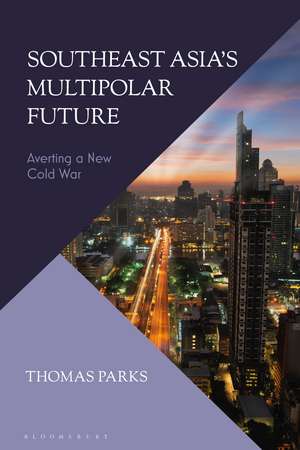
Southeast Asia’s Multipolar Future: Averting a New Cold War
Autor Thomas Parksen Limba Engleză Hardback – 13 iul 2023
This book argues that Southeast Asia is emerging as an open, autonomous region, where small and middle powers can maintain their sovereignty and shape the regional order. Despite new superpower pressures, the region is moving towards a multi-polar order, with greater agency for Southeast Asian countries. The key to Southeast Asia's future may be other external powers - particularly Japan, Australia, India, and Europe - who can provide ASEAN governments with more diverse partnerships, enabling them to avoid the bipolar blocs of superpower rivalries. The book argues that external partners are helping to shape the geopolitical order by supporting ASEAN leadership and diluting the influence of great powers. Southeast Asian countries also have remarkable capacity to manage asymmetrical relations and balance external powers. The book describes the region's history of managing great power relations, drawing on historical and contemporary cases. By examining the dynamics between Southeast Asia and external powers, the book predicts that the region's future will look entirely different from its Cold War past.
Preț: 565.55 lei
Preț vechi: 839.38 lei
-33%
Puncte Express: 848
Carte tipărită la comandă
Livrare economică 03-17 decembrie
Livrare express 29 octombrie-04 noiembrie pentru 116.58 lei
Livrare prin curier în România Termenul estimat este afișat lângă disponibilitate.
Transport gratuit pentru acest produs Plată online sau ramburs, în funcție de opțiunile comenzii.
Retur gratuit în 14 zile Comandă securizată și suport în română.
Specificații
ISBN-13: 9781350270787
ISBN-10: 1350270784
Pagini: 264
Dimensiuni: 156 x 236 x 20 mm
Greutate: 0.56 kg
Editura: Bloomsbury Publishing
Colecția Bloomsbury Academic
Locul publicării:London, United Kingdom
ISBN-10: 1350270784
Pagini: 264
Dimensiuni: 156 x 236 x 20 mm
Greutate: 0.56 kg
Editura: Bloomsbury Publishing
Colecția Bloomsbury Academic
Locul publicării:London, United Kingdom
Cuprins
Acknowledgements
Abbreviations
Introduction: Small and Middle Powers in a Dangerous World
1.Southeast Asia's Emerging Order
2.Unseen Agency
3.ASEAN: Indispensable and Misunderstood
4.The Normative Divide
5.Multipolarity Emerging
6.Diversifying Partners
7.Japan: The Understated Giant
8.Australia: Middle Power Balancing Act
9.India: A Fellow Traveler
10.Europe: Renewed Presence, Uncertain Future
Conclusion: Averting History
Bibliography
Endnotes
Abbreviations
Introduction: Small and Middle Powers in a Dangerous World
1.Southeast Asia's Emerging Order
2.Unseen Agency
3.ASEAN: Indispensable and Misunderstood
4.The Normative Divide
5.Multipolarity Emerging
6.Diversifying Partners
7.Japan: The Understated Giant
8.Australia: Middle Power Balancing Act
9.India: A Fellow Traveler
10.Europe: Renewed Presence, Uncertain Future
Conclusion: Averting History
Bibliography
Endnotes
Recenzii
Should feature not only in the briefing packets of those deployed to the region, but on the desks of their many minders back home.
Southeast Asia's Multipolar Future is meticulously researched and written in a lively and engaging manner. Through numerous interviews and conversations, Tom Parks refreshingly offers a view from Southeast Asia and accurately captures the visions and wishes of the people in the region. He demonstrates that smaller countries can shape their own future even in the midst of great power rivalry. In the process, Parks sees a way forward that does not necessarily end in conflict for the United States, China, and the region.
By reminding us that the middle powers in and around Southeast Asia have an interest in, and an impact on, the trajectory of great power competition in the Indo-Pacific, Thomas Parks fills in spaces too often ignored by policy makers and commentators. This is required reading for everyone with an interest in Asia's future.
Thomas Parks has written an important and timely book, which should be read in all the relevant capitals, especially Beijing and Washington D.C. Parks deftly locates Southeast Asia in the wider context of East Asia, South Asia, and Australasia. The region benefits from multipolarity.
Parks demonstrates Southeast Asia's agency in the unfolding geopolitics of the region, smashing the trope that ASEAN states are just passive victims of great power maneuvering. A must read for scholars and policymakers focused on the Indo-Pacific.
Nuanced and insightful, this book offers an essential corrective to portrayals of Southeast Asian states as pawns on a Sino-American chessboard. Parks instead shows the region to be a bamboo forest: Southeast Asian governments bend to geopolitical winds but remain strongly rooted in defending their interests and autonomy. Parks illuminates how Southeast Asians exercise agency as they alternately engage with and resist external powers to craft a multipolar regional order. Anyone keen to understand international relations in Southeast Asia should read this book.
This is an excellent book that should be read by anyone with a serious interest in Southeast Asia or indeed those interested in the geopolitics of the contemporary world. It is well-written, avoids jargon, and is supported by clear figures, tables, and a guide to abbreviations . The book is recommended without reservation.
Southeast Asia's Multipolar Future is meticulously researched and written in a lively and engaging manner. Through numerous interviews and conversations, Tom Parks refreshingly offers a view from Southeast Asia and accurately captures the visions and wishes of the people in the region. He demonstrates that smaller countries can shape their own future even in the midst of great power rivalry. In the process, Parks sees a way forward that does not necessarily end in conflict for the United States, China, and the region.
By reminding us that the middle powers in and around Southeast Asia have an interest in, and an impact on, the trajectory of great power competition in the Indo-Pacific, Thomas Parks fills in spaces too often ignored by policy makers and commentators. This is required reading for everyone with an interest in Asia's future.
Thomas Parks has written an important and timely book, which should be read in all the relevant capitals, especially Beijing and Washington D.C. Parks deftly locates Southeast Asia in the wider context of East Asia, South Asia, and Australasia. The region benefits from multipolarity.
Parks demonstrates Southeast Asia's agency in the unfolding geopolitics of the region, smashing the trope that ASEAN states are just passive victims of great power maneuvering. A must read for scholars and policymakers focused on the Indo-Pacific.
Nuanced and insightful, this book offers an essential corrective to portrayals of Southeast Asian states as pawns on a Sino-American chessboard. Parks instead shows the region to be a bamboo forest: Southeast Asian governments bend to geopolitical winds but remain strongly rooted in defending their interests and autonomy. Parks illuminates how Southeast Asians exercise agency as they alternately engage with and resist external powers to craft a multipolar regional order. Anyone keen to understand international relations in Southeast Asia should read this book.
This is an excellent book that should be read by anyone with a serious interest in Southeast Asia or indeed those interested in the geopolitics of the contemporary world. It is well-written, avoids jargon, and is supported by clear figures, tables, and a guide to abbreviations . The book is recommended without reservation.