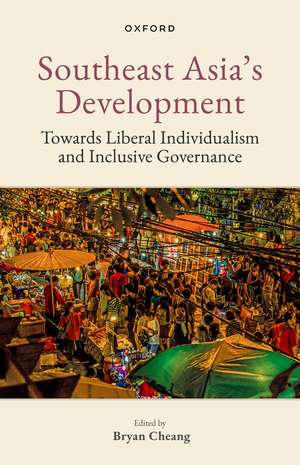
Southeast Asia's Development: Towards Liberal Individualism and Inclusive Governance
Editat de Bryan Cheangen Limba Engleză Hardback – 28 feb 2026
Preț: 819.39 lei
Preț vechi: 1189.33 lei
-31%
Puncte Express: 1229
Carte tipărită la comandă
Livrare economică 20 noiembrie-01 decembrie
Livrare prin curier în România Termenul estimat este afișat lângă disponibilitate.
Transport gratuit pentru acest produs Plată online sau ramburs, în funcție de opțiunile comenzii.
Retur gratuit în 14 zile Comandă securizată și suport în română.
Specificații
ISBN-13: 9780198984177
ISBN-10: 0198984170
Pagini: 430
Dimensiuni: 140 x 28 x 216 mm
Greutate: 0.63 kg
Editura: OUP OXFORD
Colecția OUP Oxford
Locul publicării:Oxford, United Kingdom
ISBN-10: 0198984170
Pagini: 430
Dimensiuni: 140 x 28 x 216 mm
Greutate: 0.63 kg
Editura: OUP OXFORD
Colecția OUP Oxford
Locul publicării:Oxford, United Kingdom
Recenzii
This magisterial volume is a brilliant antidote to the casual triumphalism of most analysis of Southeast Asia. The authors document the violations of political and economic rights in the region with authoritarian governments catering to elites. It suggests the lack of freedom has not only hindered material progress but denied individuals the ability to define for themselves what is really progress.
Any novelty depends on an idea in a human head. The master idea for Southeast Asia, as it was for Britain in 1800, Japan in 1900, and India now, is not the State, but Liberty. Bryan Cheang shows so--elegantly, scientifically, crushingly.
A brilliant collection that explores the role of Smithian liberal political economy in the development history of Southeast Asia. Bryan Cheang is not only one of the best scholars in this field, he also does an outstanding job in this volume of creating space for this important conversation. In the process, we learnt what has hindered development, namely, state interventionism and the entangled relationship between economics and politics, and what can be done to unleash the extraordinary creativity and resourcefulness of ordinary people through a transition to liberal principles of political economy and justice. All students of development and political economy will want to add this title to their must-read list.
This collection provides a unique perspective on Asian development, seeing it through the lens of liberal political economy. Its contributions are written in an engaging and accessible style, ensuring that it will be widely read.
Any novelty depends on an idea in a human head. The master idea for Southeast Asia, as it was for Britain in 1800, Japan in 1900, and India now, is not the State, but Liberty. Bryan Cheang shows so--elegantly, scientifically, crushingly.
A brilliant collection that explores the role of Smithian liberal political economy in the development history of Southeast Asia. Bryan Cheang is not only one of the best scholars in this field, he also does an outstanding job in this volume of creating space for this important conversation. In the process, we learnt what has hindered development, namely, state interventionism and the entangled relationship between economics and politics, and what can be done to unleash the extraordinary creativity and resourcefulness of ordinary people through a transition to liberal principles of political economy and justice. All students of development and political economy will want to add this title to their must-read list.
This collection provides a unique perspective on Asian development, seeing it through the lens of liberal political economy. Its contributions are written in an engaging and accessible style, ensuring that it will be widely read.
Notă biografică
Dr. Bryan Cheang is Director of the Hayek Program and Research Fellow at the London School of Economics, where he teaches courses on the ethics of capitalism, history of economic thought, and public policy. He is also Assistant Director and Senior Fellow at the Centre for the Study of Governance and Society at King's College, London, where he obtained his PhD in Political Economy. He has published various interdisciplinary books and articles exploring the relationships between markets, culture, institutions, and development, with a focus on Asia. He is particularly interested in the challenge of industrial planning under conditions of radical uncertainty and social complexity. He is also a graduate of the National University of Singapore and brings with him policymaking experience from the Singapore civil service.