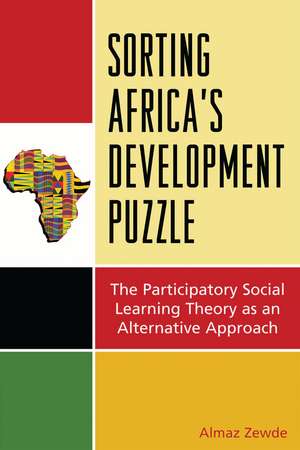
Sorting Africa's Developmental Puzzle: The Participatory Social Learning Theory as an Alternative Approach
Autor Almaz Zewdeen Limba Engleză Paperback – 2 iun 2010
Unlike many newly developed countries and regions, and contrary to the historical experiences of developed countries where ordinary people were full stakeholders and drivers of development, Africa's development has been top-down, expert and capital driven, mechanical, and typically externally designed. Ordinary Africans were made marginal to development.
This approach to Africa's development was devoid of building the people and their institutions as the legitimate means of development. The entrusting of Africa's development to local and international elites to the exclusion of the people from decision-making and full participation, has led to grievous deficits in the formation of human and social capital, and legitimate economic, social, and political institutions for development. The book offers a studied alternative that can positively change Africa's development direction - The Participatory Social Learning Approach. The philosophical, theoretical, historical and heuristic origins of this alternative are offered in detail within this book.
Preț: 349.96 lei
Preț vechi: 484.93 lei
-28%
Puncte Express: 525
Carte tipărită la comandă
Livrare economică 20 noiembrie-04 decembrie
Livrare prin curier în România Termenul estimat este afișat lângă disponibilitate.
Transport gratuit de la 400.00 lei Plată online sau ramburs, în funcție de opțiunile comenzii.
Retur gratuit în 14 zile Comandă securizată și suport în română.
Specificații
ISBN-13: 9780761849070
ISBN-10: 0761849076
Pagini: 262
Dimensiuni: 156 x 235 x 17 mm
Greutate: 0.43 kg
Editura: Bloomsbury Publishing
Colecția University Press of America
Locul publicării:New York, United States
ISBN-10: 0761849076
Pagini: 262
Dimensiuni: 156 x 235 x 17 mm
Greutate: 0.43 kg
Editura: Bloomsbury Publishing
Colecția University Press of America
Locul publicării:New York, United States
Cuprins
Chapter 1 Figures and Tables
Chapter 2 Acronyms
Chapter 3 Preface
Chapter 4 Acknowledgments
Chapter 5 Introduction
Chapter 6 Chapter 1: Selected Development Theories: Some Post-World War II Theoretical Contests
Chapter 7 Chapter 2: The Alternative Development Theory: The Participatory Social Learning Development Theory and Model for Africa
Chapter 8 Chapter 3: The Institutional Imperative: Its Condition in Africa and Implications for Development
Chapter 9 Chapter 4: The Human Resource Imperative
Chapter 10 Chapter 5: The Resource Imperative: Natural and Man-enhanced Resources for Development
Chapter 11 Chapter 6: The Technology Imperative
Chapter 12 Chapter 7: The Investment Capital Imperative
Chapter 13 Chapter 8: Putting Together the Development Puzzle: The Participatory Social Learning Paradigm and the Five Development Imperatives in Practice: Case Studies
Chapter 14 Chapter 9: African Women: The Continent's Undervalued and Overworked Development Assets
Chapter 15 Chapter 10: Looking Ahead: Some Afterthoughts
Chapter 16 References
Chapter 2 Acronyms
Chapter 3 Preface
Chapter 4 Acknowledgments
Chapter 5 Introduction
Chapter 6 Chapter 1: Selected Development Theories: Some Post-World War II Theoretical Contests
Chapter 7 Chapter 2: The Alternative Development Theory: The Participatory Social Learning Development Theory and Model for Africa
Chapter 8 Chapter 3: The Institutional Imperative: Its Condition in Africa and Implications for Development
Chapter 9 Chapter 4: The Human Resource Imperative
Chapter 10 Chapter 5: The Resource Imperative: Natural and Man-enhanced Resources for Development
Chapter 11 Chapter 6: The Technology Imperative
Chapter 12 Chapter 7: The Investment Capital Imperative
Chapter 13 Chapter 8: Putting Together the Development Puzzle: The Participatory Social Learning Paradigm and the Five Development Imperatives in Practice: Case Studies
Chapter 14 Chapter 9: African Women: The Continent's Undervalued and Overworked Development Assets
Chapter 15 Chapter 10: Looking Ahead: Some Afterthoughts
Chapter 16 References