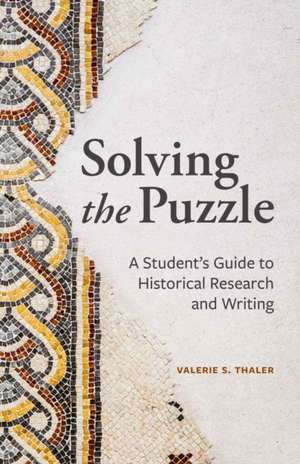
Solving the Puzzle: A Student’s Guide to Historical Research and Writing
Autor Valerie S. Thaleren Limba Engleză Paperback – 23 mai 2025
Preț: 182.68 lei
Preț vechi: 234.32 lei
-22%
Puncte Express: 274
Carte disponibilă
Livrare economică 17 noiembrie-01 decembrie
Livrare prin curier în România Termenul estimat este afișat lângă disponibilitate.
Transport gratuit de la 400.00 lei Plată online sau ramburs, în funcție de opțiunile comenzii.
Retur gratuit în 14 zile Comandă securizată și suport în română.
Specificații
ISBN-13: 9781554812820
ISBN-10: 1554812828
Pagini: 210
Dimensiuni: 140 x 216 x 10 mm
Greutate: 0.25 kg
Editura: BROADVIEW PR
Colecția Broadview Press
Locul publicării:Peterborough, Canada
ISBN-10: 1554812828
Pagini: 210
Dimensiuni: 140 x 216 x 10 mm
Greutate: 0.25 kg
Editura: BROADVIEW PR
Colecția Broadview Press
Locul publicării:Peterborough, Canada
V-ar putea interesa
-
 The Information-Literate HistorianJenny L. PresnellPreț: 480.64 lei
 -
 Why Learn History (When It's Already on Your Phone)Sam WineburgPreț: 167.29 lei
 -
 Preț: 178.73 lei
 -
 The Craft of Research, Fifth EditionWayne C. BoothPreț: 112.29 lei
 -
 Writing Essays for Dummies, UK EditionMary PagePreț: 97.06 lei
 -
 Going to the SourcesAnthony BrundagePreț: 151.53 lei
 -
 Studying HistoryJeremy Black-19%Preț: 184.93 lei227.53 lei
 -
 -9%Preț: 516.76 lei567.86 lei
 -
 Preț: 322.57 lei
 -
 -9%Preț: 113.10 lei124.79 lei
 -
 Writing for UniversityJeanne Godfrey-20%Preț: 59.02 lei73.46 lei
 -
 Preț: 233.16 lei
 -
 Write Great Essays and Dissertations: Teach YourselfHazel Hutchison-26%Preț: 78.91 lei106.99 lei
 -
 -21%Preț: 70.46 lei89.13 lei
 -
 Original Inquiry: A Guide to Research for UndergraduatesMatthew James Vechinski-20%Preț: 255.30 lei320.24 lei
 -
 Writing a Successful Research Paper: A Simple ApproachStanley Chodorow-17%Preț: 95.12 lei114.22 lei
 -
 Preț: 118.16 lei
 -
 I'm No Expert, But ...Kate Moore-17%Preț: 60.04 lei72.49 lei
 -
 Writing History!: A Companion for HistoriansJeannette KampPreț: 158.46 lei
Recenzii
This compact, friendly, and realistic guide provides hands-on help for college and university students new to the discipline of history. Written by an experienced instructor of first-year students, Solving the Puzzle encourages students to do the work of engaging with historical sources in a responsible way—and helps them to build critical thinking and writing skills that will transfer to other courses and contexts. With short, readable chapters covering each stage of the writing process, concrete examples, practical exercises, and an encouraging tone, this book will help students move past anxiety, avoid the temptation to cut corners, and solve the puzzles of historical research and writing.
“Thorough and thoughtful, Solving the Puzzle offers a practical and comprehensive guide for any student assigned to write a college-level history paper. In framing a historical question as a puzzle and clearly laying out the steps involved in crafting a solution—including how to critically evaluate and interpret their sources—this book not only will appeal to students’ innate sense of curiosity but will also help them to develop the critical thinking skills so necessary in enabling them to successfully navigate an increasingly complex and often deeply divided world.” — Andrea Geiger, Simon Fraser University
“Solving the Puzzle is comprehensive without overwhelming the reader. It shows awareness of the issues confronting current historians and addresses fundamentals such as understanding history writing as a process, sifting through the overabundance of information, raising the level of narrative above automative wording, and appreciating the qualitative difference between historian and journalist. The text will train aspiring undergraduates in the craft of historical writing and will serve as a reference work for professional historians as they develop in their careers.” — Nathan Howard, University of Tennessee at Martin
“Solving the Puzzle is a thoughtful and accessible work that will help our discipline’s newcomers harness the historical imagination. With clarity, grace, and humor, Valerie Thaler walks readers through how to take on the seemingly insurmountable challenge of developing an original and manageable research project that meets the conventions of historical practice. As a guide that aims to demystify the research process, Solving the Puzzle will inspire confidence in a new generation of historians.” — Stephan Pigeon, St. Francis Xavier University
“Thorough and thoughtful, Solving the Puzzle offers a practical and comprehensive guide for any student assigned to write a college-level history paper. In framing a historical question as a puzzle and clearly laying out the steps involved in crafting a solution—including how to critically evaluate and interpret their sources—this book not only will appeal to students’ innate sense of curiosity but will also help them to develop the critical thinking skills so necessary in enabling them to successfully navigate an increasingly complex and often deeply divided world.” — Andrea Geiger, Simon Fraser University
“Solving the Puzzle is comprehensive without overwhelming the reader. It shows awareness of the issues confronting current historians and addresses fundamentals such as understanding history writing as a process, sifting through the overabundance of information, raising the level of narrative above automative wording, and appreciating the qualitative difference between historian and journalist. The text will train aspiring undergraduates in the craft of historical writing and will serve as a reference work for professional historians as they develop in their careers.” — Nathan Howard, University of Tennessee at Martin
“Solving the Puzzle is a thoughtful and accessible work that will help our discipline’s newcomers harness the historical imagination. With clarity, grace, and humor, Valerie Thaler walks readers through how to take on the seemingly insurmountable challenge of developing an original and manageable research project that meets the conventions of historical practice. As a guide that aims to demystify the research process, Solving the Puzzle will inspire confidence in a new generation of historians.” — Stephan Pigeon, St. Francis Xavier University
Cuprins
Preface
Acknowledgements
Chapter 1: Don’t Panic!
Index
Acknowledgements
Chapter 1: Don’t Panic!
- Keep the Big Picture in Mind
- How College Papers Differ from High School Papers
- Skills Honed by the Research Process
- What a Research Project Is Not
- How This Book Can Help
- Work Habits Necessary for Writing a College-Level History Paper
- Looking Ahead to the Research Process
- A Word of Encouragement
- What to Do When You Get the Assignment
- Suggestions for Finding a Topic that Interests You
- What Makes a Topic a “Good Choice”?
- Steps to Take Once You Have Selected a General Topic
- Questions to Ask of a Topic
- From General Topic to Narrowed Topic
- From Topic to Question
- The Seven Attributes of a Usable Research Question
- Evaluating Research Questions
- Strategies for Writing and Revising Your Research Question
- Distinguishing between Primary and Secondary Sources
- Primary Sources
- Secondary Sources
- WorldCat
- Finding Sources in Your Library’s Databases
- Evaluating Websites and Avoiding Disinformation
- Qualities of a Good Thesis Statement
- Solving the Puzzle: Research Question, Evidence, and Thesis Statement
- Evaluating Thesis Statements
- Quick Tips for Improving Your Own Thesis Statements
- Why We Acknowledge Other Voices
- Ground Rules for Representing Other Opinions in Your Paper
- Strategies for Introducing Contrary Voices
- Acknowledging Contrary Voices in Practice
- Visual Organizers
- The Purpose of an Outline
- Formatting an Outline
- Guidelines for Writing an Outline
- Reverse Outlines
- Content Conventions
- Style Conventions
- Rules for Writing Papers in the Humanities
- The Reader’s Perspective
- The Title
- The Introduction
- The Body Paragraphs
- The Conclusion
- The Bibliography
- Proofreading
- Fifty Frequently Confused Words
- When to Cite Sources
- CMS vs. MLA and APA
- Why Historians Use Footnotes
- Working with Notes
- The Bibliography
- Note vs. Bibliography Formats
- Note and Bibliography Entry Models
- Use Citation Generators with Care
- When You Should Quote
- Integrating Quotations into Text
- Strategies for Quoting Clearly and Accurately
- Defining Plagiarism
- Why Students Plagiarize
- Forms of Plagiarism
- How Instructors Detect Plagiarism
- Avoiding Plagiarism
- Using Artificial Intelligence
Index