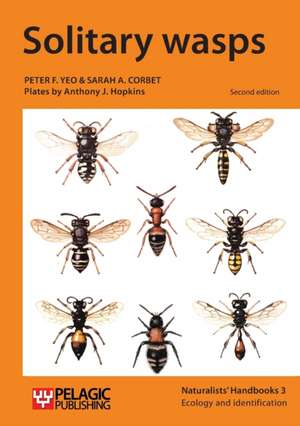
Solitary wasps: Naturalists' Handbooks, cartea 3
Autor Peter F. Yeo, Sarah Corbeten Limba Engleză Paperback – 12 iul 2015
Din seria Naturalists' Handbooks
-
 Preț: 260.62 lei
 -
 Preț: 270.72 lei
 -
 Preț: 210.77 lei
 -
 Preț: 257.90 lei
 -
 Preț: 211.41 lei
 -
 Preț: 203.75 lei
 -
 Preț: 196.01 lei
 -
 Preț: 199.96 lei
 -
 Preț: 229.28 lei
 -
 Preț: 202.44 lei
 -
 Preț: 204.10 lei
 - 15%
 Preț: 139.46 lei
Preț: 196.27 lei
Puncte Express: 294
Carte tipărită la comandă
Livrare economică 24 noiembrie-08 decembrie
Livrare prin curier în România Termenul estimat este afișat lângă disponibilitate.
Transport gratuit de la 400.00 lei Plată online sau ramburs, în funcție de opțiunile comenzii.
Retur gratuit în 14 zile Comandă securizată și suport în română.
Specificații
ISBN-13: 9781784270339
ISBN-10: 1784270334
Pagini: 82
Dimensiuni: 148 x 210 x 6 mm
Greutate: 0.17 kg
Ediția:Reprint
Editura: Pelagic Publishing Ltd
Colecția Naturalists' Handbooks
Seria Naturalists' Handbooks
ISBN-10: 1784270334
Pagini: 82
Dimensiuni: 148 x 210 x 6 mm
Greutate: 0.17 kg
Ediția:Reprint
Editura: Pelagic Publishing Ltd
Colecția Naturalists' Handbooks
Seria Naturalists' Handbooks
V-ar putea interesa
-
 Feathered Dinosaurs: The Origin of BirdsJohn Long-18%Preț: 343.08 lei420.36 lei
 -
 Snake The Essential Visual GuideChris Mattison-14%Preț: 98.09 lei114.31 lei
 -
 Dinosaur PaleobiologyStephen L. Brusatte-19%Preț: 501.05 lei618.59 lei
 -
 Amphibian EvolutionSchoch-8%Preț: 588.18 lei639.33 lei
 -
 The Secret Life of FliesErica Mcalister-16%Preț: 61.78 lei73.47 lei
 -
 The Inside Out of FliesErica McAlister-15%Preț: 64.48 lei75.57 lei
 -
 Tracks and Signs of the Animals and Birds of Britain and EuropeLars-Henrik OlsenPreț: 147.11 lei
 -
 Avian EvolutionGerald Mayr-19%Preț: 547.49 lei675.90 lei
 -
 Cuckoo: Cheating by NatureNick Davies-26%Preț: 69.47 lei93.80 lei
 -
 Moult and Ageing of European PasserinesLukas Jenni-40%Preț: 532.71 lei888.71 lei
 -
 The Biology of Moult in BirdsLukas Jenni-43%Preț: 410.39 lei714.86 lei
 -
 Preț: 461.42 lei
 -
 -28%Preț: 161.15 lei222.82 lei
 -
 -5%Preț: 366.99 lei386.30 lei
 -
 HoverfliesFrancis S. GilbertPreț: 204.10 lei
Descriere
This Naturalists' Handbook aims to attract more people to the study of solitary wasps by describing the ecology, distribution and natural history of these insects, including all relevant research in one convenient volume. Contents include an overview of the natural history of the solitary wasp, guidelines on identification, and advice on techniques and approaches to study. Further reading, a systematic checklist of genera and an alphabetical checklist of species and their distributions are included. Detailed keys to the identification of the species form the centre of the book and the text is accompanied by clear illustrations throughout, making this an invaluable practical guide for anyone seeking to broaden their knowledge of these fascinating, diverse creatures. Smaller, gentler and less intimidating than the black and yellow social wasps, the solitary wasps are attractive because of their bright colours and their fascinating behaviour. A female wasp will construct a nest, excavating it from wood or sand or building it from mud. She provisions the nest with prey, hunting down a suitable creature, perhaps a caterpillar or a fly, which she will paralyse before dragging it home to the nest. She lays her egg on the paralysed prey, and the larva when it hatches feeds on the prey. On a sunny day it is easy to observe the apparently purposeful behaviour of female wasps as they prepare their nests and stock them with food for the next generation. This book is a digital reprint of ISBN 0-85546-295-7 (1995). Naturalists' Handbooks encourage and enable those interested in natural history to undertake field study, make accurate identifications and to make original contributions to research.