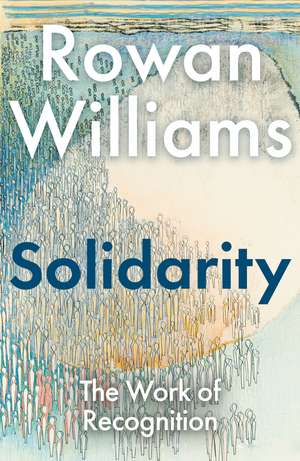
Solidarity: The Work of Recognition
Autor The Rt Hon Rowan Williamsen Limba Engleză Hardback – 26 mar 2026
From its use as a rallying cry by the labour movement to its central place in struggles for racial justice, the idea of solidarity is often invoked as the answer to inequality and conflict. And yet, as both a term and a practice, solidarity is tantalizingly slippery. We are encouraged to 'show solidarity', but how can we truly realize it?
As Rowan Williams argues in this impassioned book, solidarity is not something fixed to be achieved, but a process of mutual recognition. From its origins in the French Revolution to the Nueva Solidaridad in Mexico City and the Solidarnosc movement in Poland, Williams traces solidarity's myriad forms through its deep influence on Catholic social thought, its transformation in the hands of thinkers like Dietrich Bonhoeffer and Jan Patocka and the creative struggle so central to the writings of Gillian Rose.
He reveals solidarity to be a constant exercise in self-scrutiny and dialogue in which we find that true recognition lies not in asserting that others are 'just like us,' but rather in affirming their claim to be 'fully themselves'. It is in this work of recognition, this possibility of communion, that true hope can be found.
Preț: 111.78 lei
Preț vechi: 145.39 lei
-23%
Puncte Express: 168
Carte disponibilă
Livrare economică 16-30 noiembrie
Livrare express 30 octombrie-05 noiembrie pentru 71.65 lei
Livrare prin curier în România Termenul estimat este afișat lângă disponibilitate.
Transport gratuit de la 400.00 lei Plată online sau ramburs, în funcție de opțiunile comenzii.
Retur gratuit în 14 zile Comandă securizată și suport în română.
Specificații
ISBN-13: 9781399431514
ISBN-10: 139943151X
Pagini: 304
Dimensiuni: 156 x 236 x 34 mm
Greutate: 0.6 kg
Editura: Bloomsbury Publishing
Colecția Bloomsbury Continuum
Locul publicării:London, United Kingdom
ISBN-10: 139943151X
Pagini: 304
Dimensiuni: 156 x 236 x 34 mm
Greutate: 0.6 kg
Editura: Bloomsbury Publishing
Colecția Bloomsbury Continuum
Locul publicării:London, United Kingdom
V-ar putea interesa
-
 The Virtue of SolidarityAndrea Sangiovanni-20%Preț: 177.98 lei223.52 lei
 -
 -32%Preț: 591.35 lei869.86 lei
 -
 -25%Preț: 118.15 lei158.40 lei
 -
 Friends in Common: Radical Friendship and Everyday SolidaritiesLaura C. ForsterPreț: 134.92 lei
 -
 Global SolidarityLawrence Wilde-15%Preț: 215.30 lei253.47 lei
 -
 -21%Preț: 65.90 lei83.23 lei
 -
 -28%Preț: 55.26 lei76.37 lei
 -
 Preț: 188.30 lei
 -
 Solidarity Between SpeciesFrédéric KeckPreț: 167.77 lei
 -
 Empathy and ResistanceKristina LunzPreț: 109.62 lei
 -
 -26%Preț: 201.02 lei272.47 lei
 -
 Preț: 203.09 lei
 -
 Lean on MeLynne SegalPreț: 138.77 lei
 -
 Loving Correctionsadrienne maree brownPreț: 100.30 lei
 -
 The Fantasy and Necessity of SolidaritySarah Schulman-18%Preț: 76.77 lei93.93 lei
 -
 On SolidarityMie Inouye Et AlPreț: 112.63 lei
 -
 Their Borders, Our WorldMahdi SabbaghPreț: 132.51 lei
 -
 No Straight Road Takes You ThereRebecca SolnitPreț: 93.02 lei
 -
 Solidarity with ChildrenMadeline Lane-McKinleyPreț: 99.46 lei
Cuprins
Prologue
Introduction
Chapter 1: Recognizing Strangers: Who Counts as Human?
Chapter 2: Understanding Strangers: Empathy and Its Paradoxes
Chapter 3: The Claims of Strangers: Debating Human Rights
Chapter 4: Solidarity: the Making of a Discourse
Chapter 5: The Solidarity of the Shaken: Jan Patocka and the Care of the Soul
Chapter 6: Solidarity Without Enemies: Jozef Tischner and the Conversation of Human Labour
Chapter 7: Solidarity, Responsibility, Guilt: Dietrich Bonhoeffer's Helplessness
Chapter 8: Solidarity, Co-inherence, Communion
Conclusion
Acknowledgements
Introduction
Chapter 1: Recognizing Strangers: Who Counts as Human?
Chapter 2: Understanding Strangers: Empathy and Its Paradoxes
Chapter 3: The Claims of Strangers: Debating Human Rights
Chapter 4: Solidarity: the Making of a Discourse
Chapter 5: The Solidarity of the Shaken: Jan Patocka and the Care of the Soul
Chapter 6: Solidarity Without Enemies: Jozef Tischner and the Conversation of Human Labour
Chapter 7: Solidarity, Responsibility, Guilt: Dietrich Bonhoeffer's Helplessness
Chapter 8: Solidarity, Co-inherence, Communion
Conclusion
Acknowledgements
Recenzii
A humane and heartening book.
A magisterial vision of true comradeship.
Among the many books that I have read in the past year about the challenge of polarisation, nothing holds a candle to Rowan Williams's recently published Solidarity: The work of recognition.
A treasure trove of wisdom and insight. Its quiet optimism brings, in darkened days, a guiding light which gives the reader hope, despite the encircling gloom, that we might learn to live together with growing understanding, awareness, and a renewed sense of self.
An engaging, convivial book.as important as it is challenging. An abstract book, and all the better for it. Solidarity.badly needed the intellectual rehabilitation it gets here.
[Rowan Williams] sees all angles.Other times he brings you to a point of clarity that makes you see the world differently. Wise and imaginative.
The book reflects with impressive erudition on a range of European philosophers.
With his customary vision and unique form of attention, Rowan Williams... draws on the widest, carefully focussed, range of thinkers, each one illuminating the same dilemma - how to be together on a shared and bitterly contested planet? Rowan Williams has written a guide book and a plea. For anyone struggling with these issues, Solidarity should be indispensable.
Here is classic Rowan Williams. This is a significant work of compassion and wisdom, one that - I dare to guess - will stand out even among the great range of writings that he has produced.
Rowan Williams [offers] a sharp critique of certain aspects of empathy in his brilliant book Solidarity.
In this pioneering book, Williams argues for solidarity as a genuinely new ideal and something that cannot be reduced to some combination of compassion and communalism. It is at once a window on the human condition and justice in action. This is vintage Williams.
Against cynics and opportunists, Rowan Williams compels us to reinvest in our shared existence in the name of a better world and a more just future.
In these torrid days of enmity, war and political delirium, Rowan Williams' meditation on how to work towards a world of solidarity, peace and truthfulness comes as a breath of fresh air. He shows us that solidarity is less a choice than a predicament and that it can be done badly or better, but never perfectly.His eloquent case for a life and thought of human and planetary solidarity calls us to renounce the comforts of innocence and cynicism and to risk submitting ourselves to a work of recognition that will leave us and our world strangely changed.
This is a 'must read' book. Or a 'must discuss' book, in groups informed and led by someone who has read it. It could be a vital and necessary step toward church renewal and Christian unity.
A magisterial vision of true comradeship.
Among the many books that I have read in the past year about the challenge of polarisation, nothing holds a candle to Rowan Williams's recently published Solidarity: The work of recognition.
A treasure trove of wisdom and insight. Its quiet optimism brings, in darkened days, a guiding light which gives the reader hope, despite the encircling gloom, that we might learn to live together with growing understanding, awareness, and a renewed sense of self.
An engaging, convivial book.as important as it is challenging. An abstract book, and all the better for it. Solidarity.badly needed the intellectual rehabilitation it gets here.
[Rowan Williams] sees all angles.Other times he brings you to a point of clarity that makes you see the world differently. Wise and imaginative.
The book reflects with impressive erudition on a range of European philosophers.
With his customary vision and unique form of attention, Rowan Williams... draws on the widest, carefully focussed, range of thinkers, each one illuminating the same dilemma - how to be together on a shared and bitterly contested planet? Rowan Williams has written a guide book and a plea. For anyone struggling with these issues, Solidarity should be indispensable.
Here is classic Rowan Williams. This is a significant work of compassion and wisdom, one that - I dare to guess - will stand out even among the great range of writings that he has produced.
Rowan Williams [offers] a sharp critique of certain aspects of empathy in his brilliant book Solidarity.
In this pioneering book, Williams argues for solidarity as a genuinely new ideal and something that cannot be reduced to some combination of compassion and communalism. It is at once a window on the human condition and justice in action. This is vintage Williams.
Against cynics and opportunists, Rowan Williams compels us to reinvest in our shared existence in the name of a better world and a more just future.
In these torrid days of enmity, war and political delirium, Rowan Williams' meditation on how to work towards a world of solidarity, peace and truthfulness comes as a breath of fresh air. He shows us that solidarity is less a choice than a predicament and that it can be done badly or better, but never perfectly.His eloquent case for a life and thought of human and planetary solidarity calls us to renounce the comforts of innocence and cynicism and to risk submitting ourselves to a work of recognition that will leave us and our world strangely changed.
This is a 'must read' book. Or a 'must discuss' book, in groups informed and led by someone who has read it. It could be a vital and necessary step toward church renewal and Christian unity.
Notă biografică
Rowan Williams is a former Archbishop of Canterbury and was until 2020 Master of Magdalene College at the University of Cambridge. He is the author of many books, including Looking East in Winter, Holy Living, and The Edge of Words, published by Bloomsbury Continuum. He lives in Cardiff and continues to broadcast, preach and lecture internationally. In 2022, he gave the second of the BBC's centenary Reith Lectures. He is contributing writer to The New Statesman.