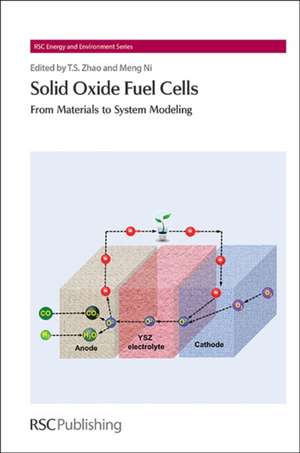
Solid Oxide Fuel Cells
Editat de Meng Ni, Tim S. Zhaoen Limba Engleză Hardback – 27 aug 2013
Relevanța acestui volum pentru cercetătorii și inginerii care vizează acreditări profesionale în domeniul energiilor regenerabile este imediată, oferind o bază teoretică și aplicată solidă pentru dezvoltarea pilelor de combustie cu oxid solid (SOFC). Solid Oxide Fuel Cells, sub coordonarea editorilor Meng Ni și Tim S. Zhao, sintetizează progresele tehnologice recente, punând un accent deosebit pe soluțiile inovatoare pentru limitările actuale ale acestei tehnologii. Observăm o structură riguroasă în 14 capitole care ghidează cititorul de la fundamentul materialelor pentru componentele individuale — electrolit, catod, anod și interconectori — către tehnici avansate de fabricare a electrozilor nanostructurați prin infiltrare și modelări la scară microscopică. Acoperă aceeași arie ca Solid Oxide Fuel Cells Science and Engineering de Kongfa Chen, dar cu o abordare mai orientată către controlul sistemelor dinamice și integrarea cu turbinele de gaz. Apreciem în mod special includerea capitolelor finale care tratează stabilitatea operațională pe termen lung și flexibilitatea combustibilului, elemente critice pentru implementarea comercială. Această ediție de la RSC Publishing reușește să echilibreze rigoarea academică a modelării matematice cu necesitățile practice ale ingineriei sistemelor complexe.
Preț: 1251.36 lei
Preț vechi: 1455.07 lei
-14%
Carte disponibilă
Livrare economică 09-23 noiembrie
Specificații
ISBN-10: 1849736545
Pagini: 523
Dimensiuni: 164 x 236 x 35 mm
Greutate: 0.96 kg
Editura: RSC Publishing
V-ar putea interesa
-
 Fusion: The Energy of the UniverseGarry McCracken-19%Preț: 314.47 lei386.29 lei
 -
 Gas and Oil Reliability Engineering: Modeling and AnalysisEduardo Calixto-29%Preț: 451.33 lei638.16 lei
 -
 -20%Preț: 406.55 lei507.23 lei
 -
 -19%Preț: 519.56 lei645.17 lei
 -
 Before the Lights Go OutMaggie Koerth-BakerPreț: 161.70 lei
 -
 -9%Preț: 721.70 lei793.07 lei
 -
 Gas TreatingDag Eimer-9%Preț: 989.42 lei1087.28 lei
 -
 SuperFuelRichard MartinPreț: 111.64 lei
 -
 -18%Preț: 1113.27 lei1357.65 lei
De ce să citești această carte
Recomandăm această lucrare specialiștilor în energie și studenților la master sau doctorat care au nevoie de o resursă tehnică detaliată despre SOFC. Cititorul câștigă o înțelegere profundă a microstructurii electrozilor și a metodelor de modelare multi-scară. Este un instrument esențial pentru cei care proiectează sisteme energetice hibride sau soluții de cogenerare, oferind date concrete despre stabilitatea și controlul sistemelor în timp real.
Descriere scurtă
Cuprins
Textul de pe ultima copertă
This book presents an overview of the SOFC technology with a focus on the recent developments in new technologies and new ideas for addressing the key issues of SOFC development.
This book first introduces the fundamental principles of SOFCs and compares SOFC technology with conventional heat engines as well as low temperature fuel cells. Then the latest developments in SOFC R&D are reviewed and future directions are discussed. Key issues related to SOFC performance improvement, long-term stability, mathematical modelling, as well as system integration/control are addressed, including material development, infiltration technique for nano-structured electrode fabrication, focused ion beam scanning electron microscopy (FIB-SEM) technique for microstructure reconstruction, the Lattice Boltzmann Method (LBM) simulation at pore scale, multi-scale modelling, SOFC integration with buildings and other cycles for stationary applications.
"