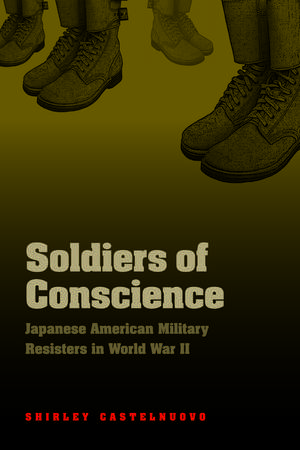
Soldiers of Conscience: Japanese American Military Resisters in World War II
Autor Shirley Castelnuovo Cuvânt înainte de Cedrick Shimoen Limba Engleză Paperback – iun 2010
After Japan’s attack on Pearl Harbor, persons of Japanese ancestry were the victims of frequent racist acts and culturally biased governmental loyalty investigations and, finally, of exclusion and imprisonment. The majority of Japanese Americans complied with government actions during this period, including the drafting of Japanese Americans into military service. However, some two hundred Japanese Americans drafted into the army refused to serve in combat while their families languished in internment camps.
The history of Japanese Americans in World War II does not record the stories of these resisters. It does not mention the War Department Special Organization, to which many of them were transferred, or the individuals who were tried and sentenced by military courts to long prison terms. The two hundred conscientious military resisters felt betrayed by the government and viewed the decision to imprison Japanese Americans as an immoral acquiescence to West Coast racism.
Here, for the first time, the resisters’ story is related in vivid detail. Shirley Castelnuovo follows many of the resisters into the postwar years, assessing the ramifications of their actions on their lives as individuals and within the broader context of the Japanese American community.
Preț: 107.67 lei
Puncte Express: 162
Carte disponibilă
Livrare economică 17 noiembrie-01 decembrie
Livrare prin curier în România Termenul estimat este afișat lângă disponibilitate.
Transport gratuit de la 400.00 lei Plată online sau ramburs, în funcție de opțiunile comenzii.
Retur gratuit în 14 zile Comandă securizată și suport în română.
Specificații
ISBN-13: 9780803232884
ISBN-10: 0803232888
Pagini: 200
Ilustrații: 19 illustrations
Dimensiuni: 152 x 229 x 15 mm
Greutate: 0.27 kg
Editura: BISON BOOKS
Colecția Bison Books
Locul publicării:United States
ISBN-10: 0803232888
Pagini: 200
Ilustrații: 19 illustrations
Dimensiuni: 152 x 229 x 15 mm
Greutate: 0.27 kg
Editura: BISON BOOKS
Colecția Bison Books
Locul publicării:United States
V-ar putea interesa
-
 The Next MoonAndre HuePreț: 111.73 lei
 -
 YaltaS. M. PlokhyPreț: 82.20 lei
 -
 -28%Preț: 407.17 lei567.07 lei
 -
 Model Nazi: Arthur Greiser and the Occupation of Western PolandCatherine Epstein-9%Preț: 379.79 lei417.13 lei
 -
 Hitler's GaulsJonathan TriggPreț: 105.07 lei
 -
 D-Day Beach ForceDavid RogersPreț: 131.61 lei
 -
 Tobruk 1941: Fortress at the Edge of the WorldPier Paolo BattistelliPreț: 70.46 lei
 -
 Preț: 316.97 lei
 -
 Other Clay: A Remembrance of the World War II InfantryCharles R. CawthonPreț: 102.20 lei
 -
 Best Little Stories from World War IIC Brian KellyPreț: 137.96 lei
 -
 Man Called IntrepidWilliam StevensonPreț: 155.70 lei
 -
 Monty's Iron SidesPatrick DelaforcePreț: 132.87 lei
Notă biografică
Shirley Castelnuovo is professor emerita of political science at Northeastern Illinois University, Chicago. Cedrick Shimo is a second-generation Japanese American who enlisted in the U.S. Army and served in the 1800th Engineering General Service Battalion during World War II. He became vice president of the export division of Honda until his retirement.
Cuprins
Foreword by Cedrick Shimo
Preface
Acknowledgments
A Note on Terminology and Names
Introduction
Chapter 1: The Presumption of Disloyalty
Chapter 2: The Pre-Detention Inductees: Individual Conscientious Resistance
Chapter 3: The Fort McClellan Conscientious Resisters
Chapter 4: The Response to Fort McClellan
Chapter 5: Renunciation / Repatriation in the Military
Chapter 6: Company of the Damned
Chapter 7: Renunciation / Repatriation at Fort Meade
Chapter 8: Partial Vindication
Chapter 9: The Conscientious Resisters and the Japanese American Community
Chapter 10: Military Service and the Right of Conscience
Notes
Index
Recenzii
“Do U.S. military personnel have the right to resist orders if these violate domestic or international law? This passionate and scholarly account of Japanese American soldiers during World War II both stuns and compels. Castelnuovo assesses a hidden chapter in American history and asks: are we mistaken to ignore ‘Objectors of Conscience’ in the U.S. Armed Forces?”—Lane Ryo Hirabayashi, George and Sakaye Aratani Professor of the Japanese American Internment, Redress & Community, University of California at Los Angeles
Descriere
Descriere de la o altă ediție sau format:
Japan's attack on Pearl Harbor unleashed rampant racism and distrust towards all things alien, and it raised perplexing questions of national identity that still reverberate. Persons of Japanese ancestry were the victims of racist acts and governmental loyalty investigations, and, finally, of exclusion and imprisonment. The majority of Japanese Americans complied with government actions, including the drafting of Japanese Americans into military service, often viewing such service as an opportunity to display their allegiance to the United States. However, some 200 Japanese Americans drafted into the Army refused to serve in combat while their families languished in internment camps. Here, for the first time, the resisters' story is told in vivid detail, following many of them into the post-war years and assessing the ramifications of their actions on their lives.
The history of Japanese Americans in World War II does not record the stories of these resisters. It does not mention the War Department Special Organization to which many of them were transferred or the individuals who were tried and sentenced by military courts to long prison terms. The 200 conscientious military resisters felt betrayed by the government and viewed the decision to imprison Japanese Americans as an immoral acquiescence to West Coast racism.
Castelnuovo does not abandon the narrative with the end of World War II. Instead, she follows many of the resisters into the post-war years, assessing the ramifications of their actions on their lives as individuals and within the broader context of the Japanese American community. Happily, most of the resisters were eventually re-embraced by their community, but, until now, they have been forgotten by students of World War II. That is an oversight Soldiers of Conscience will certainly remedy.
Japan's attack on Pearl Harbor unleashed rampant racism and distrust towards all things alien, and it raised perplexing questions of national identity that still reverberate. Persons of Japanese ancestry were the victims of racist acts and governmental loyalty investigations, and, finally, of exclusion and imprisonment. The majority of Japanese Americans complied with government actions, including the drafting of Japanese Americans into military service, often viewing such service as an opportunity to display their allegiance to the United States. However, some 200 Japanese Americans drafted into the Army refused to serve in combat while their families languished in internment camps. Here, for the first time, the resisters' story is told in vivid detail, following many of them into the post-war years and assessing the ramifications of their actions on their lives.
The history of Japanese Americans in World War II does not record the stories of these resisters. It does not mention the War Department Special Organization to which many of them were transferred or the individuals who were tried and sentenced by military courts to long prison terms. The 200 conscientious military resisters felt betrayed by the government and viewed the decision to imprison Japanese Americans as an immoral acquiescence to West Coast racism.
Castelnuovo does not abandon the narrative with the end of World War II. Instead, she follows many of the resisters into the post-war years, assessing the ramifications of their actions on their lives as individuals and within the broader context of the Japanese American community. Happily, most of the resisters were eventually re-embraced by their community, but, until now, they have been forgotten by students of World War II. That is an oversight Soldiers of Conscience will certainly remedy.