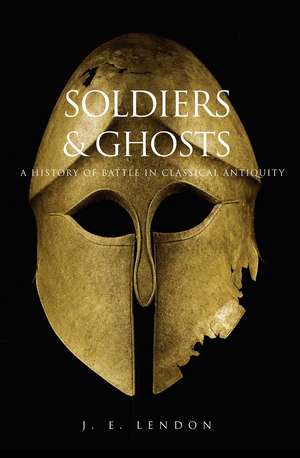
Soldiers and Ghosts: A History of Battle in Classical Antiquity
Autor J. E. Lendonen Limba Engleză Paperback – 22 aug 2006
A major new history of battle in the ancient world, from the age of Homer through the decline of the Roman empire
What set the successful armies of Sparta, Macedon, and Rome apart from those they defeated? In this major new history of battle from the age of Homer through the decline of the Roman empire, J. E. Lendon surveys a millennium of warfare to discover how militaries change—and don’t change—and how an army’s greatness depends on its use of the past.
Noting this was an age that witnessed few technological advances, J. E. Lendon shows us that the most successful armies were those that made the most effective use of cultural tradition. Ancient combat moved forward by looking backward for inspiration—the Greeks, to Homer; the Romans, to the Greeks and to their own heroic past. The best ancient armies recruited soldiers from societies with strong competitive traditions; and the best ancient leaders, from Alexander to Julius Caesar, called upon those traditions to encourage ferocious competition at every rank.
Ranging from the Battle of Champions between Sparta and Argos in 550 B.C. through Julian’s invasion of Persia in A.D. 363, Soldiers and Ghosts brings to life the most decisive military contests of ancient Greece and Rome. Lendon places these battles, and the methods by which they were fought, in a sweeping narrative of ancient military history. On every battlefield, living soldiers fought alongside the ghosts of tradition—ghosts that would inspire greatness for almost a millennium before ultimately coming to stifle it.
What set the successful armies of Sparta, Macedon, and Rome apart from those they defeated? In this major new history of battle from the age of Homer through the decline of the Roman empire, J. E. Lendon surveys a millennium of warfare to discover how militaries change—and don’t change—and how an army’s greatness depends on its use of the past.
Noting this was an age that witnessed few technological advances, J. E. Lendon shows us that the most successful armies were those that made the most effective use of cultural tradition. Ancient combat moved forward by looking backward for inspiration—the Greeks, to Homer; the Romans, to the Greeks and to their own heroic past. The best ancient armies recruited soldiers from societies with strong competitive traditions; and the best ancient leaders, from Alexander to Julius Caesar, called upon those traditions to encourage ferocious competition at every rank.
Ranging from the Battle of Champions between Sparta and Argos in 550 B.C. through Julian’s invasion of Persia in A.D. 363, Soldiers and Ghosts brings to life the most decisive military contests of ancient Greece and Rome. Lendon places these battles, and the methods by which they were fought, in a sweeping narrative of ancient military history. On every battlefield, living soldiers fought alongside the ghosts of tradition—ghosts that would inspire greatness for almost a millennium before ultimately coming to stifle it.
Preț: 178.90 lei
Puncte Express: 268
Carte disponibilă
Livrare economică 16-30 noiembrie
Livrare express 31 octombrie-06 noiembrie pentru 37.75 lei
Livrare prin curier în România Termenul estimat este afișat lângă disponibilitate.
Transport gratuit de la 400.00 lei Plată online sau ramburs, în funcție de opțiunile comenzii.
Retur gratuit în 14 zile Comandă securizată și suport în română.
Specificații
ISBN-13: 9780300119794
ISBN-10: 0300119798
Pagini: 480
Dimensiuni: 156 x 235 x 31 mm
Greutate: 0.64 kg
Editura: Yale University Press
Colecția Yale University Press
ISBN-10: 0300119798
Pagini: 480
Dimensiuni: 156 x 235 x 31 mm
Greutate: 0.64 kg
Editura: Yale University Press
Colecția Yale University Press
V-ar putea interesa
-
 -27%Preț: 547.85 lei755.33 lei
 -
 The DruzeRobert Brenton BettsPreț: 212.34 lei
 -
 Preț: 477.08 lei
 -
 Thailand: A Short History; Second EditionDavid K. WyattPreț: 386.44 lei
 -
 Rome and the African Church in the Time of AugustineJ. E. MerdingerPreț: 300.00 lei
 -
 The Degaev Affair: Terror and Treason in Tsarist RussiaRichard PipesPreț: 208.66 lei
 -
 High Tea on the Cunard QueensPaul CurtisPreț: 129.98 lei
 -
 BedlamPaul Chambers-10%Preț: 85.31 lei94.83 lei
 -
 The Permaculture HandbookPeter BanePreț: 325.21 lei
 -
 Keeping Bees with a SmileFedor LazutinPreț: 215.16 lei
 -
 Memoirs of Lieut. General Scott - Vol. II: Its Organization and AdministrationScott Lieut. -GeneralPreț: 244.46 lei
 -
 The Man Who Discovered AntarcticaSheila Bransfield MAPreț: 190.94 lei
 -
 The Secret History of the Roman Roads of BritainM. C. BishopPreț: 109.02 lei
 -
 The Strength of the WolfDouglas ValentinePreț: 139.94 lei
 -
 -11%Preț: 109.28 lei122.62 lei
 -
 Entdeckt, erdacht, erfundenTeresa NentwigPreț: 141.31 lei
Recenzii
“Brilliantly analyzed.”—William Grimes, New York Times
“Soldiers and Ghosts, like any ghost story should be, is fast-paced, cunningly constructed and supplied with an eerie final twist. And it deserves to be read far beyond the confines of university classics departments, because its theme is a universal one: the impulse that drives men to go to war.”—Tom Holland, Sunday Telegraph
“A classical scholar displays formidable scholarship . . . in this history of combat in the classical world from the Iliad to the fall of Rome. . . . Witty, erudite, and painstaking.”—Publishers Weekly
“Soldiers and Ghosts stimulates the reader and has many interesting insights. I particularly like the bibliographic notes pointing to further research.”—Matthew Trundle, Ancient History
“Lendon . . . has written a major reinterpretation of classical warfare. . . . A major and welcome addition to the literature.”—Parameters
“This book is doubly rewarding: specific historical detail, frequently linked to the prose and poetry of the era, ensure that readers get a high-level education in both military history and literature.”—Peter Skinner, Foreword Magazine
“Interesting food for thought regarding motivations for the ancient Greek and Roman soldiers and their commanders.”—Steven E. Sidebotham, Journal of Military History
“Soldiers & Ghosts is an excellent starting point for readers interested in the military histories of Greece and Rome.”—Nicholas E. Efstathiou, Military History
“The book provides an excellent survey of the military history of the Graeco-Roman world and the rise and fall of several empires."—New York Military Affairs Symposium Review
“The book is a laudable attempt to bring the fruits of Lendon’s scholarship to a much wider audience than the usual consumers of academic monographs.”—Nathan Rosenstein, New England Classical Journal
“J. E. Lendon offers an entertaining analysis of the evolution of ancient warfare in Soldiers and Ghosts.”—Archaeology
“Lendon situates battle firmly within its political, social, and economic environment. . . . The book is replete with insights, amply illustrated by examples. From the perspective of his enlightening ideological and motivational paradigms, Lendon conducts a useful review of the standard great campaigns of antiquity: Peloponnesian and Persian Wars, Alexander’s campaigns, wars of the Diocachi, Punic Wars, Julius Caesar in Gaul and the Civil War, and Trajan’s campaigns, along with much in between as well as a few conflicts that are relatively untouched in military histories. His survey of the litany of ‘great battles of antiquity’ is infused with his own novel and challenging interpretations and insights.”—James J. Bloom, H-Net Reviews
“Soldiers and Ghosts is an elegant inversion of the argument for a distinctive ‘Western way of war’ based on the idea of progress. . . . This important book is a reminder that surface similarities can conceal profoundly, essentially different matrices, and that by extension, surface differences may be mere bumper stickers concealing common underlying values and desires.”—Dennis Showalter, The Weekly Standard
“The specialist will be glad to note that Lendon does not shy away either from contradictions (real or perceived) in the evidence or scholarly controversies. . . . The interested lay reader or undergraduate student will benefit from the numerous maps and illustrations, and the useful chronological outline and glossary. Last but not least, this book is a pleasure to read, eloquently written with an eye to evocative imagery and vividness of narrative detail.”—Frances Pownall, The Classical Outlook
"It is the mark of a quality book that it gets the reader thinking and examining different angles, and Soldiers & Ghosts does that in spades. It would make an excellent addition to an undergraduate or graduate reading list, since it is accessible and clear, and its provocative thesis is likely to spark discussion."—Garrett Fagan, Mouseion
“Soldiers and Ghosts, with its analysis of military combat in cultural terms, has much to recommend it. It is a lively and well-written book that is based on close readings of the classical sources and critical reviews of the secondary literature.”—Barton C. Hacker, Technology and Culture
“[Lendon] offers an interesting analysis of the Homeric cult of the individual warrior in the subsequent age of the hoplite.”—Jeremy Black, History Today
“[The Peloponnesian War] continues to attract astoundingly good historians. [Lendon’s book is] among the very best. . . . [He puts] the fighting he describes and analyses so well into its broadest social context. . . . [His] unconventional narrative and expository strategies . . . [provide] fruitfully wide impact and interest.”—Paul Cartledge, Anglo-Hellenic Review
Runner-up for the Longman-History Today Book of the Year award, 2006
Selected for Association of American University Presses (AAUP) Books for Public and Secondary School Libraries, 2006
“Soldiers and Ghosts offersa wholly original cultural history of Greek and Roman warfare. The book is hugely impressive in scope and ambition, often brilliant in interpretation, elegantly constructed and wonderfully written.”—Hans van Wees, University College, London, author of Greek Warfare: Myths and Realities
“This fascinating book is an eloquent reminder that ideals matter even more than technology in war, then and now. Athenian and Spartan generals, and Alexander in Asia fought their battles with Homer’s Iliad in mind, mindful of the enduring Greek values of rivalry and cleverness. But (as Lendon encourages us to wonder) if Roman leaders had not continued this tradition of individual distinction, would fewer soldiers have died, and would the Roman Empire have been able to withstand the forces that eventually destroyed it?”—Mary Lefkowitz, Wellesley College
“Soldiers and Ghosts is a stunningly original contribution to our understanding of ancient warfare, written with great style and verve. It is one of those rare books that powerfully challenges received opinion and demands attention. At the same time, it is a wonderful read that should hold appeal for any layman with an interest in the Greeks and Romans or simply in the history of warfare.”—Donald Kagan, author of The Peloponnesian War
“Soldiers and Ghosts, like any ghost story should be, is fast-paced, cunningly constructed and supplied with an eerie final twist. And it deserves to be read far beyond the confines of university classics departments, because its theme is a universal one: the impulse that drives men to go to war.”—Tom Holland, Sunday Telegraph
“A classical scholar displays formidable scholarship . . . in this history of combat in the classical world from the Iliad to the fall of Rome. . . . Witty, erudite, and painstaking.”—Publishers Weekly
“Soldiers and Ghosts stimulates the reader and has many interesting insights. I particularly like the bibliographic notes pointing to further research.”—Matthew Trundle, Ancient History
“Lendon . . . has written a major reinterpretation of classical warfare. . . . A major and welcome addition to the literature.”—Parameters
“This book is doubly rewarding: specific historical detail, frequently linked to the prose and poetry of the era, ensure that readers get a high-level education in both military history and literature.”—Peter Skinner, Foreword Magazine
“Interesting food for thought regarding motivations for the ancient Greek and Roman soldiers and their commanders.”—Steven E. Sidebotham, Journal of Military History
“Soldiers & Ghosts is an excellent starting point for readers interested in the military histories of Greece and Rome.”—Nicholas E. Efstathiou, Military History
“The book provides an excellent survey of the military history of the Graeco-Roman world and the rise and fall of several empires."—New York Military Affairs Symposium Review
“The book is a laudable attempt to bring the fruits of Lendon’s scholarship to a much wider audience than the usual consumers of academic monographs.”—Nathan Rosenstein, New England Classical Journal
“J. E. Lendon offers an entertaining analysis of the evolution of ancient warfare in Soldiers and Ghosts.”—Archaeology
“Lendon situates battle firmly within its political, social, and economic environment. . . . The book is replete with insights, amply illustrated by examples. From the perspective of his enlightening ideological and motivational paradigms, Lendon conducts a useful review of the standard great campaigns of antiquity: Peloponnesian and Persian Wars, Alexander’s campaigns, wars of the Diocachi, Punic Wars, Julius Caesar in Gaul and the Civil War, and Trajan’s campaigns, along with much in between as well as a few conflicts that are relatively untouched in military histories. His survey of the litany of ‘great battles of antiquity’ is infused with his own novel and challenging interpretations and insights.”—James J. Bloom, H-Net Reviews
“Soldiers and Ghosts is an elegant inversion of the argument for a distinctive ‘Western way of war’ based on the idea of progress. . . . This important book is a reminder that surface similarities can conceal profoundly, essentially different matrices, and that by extension, surface differences may be mere bumper stickers concealing common underlying values and desires.”—Dennis Showalter, The Weekly Standard
“The specialist will be glad to note that Lendon does not shy away either from contradictions (real or perceived) in the evidence or scholarly controversies. . . . The interested lay reader or undergraduate student will benefit from the numerous maps and illustrations, and the useful chronological outline and glossary. Last but not least, this book is a pleasure to read, eloquently written with an eye to evocative imagery and vividness of narrative detail.”—Frances Pownall, The Classical Outlook
"It is the mark of a quality book that it gets the reader thinking and examining different angles, and Soldiers & Ghosts does that in spades. It would make an excellent addition to an undergraduate or graduate reading list, since it is accessible and clear, and its provocative thesis is likely to spark discussion."—Garrett Fagan, Mouseion
“Soldiers and Ghosts, with its analysis of military combat in cultural terms, has much to recommend it. It is a lively and well-written book that is based on close readings of the classical sources and critical reviews of the secondary literature.”—Barton C. Hacker, Technology and Culture
“[Lendon] offers an interesting analysis of the Homeric cult of the individual warrior in the subsequent age of the hoplite.”—Jeremy Black, History Today
“[The Peloponnesian War] continues to attract astoundingly good historians. [Lendon’s book is] among the very best. . . . [He puts] the fighting he describes and analyses so well into its broadest social context. . . . [His] unconventional narrative and expository strategies . . . [provide] fruitfully wide impact and interest.”—Paul Cartledge, Anglo-Hellenic Review
Runner-up for the Longman-History Today Book of the Year award, 2006
Selected for Association of American University Presses (AAUP) Books for Public and Secondary School Libraries, 2006
“Soldiers and Ghosts offersa wholly original cultural history of Greek and Roman warfare. The book is hugely impressive in scope and ambition, often brilliant in interpretation, elegantly constructed and wonderfully written.”—Hans van Wees, University College, London, author of Greek Warfare: Myths and Realities
“This fascinating book is an eloquent reminder that ideals matter even more than technology in war, then and now. Athenian and Spartan generals, and Alexander in Asia fought their battles with Homer’s Iliad in mind, mindful of the enduring Greek values of rivalry and cleverness. But (as Lendon encourages us to wonder) if Roman leaders had not continued this tradition of individual distinction, would fewer soldiers have died, and would the Roman Empire have been able to withstand the forces that eventually destroyed it?”—Mary Lefkowitz, Wellesley College
“Soldiers and Ghosts is a stunningly original contribution to our understanding of ancient warfare, written with great style and verve. It is one of those rare books that powerfully challenges received opinion and demands attention. At the same time, it is a wonderful read that should hold appeal for any layman with an interest in the Greeks and Romans or simply in the history of warfare.”—Donald Kagan, author of The Peloponnesian War
Notă biografică
J. E. Lendon teaches history at the University of Virginia. He is the author of Empire of Honour: The Art of Government in the Roman World.