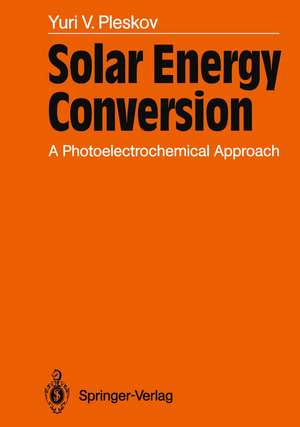
Solar Energy Conversion
Autor Yuri V. Pleskov Traducere de Prem K. Dangen Limba Engleză Paperback – 22 noi 2011
Preț: 370.57 lei
Puncte Express: 556
Carte tipărită la comandă
Livrare economică 26 noiembrie-10 decembrie
Livrare prin curier în România Termenul estimat este afișat lângă disponibilitate.
Transport gratuit de la 400.00 lei Plată online sau ramburs, în funcție de opțiunile comenzii.
Retur gratuit în 14 zile Comandă securizată și suport în română.
Specificații
ISBN-13: 9783642749605
ISBN-10: 3642749607
Pagini: 176
Ilustrații: X, 163 p.
Dimensiuni: 170 x 242 x 10 mm
Greutate: 0.31 kg
Ediția:Softcover reprint of the original 1st edition 1990
Editura: Springer
Locul publicării:Berlin, Heidelberg, Germany
ISBN-10: 3642749607
Pagini: 176
Ilustrații: X, 163 p.
Dimensiuni: 170 x 242 x 10 mm
Greutate: 0.31 kg
Ediția:Softcover reprint of the original 1st edition 1990
Editura: Springer
Locul publicării:Berlin, Heidelberg, Germany
V-ar putea interesa
-
 Preț: 228.55 lei
 -
 -23%Preț: 674.86 lei876.44 lei
 -
 -18%Preț: 1000.32 lei1219.90 lei
 -
 Electrochemistry of SemiconductorsViktor Alekseevich MiamlinPreț: 385.84 lei
 -
 Communication Challenges and Solutions in the Smart GridFayҫal Bouhafs-20%Preț: 310.87 lei388.59 lei
 -
 Elektrische MaschinenRudolf Richter-15%Preț: 529.28 lei622.69 lei
 -
 -18%Preț: 696.00 lei848.78 lei
 -
 -23%Preț: 818.81 lei1063.39 lei
 -
 Induktivitäten in der LeistungselektronikManfred Albach-11%Preț: 637.47 lei716.26 lei
 -
 Preț: 397.35 lei
 -
 FEM bei elektrischen Antrieben 1Bernd AschendorfPreț: 414.29 lei
 -
 Power Electronics and Renewable Energy SystemsC. Kamalakannan-24%Preț: 1903.73 lei2504.90 lei
 -
 Power Electronics and Renewable Energy SystemsC. Kamalakannan-24%Preț: 1799.10 lei2367.24 lei
 -
 Power System Economics: The Nordic Electricity MarketIvar Wangensten-17%Preț: 292.26 lei352.85 lei
 -
 Phasor Power ElectronicsChun T. Rim-18%Preț: 984.91 lei1201.11 lei
 -
 Electronics, Communications and Networks VAmir Hussain-18%Preț: 1274.67 lei1554.48 lei
 -
 -18%Preț: 1156.02 lei1409.78 lei
 -
 Static Compensators (STATCOMs) in Power SystemsFarhad Shahnia-18%Preț: 1291.81 lei1575.38 lei
Public țintă
ResearchCuprins
1 Role of Solar Energy in the National Economy.- 2 Photoelectrochemistry as the Theoretical Basis of a Solar Energy Conversion Method.- 3 Stages of a Photoelectrochemical Process.- 4 Advantages of Semiconductor Photoelectrochemical Cells for Solar Energy Conversion.- 1 Fundamentals of Describing the Structure of the Semiconductor/Electrolyte Interface and its Photoelectrochemical Reactions.- 1.1 Aspects of the Physics of Semiconductors.- 1.2 Action of Light on Semiconductors.- 1.3 Energy and Electrochemical Potential Levels in the Electrolyte Solution.- 1.4 Structure of the Semiconductor/Electrolyte Solution Interface.- 1.5 Kinetics of Electrochemical Reactions on Semiconductor Electrodes.- 2 Processes Underlying the Action of Semiconductor Photoelectrochemical Cells.- 2.1 Fundamentals of Describing Photoelectrochemical Reactions on Semiconductor Electrodes.- 2.2 Photocorrosion and Protection of Semiconductor Electrodes.- 2.3 Types of Photoelectrochemical Reactions and Classification of Photoelectrochemical Cells.- 2.4 Characteristics of a Photoelectrochemical Cell.- 3 Solar Energy Conversion into Chemical Energy. Cells for Photoelectrolysis of Water.- 3.1 Basic Problems.- 3.2 Photoassisted Electrolysis of Water.- 3.3 Two-Quantum Photoelectrolysis of Water.- 3.4 Two-Stage Conversion of Solar Energy: Generation of Electrical Energy Followed by Electrolysis of Water.- 3.5 Oxide Photoanodes for Photoelectrolysis of Water.- 4 Solar Energy Conversion into Chemical Energy. Cells for Photoelectrolysis of Inorganic (other than Water) and Organic Substances.- 4.1 Photodecomposition of Hydrogen Halide Acids and other Inorganic Compounds.- 4.2 Photoelectrochemical Reactions of Organic Compounds.- 4.3 Photoelectrodes Made of Semiconductors with a Layered Crystal Lattice: Photointercalation and Photodeintercalation Processes.- 5 Solar Energy Conversion into Chemical Energy. Suspensions and Colloidal Systems.- 5.1 Mechanisms of Photoelectrochemical Processes in Microheterogeneous Systems.- 5.2 Microheterogeneous Systems: Fundamentals of their Preparation and Study Methods. Special Effects.- 5.3 Photosplitting of Water.- 5.4 Photodecomposition of H2S and Sulfides. Other Reactions Involving the Participation of Inorganic and Organic Compounds.- 6 Solar Energy Conversion into Electrical Energy. Regenerative Photoelectrochemical Cells.- 6.1 Basic Problems.- 6.2 Description of Particular Systems.- 6.3 Liquid-Junction Solar Cells for Storage of Energy.- 7 Protective Coatings for Semiconductor Electrodes.- 7.1 Coatings of Metals and Degenerated Semiconductors.- 7.2 Coatings of Electrically Conductive Polymers.- 7.3 Electrodes with Chemically Modified Surface.- Conclusion.- References.