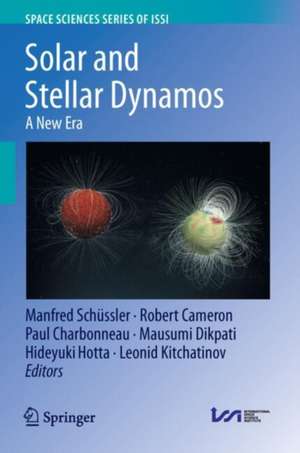
Solar and Stellar Dynamos: Space Sciences Series of ISSI, cartea 90
Editat de Manfred Schüssler, Robert Cameron, Paul Charbonneau, Mausumi Dikpati, Hideyuki Hotta, Leonid Kitchatinoven Limba Engleză Hardback – 9 oct 2024
Descoperim în acest volum o abordare riguroasă a proceselor de dinam care generează câmpuri magnetice, elemente centrale pentru înțelegerea activității solare și stelare. Lucrarea debutează cu o analiză a simulărilor numerice complexe, devenite astăzi indispensabile pentru descifrarea proceselor turbulente din interiorul stelelor și pentru validarea modelelor teoretice privind emergența tiparelor magnetice. Remarcăm o structură progresivă, care pornește de la evoluția istorică a teoriei dinamului și observațiile directe ale ciclului solar de 11 ani, avansând către mecanismele profunde precum dinamica fluxurilor la scară largă și rolul tahoclinei. Această ediție 2024 oferă o sinteză actualizată a modului în care câmpurile magnetice influențează coroana solară și erupțiile de masă ce pot afecta sistemele tehnice terestre. Apreciem modul în care editorii au integrat contribuțiile experților pentru a explica nu doar Soarele, ci și stelele cu zone de convecție externe, unde activitatea magnetică poate fi mult mai energică. Solar and Stellar Dynamos completează perspectiva oferită de The Sun and Cool Stars: activity, magnetism, dynamos, adăugând o componentă modernă de modelare computațională și date recente despre modulația pe termen lung a ciclurilor stelare, pe care lucrările mai vechi nu le puteau procesa la acest nivel de detaliu. În contextul operei editorilor, acest volum rafinează temele explorate în Solar and Stellar Physics, trecând de la o prezentare generală a observațiilor spațiale la o investigație profundă a mecanismelor fizice care susțin magnetismul cosmic. Este o resursă esențială care reflectă tranziția domeniului către o eră a preciziei numerice și a integrării datelor multi-stelare.
Din seria Space Sciences Series of ISSI
- 18%
 Preț: 938.65 lei
 - 18%
 Preț: 1051.35 lei
 - 15%
 Preț: 679.49 lei
 - 18%
 Preț: 994.86 lei
 - 18%
 Preț: 1458.84 lei
 - 18%
 Preț: 934.60 lei
 - 18%
 Preț: 1165.74 lei
 - 18%
 Preț: 936.73 lei
 - 15%
 Preț: 678.03 lei
 - 18%
 Preț: 1159.33 lei
 - 18%
 Preț: 830.19 lei
 - 18%
 Preț: 766.82 lei
 - 18%
 Preț: 1170.59 lei
 - 18%
 Preț: 1052.55 lei
 - 15%
 Preț: 564.38 lei
 -
 Preț: 420.58 lei
 -
 Preț: 449.82 lei
 -
 Preț: 444.89 lei
 -
 Preț: 422.47 lei
 -
 Preț: 488.22 lei
 -
 Preț: 380.08 lei
 - 18%
 Preț: 989.11 lei
 - 18%
 Preț: 986.77 lei
 - 18%
 Preț: 957.93 lei
 - 24%
 Preț: 1151.92 lei
 - 18%
 Preț: 987.71 lei
 - 24%
 Preț: 858.83 lei
 - 15%
 Preț: 685.71 lei
 - 18%
 Preț: 927.07 lei
 - 24%
 Preț: 1140.31 lei
 - 20%
 Preț: 645.33 lei
 - 18%
 Preț: 996.28 lei
 - 15%
 Preț: 626.12 lei
 - 18%
 Preț: 995.36 lei
 - 18%
 Preț: 917.28 lei
 -
 Preț: 380.32 lei
 - 15%
 Preț: 672.68 lei
Preț: 427.85 lei
Carte disponibilă
Livrare economică 09-23 noiembrie
Specificații
ISBN-10: 9402422617
Pagini: 524
Ilustrații: Approx. 530 p.
Dimensiuni: 160 x 241 x 32 mm
Greutate: 0.99 kg
Ediția:2024
Editura: Springer
Colecția Space Sciences Series of ISSI
Seria Space Sciences Series of ISSI
Locul publicării:Dordrecht, Netherlands
De ce să citești această carte
Această lucrare este esențială pentru cercetătorii activi și studenții la doctorat în astrofizică. Cititorul câștigă o înțelegere profundă a mecanismelor magnetice care guvernează vremea spațială, beneficiind de un compendiu care face legătura între observațiile clasice ale petelor solare și cele mai noi simulări numerice ale turbulențelor stelare. Este resursa definitivă pentru a înțelege cum funcționează motorul magnetic al stelelor.
Despre autor
Editorii acestui volum, printre care se numără Manfred Schüssler și Paul Charbonneau, sunt figuri proeminente în comunitatea de astrofizică solară. Manfred Schüssler este recunoscut pentru contribuțiile sale la înțelegerea structurilor magnetice mici de pe suprafața Soarelui, în timp ce Paul Charbonneau este autorul unor modele teoretice fundamentale despre ciclul solar. Împreună cu ceilalți editori, aceștia reprezintă expertiza de vârf din instituții precum Institutul Max Planck și Universitatea din Montréal, oferind volumului o autoritate academică incontestabilă în domeniul fizicii solare și stelare.
Descriere scurtă
The review papers collected in this volume are written by experts in this research field. The papers deliver introductions to the observational results on solar and stellar magnetic fields and provide detailed presentations on the theoretical concepts and models for self-excited dynamo processes and the underlying flow patterns that cause the emergence, structure, and evolution of magnetic patterns at the surfaces of the Sun and other stars. Comprehensive and realistic numerical simulations have become an indispensable tool for understanding the turbulent processes in stellar interiors as well as for testing analytical approaches and simplified models.
Readers looking for a comprehensive and up-to-date account of this dynamic research field will find a most valuable collection of reviews; serving both as an introduction for newcomers in the field as well as a timely compendium for the active researcher.
The book is a spin-off from the Topical Collection "Solar and Stellar Dynamos: A New Era" of the journal Space Science Reviews.
Cuprins
Notă biografică
Manfred Schüssler worked at the Max Planck Institute for Solar System Research (MPS) as a Research Group Leader. Since his retirement in 2016 he is a guest scientist at MPS. His main research interests are the structure and dynamics of solar magnetic fields and dynamo theory of the solar cycle. His research methods are numerical simulations and analytical calculations, often with an emphasis on interpreting and understanding observational results. He was also involved in the preparation and realization of the “Sunrise” stratospheric balloon observatory. Manfred Schüssler authored and co-authored over 180 research papers in refereed journals and more than 40 review papers.
Robert H. Cameron
Robert Cameron studies how magnetic fields, plasma and radiation interact on the Sun and other stars. In particular, he is interested in how the magnetic field is generated and its role coupling the lower layers of stellar atmospheres. To these ends he uses numerical models and theory, but with a particular emphasis on understanding the observations.
Paul Charbonneau
Paul Charbonneau is professor of Physics at the Université de Montréal (Canada) since 2002. During the preceding decade he was a member of scientic staff of the National Center for Atmospheric Research's High Altitude Observatory, in Boulder (Colorado, U.S.A.). His research is primarily in the areas of computational physics and numerical simulations, focusing on magnetohydrodynamics, the dynamo mechanism underlying solar and stellar magnetic cycles, and the prediction of solar flares. He also pursues other research interests, notably in the intersection of physics and biology, the emergence of complexity in natural systems, including questions related the origin of life. He has authored or co-authored over 150 research articles, review articles, and book chapters, and is the authors of two research monographs/textbooks entitled Solar and Stellar Dynamos (2013, Springer) and Natural Complexity (2017, Princeton University Press)
Mausumi Dikpati
Mausumi Dikpati, currently a senior scientist at HAO, came to NSF-NCAR in 1996 as an ASP Postdoc, after receiving her PhD in physics from the Indian Institute of Science in Bangalore, India. She has since continued her career at NSF-NCAR. Mausumi’s primary research area has been global magnetohydrodynamics of the Sun, to simulate solar variability on time scales from a few days to several months, up to a decade, with recent focus on solar MHD Rossby waves, their implications for pre-solar-storm activity-patterns, and for predicting the “stormy seasons” of space weather. Her activities in the application of modern data assimilation methods to solar models, using the NCAR-DART framework in collaboration with CISL, have enabled her to win several large research grants. She won John Firor HAO Outstanding Publication award in 2007 for solar cycle prediction research and the Wenner-Gren guest professorship award from Stockholm in 2016. Her research on the extended minimum at the end of solar cycle 23 was recognized as one of the top 100 science-discoveries in 2011 by Discover Magazine. Mausumi has also been active in education and outreach as well as in various community services; she is currently serving on "Solar & Heliospheric Decadal Panel'' of the US National Academy.
Hideyuki Hotta
Hideyuki Hotta is currently a Professor at the Institute for Space-Earth Environmental Research at Nagoya University. He earned his Ph.D. in science from the University of Tokyo, Japan, in 2014. Then, he worked at High Altitude Observatory, USA, and got a tenure track position at Chiba University, Japan, in 2015. Since 2023, he has been working at Nagoya University as a professor, where he has been since that time. His research interests are solar and stellar turbulence and magnetic fields. He mainly carries out numerical simulations with high-performance computing.
Leonid Kitchatinov
Leonid Kitchatinov received his Ph.D. from the Ioffe Institute of Physics and Technology, St. Petersburg. He is a specialist in stellar MHD and dynamo theory. He is permanently affiliated to the Institute of Solar-Terrestrial Physics, Irkutsk, and in parallel to the Pulkovo Astronomical Observatory, St. Petersburg. He has worked repeatedly at the Leibnitz Institute for Astrophysics, Potsdam, supported by either the Alexander von Humboldt Foundation or the Deuthsche Forshungsgemeinshaft. He has also spend a year as a research fellow at the University of St. Andrews, UK.