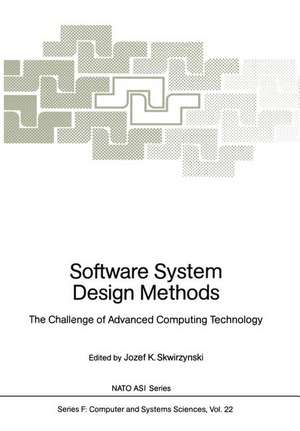
Software System Design Methods: The Challenge of Advanced Computing Technology: NATO ASI Subseries F:, cartea 22
Editat de Josef K. Skwirzynskien Limba Engleză Paperback – 16 dec 2011
Din seria NATO ASI Subseries F:
- 20%
 Preț: 642.70 lei
 - 20%
 Preț: 1023.01 lei
 - 18%
 Preț: 1278.69 lei
 - 20%
 Preț: 1847.73 lei
 - 20%
 Preț: 674.36 lei
 - 18%
 Preț: 1283.67 lei
 - 18%
 Preț: 1179.90 lei
 - 20%
 Preț: 682.88 lei
 - 18%
 Preț: 1914.77 lei
 - 20%
 Preț: 360.65 lei
 - 20%
 Preț: 953.40 lei
 - 20%
 Preț: 645.09 lei
 - 20%
 Preț: 1850.75 lei
 - 20%
 Preț: 1030.44 lei
 - 20%
 Preț: 949.94 lei
 -
 Preț: 374.71 lei
 - 20%
 Preț: 674.28 lei
 - 20%
 Preț: 621.14 lei
 - 20%
 Preț: 675.21 lei
 - 18%
 Preț: 1177.62 lei
 - 18%
 Preț: 981.53 lei
 - 20%
 Preț: 319.42 lei
 - 20%
 Preț: 1324.83 lei
 - 20%
 Preț: 619.89 lei
 -
 Preț: 380.82 lei
 - 18%
 Preț: 1258.90 lei
 - 15%
 Preț: 646.82 lei
 - 20%
 Preț: 620.52 lei
 - 20%
 Preț: 1233.02 lei
 - 20%
 Preț: 1323.53 lei
 - 20%
 Preț: 1985.69 lei
 - 20%
 Preț: 1842.51 lei
 - 20%
 Preț: 348.43 lei
 - 20%
 Preț: 621.81 lei
 - 20%
 Preț: 322.93 lei
 - 20%
 Preț: 664.12 lei
 - 20%
 Preț: 331.17 lei
 - 20%
 Preț: 327.84 lei
Preț: 647.95 lei
Preț vechi: 809.93 lei
-20%
Puncte Express: 972
Carte tipărită la comandă
Livrare economică 27 noiembrie-11 decembrie
Livrare prin curier în România Termenul estimat este afișat lângă disponibilitate.
Transport gratuit pentru acest produs Plată online sau ramburs, în funcție de opțiunile comenzii.
Retur gratuit în 14 zile Comandă securizată și suport în română.
Specificații
ISBN-13: 9783642828485
ISBN-10: 3642828485
Pagini: 768
Ilustrații: XIII, 747 p.
Dimensiuni: 170 x 244 x 40 mm
Greutate: 1.2 kg
Ediția:Softcover reprint of the original 1st ed. 1986
Editura: Springer Berlin, Heidelberg
Colecția Springer
Seria NATO ASI Subseries F:
Locul publicării:Berlin, Heidelberg, Germany
ISBN-10: 3642828485
Pagini: 768
Ilustrații: XIII, 747 p.
Dimensiuni: 170 x 244 x 40 mm
Greutate: 1.2 kg
Ediția:Softcover reprint of the original 1st ed. 1986
Editura: Springer Berlin, Heidelberg
Colecția Springer
Seria NATO ASI Subseries F:
Locul publicării:Berlin, Heidelberg, Germany
V-ar putea interesa
-
 -27%Preț: 676.09 lei926.15 lei
 -
 Software Modeling and DesignHassan Gomaa-20%Preț: 665.25 lei831.56 lei
 -
 KanbanDavid J. Anderson-20%Preț: 264.20 lei330.25 lei
 -
 The Human Side of AgileGil BrozaPreț: 271.68 lei
 -
 Software EngineeringRuneson-20%Preț: 471.15 lei588.94 lei
 -
 Professional GitBrent Laster-20%Preț: 256.78 lei320.97 lei
 -
 Python AlgorithmsMagnus Lie Hetland-20%Preț: 468.00 lei584.99 lei
 -
 The Definitive Guide to HTML5 WebSocketVanessa Wang-20%Preț: 372.28 lei465.36 lei
 -
 Head First AgileAndrew Stellman-20%Preț: 343.20 lei429.00 lei
 -
 Continuous Delivery with Visual Studio ALM 2015Mathias Olausson-20%Preț: 299.70 lei374.63 lei
 -
 Design It! : Pragmatic ProgrammersMicahel Keeling-20%Preț: 257.50 lei321.87 lei
 -
 Mastering ServiceNow - Second EditionMartin Wood-20%Preț: 368.74 lei460.93 lei
 -
 Generative Programming and Component EngineeringGabor Karsai-20%Preț: 332.81 lei416.02 lei
 -
 -20%Preț: 345.68 lei432.09 lei
 -
 Software Engineering for Multi-Agent Systems IIIRicardo Choren-20%Preț: 322.59 lei403.23 lei
 -
 Scientific Engineering of Distributed Java ApplicationsNicolas Guelfi-20%Preț: 314.16 lei392.71 lei
 -
 UML Modeling Languages and ApplicationsNuno Jardim Nunes-20%Preț: 322.99 lei403.74 lei
 -
 Recent Trends in Algebraic Development TechniquesJosé Luiz Fiadeiro-20%Preț: 321.56 lei401.94 lei
 -
 Fundamental Approaches to Software EngineeringMaura Cerioli-20%Preț: 327.07 lei408.84 lei
 -
 Operational Semantics for Timed SystemsHeinrich Rust-20%Preț: 319.10 lei398.88 lei
Public țintă
ResearchCuprins
1. The Development of Low-Fault and Fault-Tolerant Software.- Four Applications of Software Data Collection and Analysis Methodology.- Recursively Structured Fault-Tolerant Distributed Computing Systems.- Knowledge Engineering Techniques Applied to Fault Detection Test Generation and Maintenance.- Software Development Under Statistical Quality Control.- Life Time Distributions for Coherent Systems.- Panel Discussion on Safety Analysis of Computer Programs Using Fault Trees.- 2. Human Factors in Development and Use of Software.- Psychological Research on Software Development.- From Interactive to Intelligent System.- Design and Use of Programming Languages.- Panel Discussion on Will Artificial Intelligence Make Human Factors Obsolete?.- 3. The Development and Status of Empirical/Statistical Reliability Models for Software and Their Relation to Reality.- Application of Basic and Logarithmic Poisson Execution Time Models in Software Reliability Measurement.- Tools for the Analysis of the Accuracy of Software Reliability Predictions.- The Use of Exploratory Data Analysis Techniques for Software Reliability Assessment and Prediction.- Failure Patterns and Reliability Growth Potential for Software Systems.- The Use of Regression Techniques for Matching Reliability Models to the Real World.- The Assessment of Software Reliability for Systems with High Reliability Requirements.- Process and Design Considerations as They Affect the Number, Nature and Disclosure of Software Faults.- Assessing System Reliability Using Censoring Methodology.- Statistical Design of Experiments for Computer Performance Evaluation.- Reliability Analysis for Integrated Voice/Data Networks.- Computers of the Fifth Generation and Their Role in Communications.- The Rationale of Reliability Prediction.- 4.The Economics of Computing and Methods of Cost Assessment.- Needs Assessment: The First Step in a Cost-Effective Design of a Computer-Based System.- Steps Toward Establishing Normal Rules for Software Cost, Schedule, and Productivity Estimating.- The Economics of Software.- Panel Discussion on Comparison of Evaluation Methods of Cost Assessment in Computing.- Panel Discussion on Software Cost Estimating.- 5. Security, Safety, Privacy and Integrity in Developing and in Using Computer Communication and Computer Data Storage and Retrieval.- Security, Privacy, Safety and Resiliency in Computation.- Software Hazard Analysis Techniques.- Data Security.- Panel Discussion on Human Beings as the Source of Problems, Concerns and Protection Needs, e. g. Computer Crime.- Summary of Panel Discussion on Women in Information Science.- List of Delegates.