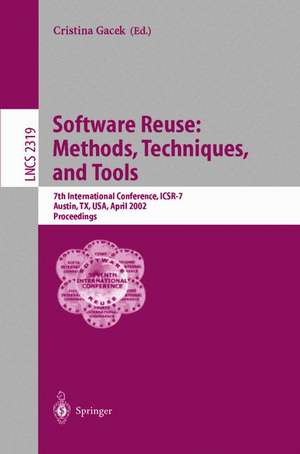
Software Reuse: Methods, Techniques, and Tools
Editat de Cristina Gaceken Limba Engleză Paperback – 3 apr 2002
Preț: 325.63 lei
Preț vechi: 407.04 lei
-20%
Puncte Express: 488
Carte tipărită la comandă
Livrare economică 28 noiembrie-12 decembrie
Livrare prin curier în România Termenul estimat este afișat lângă disponibilitate.
Transport gratuit de la 400.00 lei Plată online sau ramburs, în funcție de opțiunile comenzii.
Retur gratuit în 14 zile Comandă securizată și suport în română.
Specificații
ISBN-13: 9783540434832
ISBN-10: 3540434836
Pagini: 368
Ilustrații: XII, 356 p.
Dimensiuni: 155 x 235 x 20 mm
Greutate: 0.56 kg
Ediția:2002
Editura: Springer
Locul publicării:Berlin, Heidelberg, Germany
ISBN-10: 3540434836
Pagini: 368
Ilustrații: XII, 356 p.
Dimensiuni: 155 x 235 x 20 mm
Greutate: 0.56 kg
Ediția:2002
Editura: Springer
Locul publicării:Berlin, Heidelberg, Germany
V-ar putea interesa
-
 -27%Preț: 676.09 lei926.15 lei
 -
 Software Modeling and DesignHassan Gomaa-20%Preț: 665.25 lei831.56 lei
 -
 KanbanDavid J. Anderson-20%Preț: 264.20 lei330.25 lei
 -
 The Human Side of AgileGil BrozaPreț: 271.68 lei
 -
 Software EngineeringRuneson-20%Preț: 471.15 lei588.94 lei
 -
 Professional GitBrent Laster-20%Preț: 256.78 lei320.97 lei
 -
 Python AlgorithmsMagnus Lie Hetland-20%Preț: 468.00 lei584.99 lei
 -
 The Definitive Guide to HTML5 WebSocketVanessa Wang-20%Preț: 372.28 lei465.36 lei
 -
 Head First AgileAndrew Stellman-20%Preț: 343.20 lei429.00 lei
 -
 Continuous Delivery with Visual Studio ALM 2015Mathias Olausson-20%Preț: 299.70 lei374.63 lei
 -
 Design It! : Pragmatic ProgrammersMicahel Keeling-20%Preț: 257.50 lei321.87 lei
 -
 Mastering ServiceNow - Second EditionMartin Wood-20%Preț: 368.74 lei460.93 lei
 -
 -20%Preț: 635.06 lei793.83 lei
 -
 Adoption-centric Usability EngineeringAhmed Seffah-20%Preț: 343.71 lei429.64 lei
 -
 -20%Preț: 314.81 lei393.51 lei
 -
 The IOTA Programming SystemR. Nakajima-20%Preț: 318.69 lei398.37 lei
 -
 -20%Preț: 337.17 lei421.47 lei
 -
 Architecting Dependable Systems IIRogério de Lemos-20%Preț: 325.25 lei406.56 lei
 -
 Architecting Dependable SystemsRogério de Lemos-20%Preț: 323.60 lei404.50 lei
 -
 First-Order Programming TheoriesLaszlo Ury-20%Preț: 675.44 lei844.29 lei
 -
 Experiences in Software Evolution and ReuseSvein Hallsteinsen-20%Preț: 315.26 lei394.07 lei
 -
 Logic ProgrammingVerónica Dahl-20%Preț: 331.59 lei414.49 lei
 -
 Architecting Dependable Systems VRogério de Lemos-20%Preț: 338.24 lei422.80 lei
 -
 Logic-Based Program Synthesis and TransformationMichael Hanus-20%Preț: 329.48 lei411.85 lei
 -
 Architecting Dependable Systems VIRogério de Lemos-20%Preț: 337.58 lei421.98 lei
 -
 Architecting Dependable Systems VIIAntonio Casimiro-20%Preț: 311.50 lei389.38 lei
Public țintă
ResearchCuprins
Integrating and Reusing GUI-Driven Applications.- Source Tree Composition.- Layered Development with (Unix) Dynamic Libraries.- Early-Reply Components: Concurrent Execution with Sequential Reasoning.- Concepts and Guidelines of Feature Modeling for Product Line Software Engineering.- Domain Modeling for World Wide Web Based Software Product Lines with UML.- Enhancing Component Reusability through Product Line Technology.- Modeling Variability with the Variation Point Model.- Reusing Open-Source Software and Practices: The Impact of Open-Source on Commercial Vendors.- Integrating Reference Architecture Definition and Reuse Investment Planning.- Control Localization in Domain Specific Translation.- Model Reuse with Metamodel-Based Transformations.- Generation of Text Search Applications for Databases. An Exercise on Domain Engineering.- Domain Networks in the Software Development Process.- Supporting Reusable Use Cases.- Project Management Knowledge Reuse through Scenario Models.- Adaptation of Coloured Petri Nets Models of Software Artifacts for Reuse.- Improving Hazard Classification through the Reuse of Descriptive Arguments.- Service Oriented Programming: A New Paradigm of Software Reuse.- An Empirical User Study of an Active Reuse Repository System.- Towards the Formalization of a Reusability Framework for Refactoring.- Service Facilities: Extending Abstract Factories to Decouple Advanced Dependencies.- Software Fortresses.- The Case against a Grand Unification Theory.- ICSR7 Young Researchers Workshop.- International Workshop on Reuse Economics.- Workshop on Generative Programming 2002 (GP2002).- ICSR7 Workshop on Component-Based Software Development Processes.- Industrial Experience with Product Line Approaches.- Workshop on Software Reuse and Agile Approaches.- Software Architecture Quality Analysis Methods.- Tutorial on Practical Product Line Scoping and Modeling.- Transformation Systems: Generative Reuse for Software Generation, Maintenance and Reengineering.- Component-Based Product-Line Engineering with the UML.- Building Reusable Test Assets for a Product Line.- Architecture-Centric Software Engineering.- Practical Strategies and Techniques for Adopting Software Product Lines.- Generative Programming: Methods, Techniques, and Applications Tutorial Abstract.