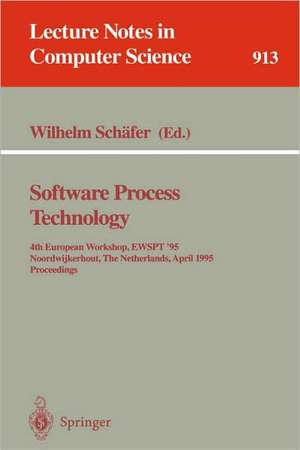
Software Process Technology
Editat de Wilhelm Schäferen Limba Engleză Paperback – 22 mar 1995
The book contains 28 revised full research papers selected from a total of 50 submissions; in addition, the session chairpersons contributed 7 short surveys on the topics treated. Among the issues addressed are analysis and metrics, application experiments, language experiments, models for distributions, mechanisms for cooperation, and change and meta-processes. This book documents that software process technology has become a key technology to cope with the challenges of team-oriented production of large and high-quality software systems.
Preț: 321.15 lei
Preț vechi: 401.43 lei
-20%
Puncte Express: 482
Carte tipărită la comandă
Livrare economică 27 noiembrie-11 decembrie
Livrare prin curier în România Termenul estimat este afișat lângă disponibilitate.
Transport gratuit de la 400.00 lei Plată online sau ramburs, în funcție de opțiunile comenzii.
Retur gratuit în 14 zile Comandă securizată și suport în română.
Specificații
ISBN-13: 9783540592051
ISBN-10: 3540592059
Pagini: 280
Ilustrații: IX, 265 p.
Dimensiuni: 155 x 235 x 16 mm
Greutate: 0.43 kg
Ediția:1995
Editura: Springer
Locul publicării:Berlin, Heidelberg, Germany
ISBN-10: 3540592059
Pagini: 280
Ilustrații: IX, 265 p.
Dimensiuni: 155 x 235 x 16 mm
Greutate: 0.43 kg
Ediția:1995
Editura: Springer
Locul publicării:Berlin, Heidelberg, Germany
V-ar putea interesa
-
 -27%Preț: 676.09 lei926.15 lei
 -
 Software Modeling and DesignHassan Gomaa-20%Preț: 665.25 lei831.56 lei
 -
 KanbanDavid J. Anderson-20%Preț: 264.20 lei330.25 lei
 -
 The Human Side of AgileGil BrozaPreț: 271.68 lei
 -
 Software EngineeringRuneson-20%Preț: 471.15 lei588.94 lei
 -
 Professional GitBrent Laster-20%Preț: 256.78 lei320.97 lei
 -
 Python AlgorithmsMagnus Lie Hetland-20%Preț: 468.00 lei584.99 lei
 -
 The Definitive Guide to HTML5 WebSocketVanessa Wang-20%Preț: 372.28 lei465.36 lei
 -
 Head First AgileAndrew Stellman-20%Preț: 343.20 lei429.00 lei
 -
 Continuous Delivery with Visual Studio ALM 2015Mathias Olausson-20%Preț: 299.70 lei374.63 lei
 -
 Design It! : Pragmatic ProgrammersMicahel Keeling-20%Preț: 257.50 lei321.87 lei
 -
 Mastering ServiceNow - Second EditionMartin Wood-20%Preț: 368.74 lei460.93 lei
 -
 Reliable and Autonomous Computational ScienceSung Y. Shin-20%Preț: 633.17 lei791.46 lei
 -
 Software Engineering - ESEC '95Wilhelm Schäfer-20%Preț: 334.47 lei418.08 lei
 -
 -20%Preț: 327.36 lei409.20 lei
 -
 -20%Preț: 333.68 lei417.09 lei
 -
 -20%Preț: 326.55 lei408.19 lei
 -
 -20%Preț: 317.85 lei397.31 lei
 -
 -20%Preț: 333.68 lei417.09 lei
 -
 -20%Preț: 318.67 lei398.33 lei
 -
 -20%Preț: 313.87 lei392.34 lei
Public țintă
ResearchCuprins
Metrics and analysis session.- Process viewpoints.- Process-based software risk assessment.- The use of roles and measurement to enact project plans in MVP-S.- Combining process models and metrics in practice.- Application experiments.- Space shuttle onboard software (OBS) development and maintenance process automation.- PM case studies: A tentative characterisation.- A survey and comparison of some research areas relevant to software process modeling.- Customising software process models.- Process differentiation and integration: The key to just-in-time in product development.- Open issues in the design of PM languages.- In favour of a coherent process coding language.- Process modelling languages: One or many?.- Experiments in process interface descriptions, visualizations and analyses.- The software process and the modelling of complex systems.- Interpretable process models for software development and workflow.- Integrating process technology and CSCW.- Distributed modelling session.- Process management in-the-many.- A generalized multi-view approach.- Decentralised process modelling.- Coordination by behavioural views and communication patterns.- Configuration of situational process models: An information systems engineering perspective.- Mechanisms for cooperation (Chair: Christer fernström) current issues on integration.- Enveloping “persistent” tools for a process-centered environment.- Coordination for process support is not enough!.- Coordination theory and software process technology.- Transaction technology for process modelling.- Stepwise specification of interactive processes in COO.- Session on change and meta-process.- A reflexive formal software process model.- Transients change processes in process centered environments.