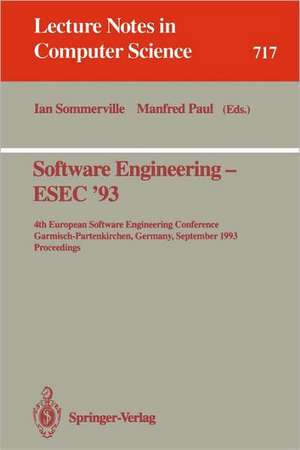
Software Engineering - ESEC '93
Editat de Ian Sommerville, Manfred Paulen Limba Engleză Paperback – 30 aug 1993
Preț: 334.25 lei
Preț vechi: 417.82 lei
-20%
Puncte Express: 501
Carte tipărită la comandă
Livrare economică 01-15 decembrie
Livrare prin curier în România Termenul estimat este afișat lângă disponibilitate.
Transport gratuit de la 400.00 lei Plată online sau ramburs, în funcție de opțiunile comenzii.
Retur gratuit în 14 zile Comandă securizată și suport în română.
Specificații
ISBN-13: 9783540572091
ISBN-10: 3540572090
Pagini: 536
Ilustrații: XII, 520 p.
Dimensiuni: 155 x 235 x 29 mm
Greutate: 0.8 kg
Ediția:1993
Editura: Springer
Locul publicării:Berlin, Heidelberg, Germany
ISBN-10: 3540572090
Pagini: 536
Ilustrații: XII, 520 p.
Dimensiuni: 155 x 235 x 29 mm
Greutate: 0.8 kg
Ediția:1993
Editura: Springer
Locul publicării:Berlin, Heidelberg, Germany
V-ar putea interesa
-
 -27%Preț: 676.09 lei926.15 lei
 -
 Software Modeling and DesignHassan Gomaa-20%Preț: 665.25 lei831.56 lei
 -
 KanbanDavid J. Anderson-20%Preț: 264.20 lei330.25 lei
 -
 The Human Side of AgileGil BrozaPreț: 271.68 lei
 -
 Software EngineeringRuneson-20%Preț: 471.15 lei588.94 lei
 -
 Professional GitBrent Laster-20%Preț: 256.78 lei320.97 lei
 -
 Software Engineering, Global EditionIan Sommerville-20%Preț: 633.41 lei791.76 lei
 -
 Trust in Technology: A Socio-Technical PerspectiveKaren Clarke-20%Preț: 675.88 lei844.84 lei
 -
 Python AlgorithmsMagnus Lie Hetland-20%Preț: 468.00 lei584.99 lei
 -
 The Definitive Guide to HTML5 WebSocketVanessa Wang-20%Preț: 372.28 lei465.36 lei
 -
 Head First AgileAndrew Stellman-20%Preț: 343.20 lei429.00 lei
 -
 Continuous Delivery with Visual Studio ALM 2015Mathias Olausson-20%Preț: 299.70 lei374.63 lei
 -
 Design It! : Pragmatic ProgrammersMicahel Keeling-20%Preț: 257.50 lei321.87 lei
 -
 Mastering ServiceNow - Second EditionMartin Wood-20%Preț: 368.74 lei460.93 lei
 -
 1. Fachtagung über ProgrammiersprachenHans Langmaack-20%Preț: 350.72 lei438.39 lei
 -
 QVT - Operational MappingsSiegfried Nolte-20%Preț: 406.52 lei508.15 lei
 -
 Requirements Engineering und ProjektmanagementJörg Glunde-20%Preț: 787.92 lei984.90 lei
 -
 Software-QualitätDirk W. Hoffmann-20%Preț: 366.71 lei458.39 lei
 -
 -20%Preț: 343.78 lei429.73 lei
 -
 Software and Data TechnologiesMaria José Escalona-20%Preț: 327.91 lei409.88 lei
 -
 System Analysis and Modeling: Theory and PracticeOystein Haugen-20%Preț: 429.99 lei537.50 lei
 -
 Transactions on Aspect-Oriented Software Development XGary T. Leavens-20%Preț: 329.69 lei412.12 lei
 -
 Programming Languages and SystemsMatthias Felleisen-20%Preț: 339.58 lei424.48 lei
 -
 Im Aufwind lebenManfred PaulPreț: 155.31 lei
Public țintă
ResearchCuprins
On the decline of classical programming.- Computers are not omnipotent.- Real-time systems: A survey of approaches to formal specification and verification.- Software engineering in business and academia: How wide is the gap?.- Software faults in evolving a large, real-time system: a case study.- The Experience Factory and its relationship to other Improvement Paradigms.- Inconsistency handling in multi-perspective specifications.- Requirements engineering: An integrated view of representation, process, and domain.- Making changes to formal specifications: Requirements and an example.- Formal requirements made practical.- Databases for software engineering environments.- A regression testing database model.- Experiences with a federated environment testbed.- Observations on object management systems and process support in environments.- Software technology for a distributed telecommunication system.- Industrial software development — a case study.- Quantitative approach to software management: the ami method.- Preventative software engineering.- Distributed information systems: An advanced methodology.- Tractable flow analysis for anomaly detection in distributed programs.- A pragmatic task design approach based on a Ward/Mellor real-time structured specification.- Integration of structured analysis and timed statecharts for real-time and concurrency specification.- Language constructs for cooperative systems design.- Scrutiny: A collaborative inspection and review system.- COO: A transaction model to support cooperating software developers Coordination.- An experiment in software retrieval.- Using formal methods to construct a software component library.- Capsule oriented reverse engineering for software reuse.- Automatic replanning of task networks for process modelevolution in EPOS.- Provence: A process visualization and enactment environment.- Process programming with active and passive components.- A formal framework for ASTRAL intra-level proof obligations.- Assertion-based debugging of imperative programs by abstract interpretation.