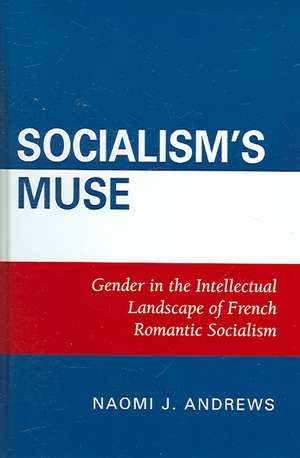
Socialism's Muse: Gender in the Intellectual Landscape of French Romantic Socialism
Autor Naomi J. Andrewsen Limba Engleză Hardback – 13 apr 2006
Preț: 568.84 lei
Preț vechi: 862.95 lei
-34%
Puncte Express: 853
Carte tipărită la comandă
Livrare economică 19 noiembrie-03 decembrie
Livrare prin curier în România Termenul estimat este afișat lângă disponibilitate.
Transport gratuit pentru acest produs Plată online sau ramburs, în funcție de opțiunile comenzii.
Retur gratuit în 14 zile Comandă securizată și suport în română.
Specificații
ISBN-13: 9780739108444
ISBN-10: 0739108441
Pagini: 179
Dimensiuni: 164 x 237 x 20 mm
Greutate: 0.43 kg
Editura: Bloomsbury Publishing
Colecția Lexington Books
Locul publicării:New York, United States
ISBN-10: 0739108441
Pagini: 179
Dimensiuni: 164 x 237 x 20 mm
Greutate: 0.43 kg
Editura: Bloomsbury Publishing
Colecția Lexington Books
Locul publicării:New York, United States
V-ar putea interesa
-
 The Bronte MythLucasta Miller-19%Preț: 75.44 lei93.35 lei
 -
 Russian ThinkersIsaiah Berlin-17%Preț: 66.66 lei80.62 lei
 -
 W. B. Yeats, A Life I: The Apprentice Mage 1865-1914R. F. Foster-12%Preț: 299.06 lei338.48 lei
 -
 -23%Preț: 364.58 lei472.26 lei
 -
 Romanticism: An Oxford GuideNicholas Roe-27%Preț: 437.96 lei595.98 lei
 -
 -31%Preț: 524.18 lei760.39 lei
 -
 Charlotte Brontë: The Imagination in HistoryHeather Glen-19%Preț: 361.19 lei446.21 lei
 -
 Dorothy Wordsworth and Hartley ColeridgeN. HealeyPreț: 395.20 lei
 -
 Preț: 60.88 lei
 -
 Dickens's LondonJulian Wolfreys-24%Preț: 640.87 lei847.10 lei
 -
 Wuthering Heights: Character StudiesDr Melissa Fegan-21%Preț: 155.42 lei196.81 lei
 -
 York Notes Companions: Romantic LiteratureJohn GilroyPreț: 90.53 lei
 -
 From Balzac to Zola: Selected Short StoriesRichard Hobbs-17%Preț: 162.37 lei195.83 lei
 -
 The PoemsW. B. YeatsPreț: 147.81 lei
Cuprins
Chapter 1 Disillusionment and its consequences: The Revolution of 1830
Chapter 2 New territory: Socialism and feminism in the 1830s
Chapter 3 la femme imagine: Romantic socialists envision woman
Chapter 4 la mere humanite: Gender and the human community
Chapter 5 Utopian androgyny: Romantic socialists confront individualism
Chapter 6 Can a dream vote?: The ambivalent feminism of romantic socialists
Chapter 7 The feminist and the socialist: Adele and Alphonse Esquiros
Chapter 2 New territory: Socialism and feminism in the 1830s
Chapter 3 la femme imagine: Romantic socialists envision woman
Chapter 4 la mere humanite: Gender and the human community
Chapter 5 Utopian androgyny: Romantic socialists confront individualism
Chapter 6 Can a dream vote?: The ambivalent feminism of romantic socialists
Chapter 7 The feminist and the socialist: Adele and Alphonse Esquiros
Recenzii
In Socialism's Muse Naomi Andrews convincingly argues that the feminine gendering of early French socialism failed the feminist cause. Male romantic socialists imagined a spiritual, interdependent society that imitated an idealized womanhood uncorrupted by public life. This ideal collapsed at the prospect of women's suffrage in the 1848 Revolution, and so did romantic socialism with its feminist promise. To paraphrase Andrews, "a dream cannot vote." This first-rate gender analysis offers new insight into socialism and feminism during the July Monarchy.
This fascinating book brilliantly challenges traditional histories of feminism and brings to light the richness of socialist thought before Marx. Deftly analyzing a variety of eccentric figures, many of whom were attracted to the Virgin Mary and the trope of androgyny, Andrews demonstrates that early socialists promoted an idealized version of woman to advance their vision of a harmonious society. Their concern for social justice preempted their worries about political rights and gave their feminism an original twist. No historian before Andrews has ever managed to bring socialism, feminism, and romanticism together in such a riveting account. Socialism's Muse is an important book.
Socialism's Muse casts new light on the diversity and creativity of French Romantic socialism. It offers a fresh and engaging account of the significance of gender to socialism in the early nineteenth century. Rather than focusing on the best-known individuals, it reveals the important contributions made by others often dismissed as marginal. Andrews explains convincingly why the idealisation of 'woman' did not necessarily lead to greater gains for women during the heady days of the July Monarchy and the Second Republic. This is a nicely crafted work that should be read by anyone interested in these years, as well as in gender history and the history of socialism.
Socialism's Muse is a fascinating and highly original study of the early history of French socialism and its relation to the emerging women's movement during the July Monarchy...a remarkably rich, suggestive, and above all original interpretation of early French socialism.
...Andrews effectively demonstrates just how central the philosophical question of the nature and limits of individualism was to early socialist discourse. Her deft analyses of gendered fantasies on social cohesion provide a useful roadmap through the often tortuous labyrinths of romantic socialist thought...
Naomi J. Andrews's book puts feminism back into socialism at its foundations, as an essential component of the ideal society envisioned by leading French social philosophers of the July Monarchy. By recuperating the work of Pierre Leroux, the Abbè Constant, Adéle and Alphonse Esquiros and others who hoped to replace a competitive society of atomized, masculine individuals with a less egoistic, harmonious, indeed feminized, world, Andrews helps us understand the significance and the appeal of a profoundly anti-individualistic, quasi-religious movement. This book brings a somewhat neglected group of thinkers out of the post-Marxist shadows, and makes an important contribution to both intellectual and women's history.
This fascinating book brilliantly challenges traditional histories of feminism and brings to light the richness of socialist thought before Marx. Deftly analyzing a variety of eccentric figures, many of whom were attracted to the Virgin Mary and the trope of androgyny, Andrews demonstrates that early socialists promoted an idealized version of woman to advance their vision of a harmonious society. Their concern for social justice preempted their worries about political rights and gave their feminism an original twist. No historian before Andrews has ever managed to bring socialism, feminism, and romanticism together in such a riveting account. Socialism's Muse is an important book.
Socialism's Muse casts new light on the diversity and creativity of French Romantic socialism. It offers a fresh and engaging account of the significance of gender to socialism in the early nineteenth century. Rather than focusing on the best-known individuals, it reveals the important contributions made by others often dismissed as marginal. Andrews explains convincingly why the idealisation of 'woman' did not necessarily lead to greater gains for women during the heady days of the July Monarchy and the Second Republic. This is a nicely crafted work that should be read by anyone interested in these years, as well as in gender history and the history of socialism.
Socialism's Muse is a fascinating and highly original study of the early history of French socialism and its relation to the emerging women's movement during the July Monarchy...a remarkably rich, suggestive, and above all original interpretation of early French socialism.
...Andrews effectively demonstrates just how central the philosophical question of the nature and limits of individualism was to early socialist discourse. Her deft analyses of gendered fantasies on social cohesion provide a useful roadmap through the often tortuous labyrinths of romantic socialist thought...
Naomi J. Andrews's book puts feminism back into socialism at its foundations, as an essential component of the ideal society envisioned by leading French social philosophers of the July Monarchy. By recuperating the work of Pierre Leroux, the Abbè Constant, Adéle and Alphonse Esquiros and others who hoped to replace a competitive society of atomized, masculine individuals with a less egoistic, harmonious, indeed feminized, world, Andrews helps us understand the significance and the appeal of a profoundly anti-individualistic, quasi-religious movement. This book brings a somewhat neglected group of thinkers out of the post-Marxist shadows, and makes an important contribution to both intellectual and women's history.