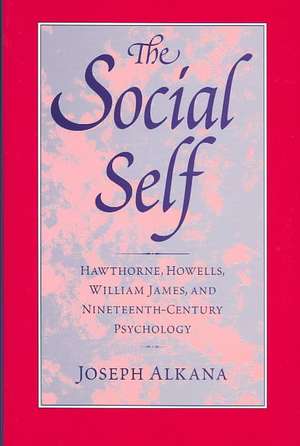
Social Self
Autor Joseph Alkanaen Limba Engleză Hardback – 21 noi 1996
Sudden changes caused by the industrial revolution, urban development, increased immigration, and regional conflicts were threatening to fragment the community, and such writers as Nathaniel Hawthorne, William James, and William Dean Howells were deeply concerned about social cohesion. Alkana persuasively reintroduces Common Sense philosophy and Jamesian psychology as ways to understand how the nineteenth-century self/society dilemma developed.
All three writers believed that introspection was the proper path to the discovery of truth. They also felt, Alkana argues, that such discoveries had to be validated by society. In these sophisticated readings of Hawthorne's short stories and "The Scarlet Letter," Howells's utopian Altrurian romances, and James's "The Principles of Psychology," it becomes obvious that characters who isolate themselves from the community do so at considerable psychological risk.
"The Social Self" links these writers' interest in contemporary psychology to their concern for history and society. Alkana's argument that nineteenth-century expressions of individualism were defensive responses to the fear of social chaos radically revises the traditional narrative of American literary culture.
Preț: 263.77 lei
Puncte Express: 396
Carte tipărită la comandă
Livrare economică 27 noiembrie-11 decembrie
Livrare prin curier în România Termenul estimat este afișat lângă disponibilitate.
Transport gratuit de la 400.00 lei Plată online sau ramburs, în funcție de opțiunile comenzii.
Retur gratuit în 14 zile Comandă securizată și suport în română.
Specificații
ISBN-13: 9780813119717
ISBN-10: 0813119715
Pagini: 176
Dimensiuni: 157 x 235 x 14 mm
Greutate: 0.42 kg
Ediția:New.
Editura: University Press of Kentucky
ISBN-10: 0813119715
Pagini: 176
Dimensiuni: 157 x 235 x 14 mm
Greutate: 0.42 kg
Ediția:New.
Editura: University Press of Kentucky
V-ar putea interesa
-
 The Bronte MythLucasta Miller-19%Preț: 76.01 lei93.50 lei
 -
 W. B. Yeats, A Life I: The Apprentice Mage 1865-1914R. F. Foster-12%Preț: 299.06 lei338.48 lei
 -
 -23%Preț: 364.58 lei472.26 lei
 -
 -29%Preț: 370.52 lei518.45 lei
 -
 -28%Preț: 385.05 lei537.82 lei
 -
 Romanticism: An Oxford GuideNicholas Roe-27%Preț: 437.96 lei595.98 lei
 -
 Charlotte Brontë: The Imagination in HistoryHeather Glen-19%Preț: 361.19 lei446.21 lei
 -
 Dorothy Wordsworth and Hartley ColeridgeN. HealeyPreț: 408.25 lei
 -
 Preț: 60.88 lei
 -
 Fiery HeartNicholas RoePreț: 121.63 lei
 -
 Wuthering Heights: Character StudiesDr Melissa Fegan-21%Preț: 155.42 lei196.81 lei
 -
 York Notes Companions: Romantic LiteratureJohn GilroyPreț: 90.53 lei
 -
 Preț: 150.15 lei
Textul de pe ultima copertă
The Social Self reinterprets in an innovative way a central feature of nineteenth-century American culture: the literary representation of selfhood. Taking issue with literary histories that have routinely reduced nineteenth-century culture to simple dichotomies between dominant and oppositional discourses, Joseph Alkana argues that writers such as Hawthorne, Howells, and William James treated ideas about the self with far more complexity than such polarities imply. By showing how these and other nineteenth-century authors handled competing commitments to sociality and the individual consciousness, The Social Self offers an original and provocative reassessment of a fundamental American literary preoccupation and radically revises traditional and recent narratives of American literary culture.
Notă biografică
Joseph Alkana is associate professor of English at the University of Miami.