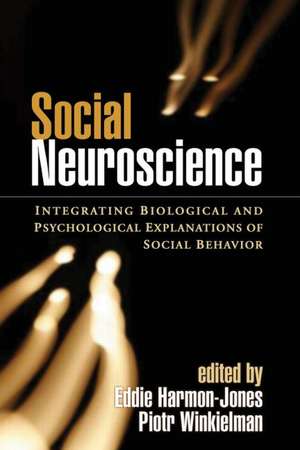
Social Neuroscience: Integrating Biological and Psychological Explanations of Social Behavior
Editat de Eddie Harmon-Jones, Piotr Winkielmanen Limba Engleză Hardback – 8 mar 2007
Analiza interacțiunilor dintre emoție și cogniția socială, facilitată de perspectivele oferite de studiul cortexului orbitofrontal, constituie punctul central al acestui volum riguros. Social Neuroscience propune o integrare necesară între explicațiile biologice și cele psihologice, oferind un cadru structurat pentru înțelegerea modului în care sistemele noastre neurale guvernează comportamentul în societate. Remarcăm organizarea tematică precisă a lucrării, care trece de la o introducere conceptuală spre secțiuni tehnice despre procesele emoționale și motivaționale, culminând cu analize despre stresul social și circuitele de recompensă.
Suntem de părere că forța acestui volum rezidă în capacitatea de a reuni cercetări de ultimă oră despre fenomene precum stereotipizarea și prejudecățile, transformând concepte abstracte în date observabile prin neuroimagistică. Cititorii familiarizați cu The Student's Guide to Social Neuroscience de Jamie Ward vor aprecia în acest volum profunzimea detaliilor tehnice și accentul pus pe programele de cercetare specifice, dincolo de formatul clasic de manual. Spre deosebire de lucrările introductive, volumul editat de Eddie Harmon-Jones și Piotr Winkielman se adresează profesioniștilor care caută să înțeleagă mecanismele fiziologice fine, precum activitatea corticală frontală asimetrică în raport cu motivația.
Structura editorială reflectă o progresie logică: de la recunoașterea emoțiilor la controlul cognitiv al sentimentelor. Apreciem în mod deosebit capitolul dedicat testului de stres social Trier, care oferă o perspectivă aplicată asupra modului în care mediul influențează biologia umană. Cartea reușește să sintetizeze un deceniu de progrese, devenind o resursă esențială pentru cercetătorii care doresc să depășească barierele disciplinare dintre psihologia socială și neuroștiințe.
Preț: 717.86 lei
Preț vechi: 886.25 lei
-19%
Carte tipărită la comandă
Livrare economică 23 noiembrie-07 decembrie
Specificații
ISBN-10: 1593854048
Pagini: 512
Ilustrații: Illustrations
Dimensiuni: 156 x 234 x 30 mm
Greutate: 0.85 kg
Ediția:New.
Editura: Guilford Publications
Colecția Guilford Press
V-ar putea interesa
-
 -26%Preț: 537.55 lei725.94 lei
 -
 -30%Preț: 594.01 lei851.59 lei
 -
 Consciousness: Creeping up on the hard problemJeffrey Gray-28%Preț: 494.06 lei688.59 lei
 -
 Law and the BrainSemir Zeki-28%Preț: 465.90 lei650.34 lei
 -
 Molecules Of Emotion: Why You Feel The Way You FeelCandace Pert-32%Preț: 54.20 lei79.55 lei
 -
 Achilles in VietnamJonathan ShayPreț: 104.13 lei
 -
 The Emotional BrainJoseph LedouxPreț: 118.66 lei
 -
 Into the Silent LandPaul BroksPreț: 91.82 lei
 -
 The Art of LovingErich FrommPreț: 71.06 lei
Public țintă
Professional Practice & DevelopmentDe ce să citești această carte
Această lucrare este esențială pentru psihologi, neurocercetători și studenți avansați care doresc să înțeleagă bazele biologice ale interacțiunii umane. Veți câștiga o perspectivă integrată asupra modului în care creierul procesează informația socială, de la mecanismele empatiei până la circuitele neurale ale prejudecății. Este un instrument teoretic solid care explică nu doar „cum” ne comportăm, ci și „de ce” biologia noastră dictează dinamica socială.
Despre autor
Eddie Harmon-Jones, PhD, este conferențiar de psihologie la Texas A&M University, fiind un specialist recunoscut în studiul circuitelor neurale ale emoțiilor și motivațiilor. Activitatea sa de cercetare este susținută de instituții prestigioase precum National Institute of Mental Health. În contextul operei sale, acest volum continuă preocupările explorate în Cognitive Dissonance, unde a analizat evoluția teoriilor psihologice clasice, și în Motivation and Its Regulation, extinzând analiza de la procese pur cognitive spre substratul lor biologic complex.
Descriere scurtă
Notă biografică
Piotr Winkielman, PhD, is an Associate Professor of Psychology at the University of California, San Diego. Dr. Winkielman’s current research focuses on the relation between emotion, cognition, body, and consciousness using psychological and psychophysiological approaches. His research has been supported by the National Science Foundation and the National Alliance for Autism Research. He has served on the editorial boards of the Journal of Personality and Social Psychology and Personality and Social Psychology Bulletin, and is currently Associate Editor of Emotion. In 2005 Dr. Winkielman coedited Emotion and Consciousness.
Cuprins
1. A Brief Overview of Social Neuroscience, Eddie Harmon-Jones and Piotr Winkielman
II. Emotion Processes
2. The Importance of Emotion–Social Cognition Interactions for Social Functioning: Insights from Orbitofrontal Cortex, Jennifer S. Beer
3. Neurobiology of Emotion Recognition: Current Evidence for Shared Substrates, Andrea S. Heberlein and Ralph Adolphs
4. Ten Years of Research with the Trier Social Stress Test—Revisited, Brigitte M. Kudielka, Dirk H. Hellhammer, and Clemens Kirschbaum
5. I Know How You Feel: Social and Emotional Information Processing in the Brain, Catherine J. Norris and John T. Cacioppo
6. How Thinking Controls Feeling: A Social Cognitive Neuroscience Approach, Kevin N. Ochsner
III. Motivation Processes
7. Asymmetrical Frontal Cortical Activity, Affective Valence, and Motivational Direction, Eddie Harmon-Jones
8. Reward: Neural Circuitry for Social Valuation, Brian Knutson and G. Elliott Wimmer
9. A Biobehavioral Model of Implicit Power Motivation Arousal, Reward, and Frustration, Oliver C. Schultheiss
10. Vigilant and Avoidant Responses to Angry Facial Expressions: Dominance and Submission Motives, Jack van Honk and Dennis J. L. G. Schutter
IV. Attitudes and Social Cognition
11. Attitudes and Evaluation: Toward a Component Process Framework, William A. Cunningham and Marcia K. Johnson
12. A Social Cognitive Neuroscience Model of Human Empathy, Jean Decety
13.How Dynamics of Thinking Create Affective and Cognitive Feelings: Psychology and Neuroscience of the Connection between Fluency, Liking, and Memory, Tedra A. Fazendeiro, Troy Chenier, and Piotr Winkielman
14. The X- and C-Systems: The Neural Basis of Automatic and Controlled Social Cognition, Matthew D. Lieberman
15. An Evolutionary Perspective on Domain Specificity in Social Intelligence, Valerie E. Stone
V. Person Perception, Stereotyping, and Prejudice
16. Mechanisms for the Regulation of Intergroup Responses: Insights from a Social Neuroscience Approach, David M. Amodio, Patricia G. Devine, and Eddie Harmon-Jones
17. Social Cognitive Neuroscience of Person Perception: A Selective Review Focused on the Event-Related Brain Potential, Bruce D. Bartholow and Cheryl L. Dickter
18. Social Neuroscience and Social Perception: New Perspectives on Categorization, Prejudice, and Stereotyping, Tiffany A. Ito, Eve Willadsen-Jensen, and Joshua Correll
VI. Interpersonal Relationships
19. Neuropeptides and the Protective Effects of Social Bonds, C. Sue Carter
20. The Quiet Revolution of Existential Neuroscience, Marco Iacoboni
21. Affiliative Responses to Stress: A Social Neuroscience Model, Shelley E. Taylor and Gian C. Gonzaga
22. The Social Neuroscience of Relationships: An Examination of Health-Relevant Pathways, Bert N. Uchino, Julianne Holt-Lunstad, Darcy Uno, Rebecca Campo, and Maija Reblin
Recenzii
For students unfamiliar with the field, Social Neuroscience provides an accessible overview of the major topics of study and makes a strong case for the need for more research on the physiological and neurological bases of social behavior. In the classroom, this book would be beneficial to advanced undergraduates or graduate students interested in either social psychology or cognitive/behavioral neuroscience.--Sarah Wood, PhD, Department of Psychology, University of Wisconsin-Stout
James Watson once said, 'there are only molecules; everything else is sociology.' His tongue-in-cheek arrogance reminds us of the great gulf that once separated the 'two cultures' of humanities and science. In the last decade this gap is successfully being bridged by social neuroscience. This fine edited volume presents a readable, comprehensive overview of this exciting new field.--V. S. Ramachandran, MD, PhD, Center for Brain and Cognition, University of California, San Diego