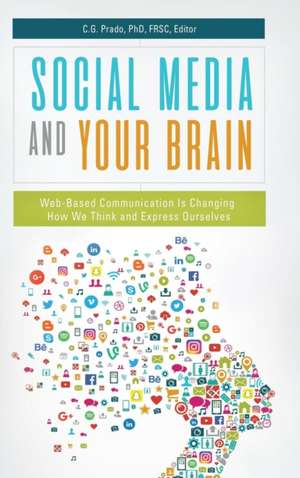
Social Media and Your Brain: Web-Based Communication Is Changing How We Think and Express Ourselves
Editat de Professor C.G. Pradoen Limba Engleză Hardback – 21 noi 2016
The ubiquitous use of the Internet and social media is changing our society-in some ways, for the worse. Use of social media, the Internet, and other purely digital and less-personal communication methods are distorting the intellectual and social maturation of teens and preteens in particular-those among us who were born into and raised with Internet technology. People's ability to read facial expressions, interpret subtle differences in spoken intonation, and perceive body language is in significant decline due to the use of social media and the Internet largely replacing direct, face-to-face contact with other human beings.
This book documents how changes in our daily behavior caused by the proliferation of social media are reshaping individuals' personalities and causing an evolution of the character of our society as a whole. Readers will understand how these important changes came about and how more connectivity all too often leads to more ignorance and less comprehension, and will consider solutions that could counter the negative effects of being "too connected, too often."
Preț: 331.56 lei
Preț vechi: 463.31 lei
-28%
Puncte Express: 497
Carte tipărită la comandă
Livrare economică 20 noiembrie-04 decembrie
Livrare prin curier în România Termenul estimat este afișat lângă disponibilitate.
Transport gratuit de la 400.00 lei Plată online sau ramburs, în funcție de opțiunile comenzii.
Retur gratuit în 14 zile Comandă securizată și suport în română.
Specificații
ISBN-13: 9781440854538
ISBN-10: 144085453X
Pagini: 172
Dimensiuni: 156 x 235 x 14 mm
Greutate: 0.45 kg
Editura: Bloomsbury Publishing
Colecția Praeger
Locul publicării:New York, United States
ISBN-10: 144085453X
Pagini: 172
Dimensiuni: 156 x 235 x 14 mm
Greutate: 0.45 kg
Editura: Bloomsbury Publishing
Colecția Praeger
Locul publicării:New York, United States
Cuprins
Chapter Synopses
Introduction
C. G. Prado
Chapter 1 The Role of Habit
C. G. Prado
Chapter 2 Bored, Addicted, or Both: How We Use Social Media Now
Mark Kingwell
Chapter 3 Attention, Emotion, and Desire in the Age of Social Media
Khadija Coxon
Chapter 4 Social Media and Self-Control: The Vices and Virtues of Attention
Juan Pablo Bermúdez
Chapter 5 Does Social Media Interfere with the Capacity to Make Reasoned Arguments?
Chris Beeman
Chapter 6 Exclusive Spaces
Alex Leitch
Chapter 7 Social Media and Communicative Unlearning: Learning to Forget in Communicating
Paul Fairfield
Chapter 8 Prices Paid for Social Media Use
Lawrie McFarlane
Afterword: Realizing the Consequences of Internet and Social Media Usage
Bruce MacNaughton
Bibliography
About the Editor and Contributors
Index
Introduction
C. G. Prado
Chapter 1 The Role of Habit
C. G. Prado
Chapter 2 Bored, Addicted, or Both: How We Use Social Media Now
Mark Kingwell
Chapter 3 Attention, Emotion, and Desire in the Age of Social Media
Khadija Coxon
Chapter 4 Social Media and Self-Control: The Vices and Virtues of Attention
Juan Pablo Bermúdez
Chapter 5 Does Social Media Interfere with the Capacity to Make Reasoned Arguments?
Chris Beeman
Chapter 6 Exclusive Spaces
Alex Leitch
Chapter 7 Social Media and Communicative Unlearning: Learning to Forget in Communicating
Paul Fairfield
Chapter 8 Prices Paid for Social Media Use
Lawrie McFarlane
Afterword: Realizing the Consequences of Internet and Social Media Usage
Bruce MacNaughton
Bibliography
About the Editor and Contributors
Index
Recenzii
In the end, Prado and company believe, social media has not been properly analyzed and may have unknown and uncalculated consequences. Summing Up: Recommended. Upper-division undergraduates through faculty.
This book would be beneficial to therapists, sociologists, educators, and students to show how social media change our approach in our daily lives.
This book would be beneficial to therapists, sociologists, educators, and students to show how social media change our approach in our daily lives.