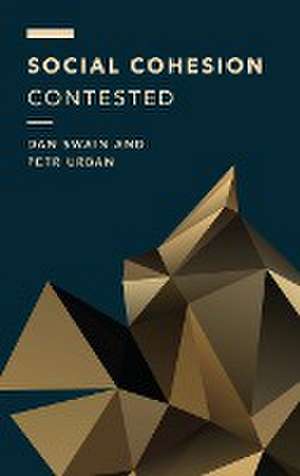
Social Cohesion Contested: Off the Fence: Morality, Politics and Society
Autor Dan Swain, Petr Urbanen Limba Engleză Hardback – 5 ian 2024
Dan Swain and Petr Urban trace the rise of the concept through the policy agendas of transnational and international bodies, and analyze the reactions of social researchers to the demands of policymakers for a clear and operationalizable concept. They argue that the term is frequently used in a way that assumes broad understanding and agreement, while in practice it is subject to contradictory definitions and often loaded with various implicit and explicit values, which become masked behind a veneer of scientific authority and normative legitimacy. The more that social cohesion is treated as a single substance with a clear and uncontroversial meaning, the more it narrows the space for debate and contestation around both the policies adopted in its name and the understanding of the social on which it rests. In contrast, if social cohesion is to mean anything it ought to be understood explicitly as a contested concept, and actively subject to contestation. The book thus provides not only a critique of a popular concept, but an example of engaged philosophical criticism of social research and policy.



Preț: 489.63 lei
Preț vechi: 720.29 lei
-32%
Puncte Express: 734
Carte tipărită la comandă
Livrare economică 19 noiembrie-03 decembrie
Livrare prin curier în România Termenul estimat este afișat lângă disponibilitate.
Transport gratuit pentru acest produs Plată online sau ramburs, în funcție de opțiunile comenzii.
Retur gratuit în 14 zile Comandă securizată și suport în română.
Specificații
ISBN-13: 9781538176627
ISBN-10: 1538176629
Pagini: 156
Dimensiuni: 160 x 234 x 18 mm
Greutate: 0.4 kg
Editura: Bloomsbury Publishing
Colecția Rowman & Littlefield
Seria Off the Fence: Morality, Politics and Society
Locul publicării:New York, United States
ISBN-10: 1538176629
Pagini: 156
Dimensiuni: 160 x 234 x 18 mm
Greutate: 0.4 kg
Editura: Bloomsbury Publishing
Colecția Rowman & Littlefield
Seria Off the Fence: Morality, Politics and Society
Locul publicării:New York, United States
Cuprins
Introduction
Chapter 1: Staking Out the Terrain - Key Trends and Directions In Social Cohesion
Chapter 2: From Radars to Regimes - Concepts Of Social Cohesion In Focus
Chapter 3: Between Economic Growth and Social Rights - European Policy Discourse
Chapter 4: Exporting Cohesive Societies - Social Cohesion and International Development
Chapter 5: Contesting Social Cohesion
Bibliography - Part A: Policy Literature
Bibliography - Part B: Research Literature
Index
About the Authors
Chapter 1: Staking Out the Terrain - Key Trends and Directions In Social Cohesion
Chapter 2: From Radars to Regimes - Concepts Of Social Cohesion In Focus
Chapter 3: Between Economic Growth and Social Rights - European Policy Discourse
Chapter 4: Exporting Cohesive Societies - Social Cohesion and International Development
Chapter 5: Contesting Social Cohesion
Bibliography - Part A: Policy Literature
Bibliography - Part B: Research Literature
Index
About the Authors
Recenzii
In Social Cohesion Contested, Dan Swain and Petr Urban problematize the taken-for-granted concept of social cohesion. They argue social cohesion narratives often unwittingly romanticize and reify an oppressive status quo, thus skirting democratic deliberation and critique. Social theorists of all disciplines will find this a timely and insightful contribution.
In a wide-ranging text, Dan Swain and Petr Urban provide an impressive critical analysis of the notion of social cohesion increasingly invoked in analysis and policy in relation to rising concerns about the sustainability and stability of late modern social life. Social Cohesion Contested is an invaluable text for challenging understandings of our increasingly precarious times.
This thought-provoking book urges a critical view on social cohesion. While cohesion appears preferable to conflict, the authors convincingly demonstrate how political efforts to promote it can result in injustices and exclusions, hampering a legitimate approach to diversity in liberal-democratic societies. A highly valuable contribution to academic and public debates.
What social cohesion means depends on who is using the term. The more often it's taught as a concept in policy intervention programs, the more vigilant we need to be regarding its use. What meanings are being pushed or erased? What tacit normality and intentions dominate? This book provides the tools to answer those questions.
Is social cohesion a reality or just a trade name? The question arises at a time when equality, equity, access to fundamental rights and economic well-being for all seem to have become empty concepts. In order to respond to this challenge, and with the most scrupulous rigor, Urban and Swain examine whether horizontal practices of solidarity and mutual aid do not succeed where states fail. A must read.
This elegant book shows how the concept of social cohesion has become an unquestioned policy aim through perceptive analyses of its use in various regional and international institutions since the 1990s. It can be read by politicians, researchers, leading civil servants and interested academics alike. The book offers a fresh and much-needed critical perspective to current policy discourses and to the technocratic role of social research in their diffusion. It reminds us of the value of political debates about the good society, where no concept is ever settled-and of the significant role of self-reflexive social science research.
In this book, Dan Swain and Petr Urban disentangle the dominant concept of social cohesion, as one of stability against singular threats, in social policy and academic research tracing its current reappearance to the pandemic. They rigorously map the limits of abstract universalist understanding of social cohesion as instrumentalist, and its contextually rooted particularist counterpart as erasing its distinctness. They ably underscore the quandaries beneath its claims to scientific authority and normative legitimacy, as they critically unfold the histories of social cohesion. Swain and Urban reveal these histories to be intersecting, as they move beyond the European context of social cohesion to reflect on its global ramifications in the approaches of international bodies aiming at development. They caution that good intentions notwithstanding, policies based on a singular concept of social cohesion emphasizing measurement are restrictive in neglecting social diversity, especially in non-Western contexts. Although a picture of gloom emerges in their detailed account of the hegemonic model of social cohesion, Swain and Urban urge their readers to philosophically and critically reflect on notions of progress, freedom and civil society that center around social cohesion. Aptly showing critique and reconstruction as two dimensions of what W.B. Gallie terms as an 'essentially contested' concept, they suggest that the notion of social cohesion be rethought in more democratic and participatory ways. Social Cohesion Contested is a thought-provoking account of social cohesion that establishes the lens of interdisciplinarity as integral to its project. As a timely and important work, this book is indispensable for systematically reflecting on social cohesion. It offers hope in these troubled times by bringing theory and practice together. A must read for both social scientists and philosophers!
[This title] offers numerous valuable insights with respect to both social cohesion itself and the nexus between academia and public policy more generally. It is readable and accessible, without shying away from complexity, and its clear and refreshingly direct approach makes it a particularly valuable articulation of an important perspective. It is a welcome addition to the literature.
In a wide-ranging text, Dan Swain and Petr Urban provide an impressive critical analysis of the notion of social cohesion increasingly invoked in analysis and policy in relation to rising concerns about the sustainability and stability of late modern social life. Social Cohesion Contested is an invaluable text for challenging understandings of our increasingly precarious times.
This thought-provoking book urges a critical view on social cohesion. While cohesion appears preferable to conflict, the authors convincingly demonstrate how political efforts to promote it can result in injustices and exclusions, hampering a legitimate approach to diversity in liberal-democratic societies. A highly valuable contribution to academic and public debates.
What social cohesion means depends on who is using the term. The more often it's taught as a concept in policy intervention programs, the more vigilant we need to be regarding its use. What meanings are being pushed or erased? What tacit normality and intentions dominate? This book provides the tools to answer those questions.
Is social cohesion a reality or just a trade name? The question arises at a time when equality, equity, access to fundamental rights and economic well-being for all seem to have become empty concepts. In order to respond to this challenge, and with the most scrupulous rigor, Urban and Swain examine whether horizontal practices of solidarity and mutual aid do not succeed where states fail. A must read.
This elegant book shows how the concept of social cohesion has become an unquestioned policy aim through perceptive analyses of its use in various regional and international institutions since the 1990s. It can be read by politicians, researchers, leading civil servants and interested academics alike. The book offers a fresh and much-needed critical perspective to current policy discourses and to the technocratic role of social research in their diffusion. It reminds us of the value of political debates about the good society, where no concept is ever settled-and of the significant role of self-reflexive social science research.
In this book, Dan Swain and Petr Urban disentangle the dominant concept of social cohesion, as one of stability against singular threats, in social policy and academic research tracing its current reappearance to the pandemic. They rigorously map the limits of abstract universalist understanding of social cohesion as instrumentalist, and its contextually rooted particularist counterpart as erasing its distinctness. They ably underscore the quandaries beneath its claims to scientific authority and normative legitimacy, as they critically unfold the histories of social cohesion. Swain and Urban reveal these histories to be intersecting, as they move beyond the European context of social cohesion to reflect on its global ramifications in the approaches of international bodies aiming at development. They caution that good intentions notwithstanding, policies based on a singular concept of social cohesion emphasizing measurement are restrictive in neglecting social diversity, especially in non-Western contexts. Although a picture of gloom emerges in their detailed account of the hegemonic model of social cohesion, Swain and Urban urge their readers to philosophically and critically reflect on notions of progress, freedom and civil society that center around social cohesion. Aptly showing critique and reconstruction as two dimensions of what W.B. Gallie terms as an 'essentially contested' concept, they suggest that the notion of social cohesion be rethought in more democratic and participatory ways. Social Cohesion Contested is a thought-provoking account of social cohesion that establishes the lens of interdisciplinarity as integral to its project. As a timely and important work, this book is indispensable for systematically reflecting on social cohesion. It offers hope in these troubled times by bringing theory and practice together. A must read for both social scientists and philosophers!
[This title] offers numerous valuable insights with respect to both social cohesion itself and the nexus between academia and public policy more generally. It is readable and accessible, without shying away from complexity, and its clear and refreshingly direct approach makes it a particularly valuable articulation of an important perspective. It is a welcome addition to the literature.