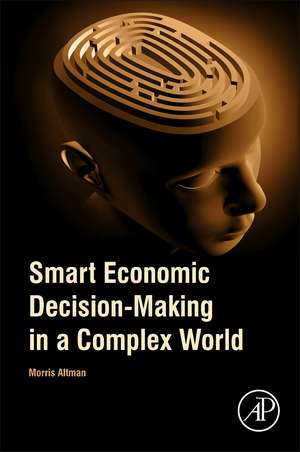
Smart Economic Decision-Making in a Complex World
Autor Morris Altmanen Limba Engleză Paperback – 26 mai 2020
Subliniem faptul că procesul decizional într-o lume marcată de incertitudine necesită mai mult decât simple teorii abstracte; necesită cadre de analiză adaptate realității. Smart Economic Decision-Making in a Complex World oferă cititorului instrumentele practice necesare pentru a naviga între asumpțiile realiste și construcția de modele robuste. Remarcăm utilizarea șabloanelor de gândire care explică cum și când comportamentul non-neoclasic devine cea mai bună practică pentru atingerea eficienței.
Structura volumului este riguros organizată în zece capitole, ghidând cititorul de la evoluția instituțiilor și impactul complexității, până la aplicații critice în alfabetizarea financiară și funcționarea pieței muncii. Dacă Decision Theory and Choices: a Complexity Approach v-a oferit cadrul teoretic al preferințelor consistente, această carte oferă instrumentele practice pentru a înțelege 'cutia neagră' a firmei și modul în care puterea și preferințele influențează productivitatea reală.
În contextul operei sale, Morris Altman continuă explorarea începută în Economic Growth and the High Wage Economy, mutând însă accentul de la cadrul teoretic al piețelor de muncă spre mecanismul intim al alegerii individuale și colective. Recomandăm această lucrare pentru modul în care reușește să integreze economia comportamentală într-un format accesibil, similar stilului din Behavioral Economics For Dummies, dar păstrând rigoarea academică necesară nivelului universitar. Analiza oferă o perspectivă clară asupra modului în care politicile greșite pot conduce la șomaj involuntar și cum, prin decizii inteligente, se poate maximiza bunăstarea socială.
Preț: 506.07 lei
Preț vechi: 705.63 lei
-28%
Carte tipărită la comandă
Livrare economică 25 noiembrie-09 decembrie
Specificații
ISBN-10: 0128114614
Pagini: 302
Dimensiuni: 152 x 229 mm
Greutate: 0.4 kg
Editura: ELSEVIER SCIENCE
V-ar putea interesa
-
 -27%Preț: 585.61 lei802.21 lei
 -
 -18%Preț: 298.11 lei362.98 lei
 -
 -29%Preț: 618.96 lei877.93 lei
 -
 Waking the Asian Pacific Co-operative PotentialMorris Altman-29%Preț: 624.00 lei880.50 lei
 -
 The Era of Chinese Multinationals: Competing for Global DominanceLourdes Casanova-30%Preț: 480.76 lei682.06 lei
 -
 -18%Preț: 2060.90 lei2513.30 lei
 -
 Optimisation in Economic AnalysisGordon Mills-18%Preț: 2032.51 lei2478.67 lei
 -
 -18%Preț: 1127.37 lei1374.85 lei
 -
 Economics of PhysiocracyRonald L. Meek-18%Preț: 2495.67 lei3043.50 lei
 -
 Elements of Pure EconomicsLéon Walras-18%Preț: 2536.65 lei3093.48 lei
 -
 Applied Economics and the Critical Realist CritiquePaul DownwardPreț: 327.53 lei
 -
 Handbook of Regional and Urban EconomicsGilles Duranton-24%Preț: 804.61 lei1064.92 lei
 -
 Handbook of Natural Resource and EnergyA.V. Kneese-15%Preț: 381.70 lei451.02 lei
 -
 The Innovation ParadoxRichard Evans FarsonPreț: 73.25 lei
 -
 Worker Satisfaction and Economic PerformanceMorris AltmanPreț: 311.10 lei
 -
 -15%Preț: 658.36 lei774.55 lei
 -
 Behavioural Economics for DummiesMorris AltmanPreț: 118.43 lei
 -
 -15%Preț: 462.55 lei544.18 lei
 -
 -49%Preț: 512.09 lei1009.52 lei
Public țintă
Under(graduate) students in economics and beyond who are interested in decision-making, the process of decision-making, decision making environments, and how real people act in the real world should be interested in this book.De ce să citești această carte
Recomandăm această carte studenților și profesioniștilor care doresc să înțeleagă economia dincolo de graficele ideale. Veți câștiga o metodologie clară pentru a evalua eficiența deciziilor în medii complexe și instrumente practice pentru a analiza comportamentul consumatorilor și dinamica productivității. Este un ghid esențial pentru oricine vrea să aplice principiile economiei comportamentale în politici publice sau management organizațional, transformând teoria în rezultate sociale și economice palpabile.
Descriere scurtă
Additional sections cover when and how efficiency is achieved, why inefficiencies can persist, when and how consumer welfare is maximized, and what benchmarks should be used to determine efficiency and rationality.
- Makes the case for ‘smart and rational’ decision-making as a context-dependent rational process that is framed by socio-cultural environment and conditioned by institutional capacities
- Explains how incorporation of the ‘smart’ decision-maker concept into economic thought improves our understanding of how, why and when people generate certain outcomes
- Explores how economic efficiency can be achieved, individual preferences realized, and social welfare maximized through the use of ‘smart and rational’ approaches
Cuprins
Recenzii
"Contemporary behavioral economics often downplays the founding work of Nobel Laureate Herbert Simon and the Carnegie School. Morris Altman shows that Simon’s original behavioral economics can still offer much insight, particularly in highly complex contexts. Going beyond the focus on ‘errors and biases’ in much of current behavioral economics, Altman develops a rich, dynamic analysis, stressing the role of institutional and environmental factors in decision-making. This is an extremely important book." -- Geoff Hodgson, Professor in Management, Loughborough University London
"Morris Altman’s understanding of behavioral economics is broad and far-reaching. In this book he has drawn on the history of economic thought, economics and ethics, and the methodology of economics to explain how behavioral economics has changed the goals and trajectory of recent economics. Especially valuable is his attention to Herbert Simon’s early contribution and those of Gerd Gigerenzer and his colleagues to an ecological economics. Altman’s assessment of Daniel Kahneman and Amos Tversky’s influential work is perceptive and fresh. This book will be very useful to scholars and students looking for a full understanding of this important development in contemporary economic thinking, and is strongly recommended." --John Davis, Professor Emeritus of Economics, Marquette University
"Altman has written an excellent evolution of behavioral economics, and how it is similar and different from neoclassical theory. Anyone interested in behavioral economics will find this book interesting and informative." -- Roger Frantz, Professor Emeritus of Economics, San Diego State University
Notă biografică
Morris Altman is Chair Professor of Behavioural and Institutional Economics and Co-operatives at the University of Dundee, United Kingdom, and former Inaugural Dean of Dundee University Business School. He has previously served as Dean at the University of Newcastle, Australia, Head of School at Victoria University of Wellington, New Zealand, and Head of Department at the University of Saskatchewan, Canada. Morris was a former visiting scholar at Cambridge, Canterbury, New Zealand, Cornell, Duke, Harvard, Hebrew, Stirling, and Stanford University. He has published more than 130 refereed articles and 20 books in behavioural economics, institutional economics, cooperative studies, governance, and sustainable development. Professor Altman is co-founder and Editor-in-Chief of the Review of Behavioural Economics and has held leadership roles in numerous international academic and professional organizations, including Association for Social Economics the Society for the Advancement of Behavioral Economics. He also served on research committees of the International Co-operative Alliance.