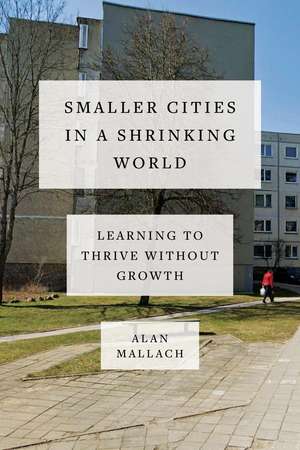
Smaller Cities in a Shrinking World: Learning to Thrive Without Growth
Autor Alan Mallachen Limba Engleză Hardback – 13 iun 2023
În literatura de specialitate dedicată urbanismului, Smaller Cities in a Shrinking World aduce o perspectivă proactivă asupra unei realități adesea ignorate: sfârșitul erei creșterii demografice constante. Dacă lucrări anterioare se concentrau pe gestionarea crizei, Alan Mallach propune aici un model de prosperitate independent de expansiunea numerică. Remarcăm curajul autorului de a contesta „motto-ul global” al ultimului secol — „mai mult, mai mult, mai mult” — demonstrând că declinul populației nu trebuie să fie sinonim cu degradarea economică sau socială.
Această lucrare completează perspectiva oferită de Shrinking Cities de Harry W. Richardson, adăugând o dimensiune practică și speranță acolo unde Richardson se concentra pe cauzele structurale și macro-regiuni. În timp ce Empty Planet de Darrell Bricker avertizează asupra colapsului demografic la nivel global, Mallach coboară analiza la nivelul străzii, explorând concepte precum „urban prairie” și reutilizarea spațiilor vacante. Autorul își rafinează aici viziunea expusă în Rebuilding America's Legacy Cities, extinzând cadrul de analiză dincolo de granițele SUA, către orașele din Japonia și Europa de Est, oferind astfel o analiză comparativă rară în domeniu.
Structura cărții este riguroasă, ghidând cititorul de la contextul istoric al orașelor în contracție, prin mecanismele migrației și demografiei, până la soluții concrete pentru orașe „mai subțiri, dar mai verzi”. Suntem de părere că abordarea lui Mallach este esențială pentru planificatorii urbani contemporani, deoarece transformă o „amenințare” demografică într-o oportunitate de a reconstrui medii sociale sustenabile, centrate pe calitatea vieții, nu pe volumul capitalului.
Preț: 236.60 lei
Carte disponibilă
Livrare economică 12-26 noiembrie
Livrare express 29 octombrie-04 noiembrie pentru 37.80 lei
Specificații
ISBN-10: 1642832278
Pagini: 336
Ilustrații: 55 photos and illustrations
Dimensiuni: 152 x 229 x 30 mm
Greutate: 0.57 kg
Editura: Island Press
Colecția Island Press
V-ar putea interesa
-
 -9%Preț: 824.60 lei906.15 lei
 -
 Rebuilding America's Legacy CitiesAlan MallachPreț: 138.63 lei
 -
 Preț: 149.17 lei
 -
 Preț: 225.34 lei
 -
 Sotsioekonomika truda i predprinimatel'stvaAlekseev O.-8%Preț: 466.24 lei506.78 lei
 -
 Tyur'ma i tvorchestvoTishchenko Natal'ya-8%Preț: 464.76 lei505.17 lei
 -
 Democratic DecentralisationAnu GeorgePreț: 324.11 lei
 -
 Hiv Risk Behavior PracticesBinyam ShimelisPreț: 310.49 lei
 -
 Preț: 445.25 lei
 -
 Skill-Based Pay and Employee AttitudesMohammed A. Al-WaqfiPreț: 375.61 lei
 -
 Bezopasnost' personalaUl'yanov VladimirPreț: 375.97 lei
 -
 -8%Preț: 470.20 lei511.08 lei
 -
 Purdah Discourse: An Anthropological StudyAnindo Rahman-8%Preț: 398.47 lei433.12 lei
 -
 Preț: 312.52 lei
De ce să citești această carte
Recomandăm această carte oricărui specialist în politici publice sau sociologie care dorește să înțeleagă viitorul post-creștere. Alan Mallach oferă un ghid realist despre cum orașele pot prospera în condiții de declin demografic și schimbări climatice. Cititorul câștigă o înțelegere profundă a modului în care spațiile urbane pot fi reinventate pentru a deveni mai verzi și mai echitabile, transformând abandonul în regenerare sustenabilă.
Despre autor
Alan Mallach este un expert recunoscut la nivel internațional în politici urbane și locuire, cu o carieră ce îmbină cercetarea academică cu practica administrativă. A servit ca director de locuințe și dezvoltare economică în Trenton, New Jersey, experiență care i-a oferit o perspectivă directă asupra provocărilor orașelor „legacy”. Este autorul unor lucrări fundamentale precum The Divided City și The Changing American Neighborhood, fiind o voce autoritară în cadrul Brookings Institution și un colaborator constant în proiecte de revitalizare urbană în Statele Unite și Europa.
Descriere scurtă
In Smaller Cities in a Shrinking World, urban policy expert Alan Mallach seeks to understand how declining population and economic growth, coupled with the other forces that will influence their fates, particularly climate change, will affect the world’s cities over the coming decades. What will it mean to have a world full of shrinking cities? Does it mean that they are doomed to decline in more ways than simply population numbers, or can we uncouple population decline from economic decay, abandoned buildings and impoverishment?
Mallach has spent much of the last thirty or more years working in, looking at, thinking, and writing about shrinking cities—from Trenton, New Jersey, where he was director of housing and economic development, to other American cities like Detroit, Flint, and St. Louis, and from there to cities in Japan and Central and Eastern Europe. He has woven together his experience, research, and analysis in this fascinating, realistic yet hopeful look at how smaller, shrinking cities can thrive, despite the daunting challenges they face.
Notă biografică
Cuprins
Introduction: The End of Growth
Chapter 1. The Past, Present, and Future Shrinking City: A Historical Overview
Chapter 2. Demography As Destiny: Beyond the Demographic Transition
Chapter 3. A Restless Species: Migration and the Fate of Cities
Chapter 4. Land and Buildings in the Shrinking City: Households, Vacant Properties, and the Urban Prairie
Chapter 5. Social and Economic Conditions in the Shrinking City: The Effects of Population Decline
Chapter 6. A Difficult Future: Three Global Challenges for the World’s Shrinking Cities
Chapter 7. Embracing the End of Growth: Rethinking Cities in a Shrinking World
Chapter 8. Thinner, Greener Cities: Greening the Urban Environment
Chapter 9. Cities are People: Building a Sustainable Social and Economic Environment
Chapter 10. The Future of American Shrinking Cities: Can the United States Learn to Be a Smaller Country, and Can Cities Learn to Change?
Chapter 11. Learning to Thrive in a Shrinking World: How Do We Get There?
Notes
About the Author
Index