Cantitate/Preț
Produs

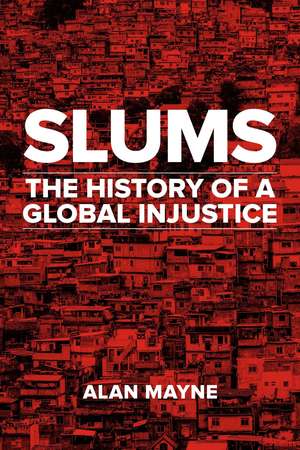
Slums

Autor Alan Mayne
en Limba Engleză Hardback – iul 2017

Notăm cu interes cum Slums propune o deconstrucție riguroasă a unui termen care, timp de două secole, a funcționat mai degrabă ca un stigmat social decât ca o descriere geografică neutră. Analiza pornește de la studiile de caz ale Londrei victoriene și ajunge până la controversele recente legate de favelele din Rio de Janeiro, demonstrând cum politicile publice au eșuat constant în a înțelege dinamica internă a acestor spații. Credem că forța acestui volum rezidă în capacitatea autorului de a privi dincolo de clișeele dezorganizării sociale, scoțând la lumină structuri complexe de solidaritate și organizare comunitară.

Alan Mayne investighează modul în care eticheta de „mahalaua” a fost folosită sistematic pentru a condamna comunitățile sărace, transformând agenda politică într-una represivă sau de neglijare. Cititorii familiarizați cu The Challenge of Slums publicat de UN-Habitat vor aprecia modul în care acest volum aduce o perspectivă istorică și umanistă mult mai profundă, refuzând să trateze subiectul doar prin prisma statisticilor demografice. Dacă lucrările anterioare ale autorului, precum The Archaeology of Urban Landscapes, explorau cultura materială a acestor spații prin artefacte, Slums sintetizează aceste cercetări într-o pledoarie pentru reformă lingvistică și socială.

Această ediție publicată de REAKTION BOOKS oferă o perspectivă globală esențială pentru înțelegerea urbanismului contemporan. Găsim în text o critică argumentată la adresa inerției administrative, autorul demonstrând că „problema” nu sunt oamenii, ci modul în care spațiul lor de locuire este definit și gestionat de către autorități.

Citește tot Restrânge

Preț: 20350 lei

Preț vechi: 24050 lei
-15%

Puncte Express: 305

Carte disponibilă

Livrare economică 01-08 iunie
Livrare express 15-21 mai pentru 8631 lei


Specificații

ISBN-13: 9781780238098
ISBN-10: 1780238096
Pagini: 360
Dimensiuni: 162 x 241 x 35 mm
Greutate: 0.71 kg
Editura: REAKTION BOOKS

De ce să citești această carte

O lectură esențială pentru studenții la istorie urbană, sociologie și politici publice. Alan Mayne oferă argumentele necesare pentru a regândi modul în care societatea se raportează la sărăcia urbană, demonstrând că schimbarea începe cu limbajul pe care îl folosim. Veți câștiga o perspectivă critică asupra evoluției orașelor moderne și a mecanismelor de excludere socială care persistă de peste 200 de ani.


Despre autor

Alan Mayne este profesor asociat în cadrul Departamentului de Istorie de la Universitatea din Melbourne și o autoritate recunoscută în studiul istoriei urbane și sociale. Cariera sa a fost dedicată explorării comunităților marginalizate, publicând lucrări de referință precum „The Imagined Slum” (1993) și „Represent the Slum” (1991). Expertiza sa îmbină rigoarea documentării istorice cu o înțelegere profundă a arheologiei peisajelor urbane, abordare vizibilă și în colaborările sale pentru volume de cercetare interdisciplinară. Prin opera sa, Mayne a contestat constant miturile despre „clasele periculoase” și a analizat impactul urbanizării asupra identităților colective.


Descriere scurtă

More than half of the world’s population now lives in urban areas, and a billion of these urban dwellers reside in neighborhoods of entrenched disadvantage—neighborhoods that are characterized  as slums. Slums are often seen as a debilitating and even subversive presence within society. In reality, though, it is public policies that are often at fault, not the people who live in these neighborhoods.

In this comprehensive global history, Alan Mayne explores the evolution and meaning of the word “slum,” from its origins in London in the early nineteenth century to its use as a slur against the favela communities in the lead-up to the Rio Olympics in 2016. Mayne shows how the word slum has been extensively used for two hundred years to condemn and disparage poor communities, with the result that these agendas are now indivisible from the word’s essence. He probes beyond the stereotypes of deviance, social disorganization, inertia, and degraded environments to explore the spatial coherence, collective sense of community, and effective social organization of poor and marginalized neighborhoods over the last two centuries.

In mounting a case for the word’s elimination from the language of progressive urban social reform, Slums is a must-read book for all those interested in social history and the importance of the world’s vibrant and vital neighborhoods.

Notă biografică

Alan Mayne is visiting professor in the Centre for Urban History at the University of Leicester and adjunct professor at the University of South Australia.

Recenzii

“A billion people live in the shadow cities we call slums. Mayne’s trenchant social history traces how perception of them shifted. Victorians saw them as labyrinths or vortices—‘topsy-turvy’ realms of otherness. Today, they are more likely to be viewed as resilient hubs of innovation. Yet developers’ war on slums has seen no ceasefire. It’s hard to refute Mayne’s estimation: ‘We invent them to explain to ourselves the ugly traits, the logical incongruities, and the social inequalities of modern capitalist cities.’”

"Mayne's reach is impressively wide, ranging confidently over the policies an initiatives of not only the global south (As well as India, he cites evidence from Hong Kong, Singapore, Indonesia, Kenya, Nigeria, and Brazil) but the contemporary developed world too, where the clearance of areas condemned as obsolete or substandard has returned from time to time to disrupt and scarify the lives of the poor. . . . Inevitably Slums  is about failure. Mayne is candid about offering no solution to the problem he so comprehensively dissects. It is the dissection itself, laying bare the history of the slum label and exposing its malevolence, that he hopes will assist the world's policy makers to take a fresh look at the potential for environmentally sustainable informal housing areas, built as they have been, in the developing world at least, by the initiative and sheer hard graft of generations of the planet's poorest."

"Mayne reinforces his position as an academic expert on poverty. His impressive research and use of forceful language drives home his position to readers: the term 'slums' is a historically derived term of derision that is perpetuated by both popular misunderstandings ('slum tourism') and government-driven attempts to mitigate the negative consequences of slums ('slum wars'). The result is a continual misunderstanding of slums throughout the globe, characterized by inaccurate stereotypes, reinforced by existing prejudices against the poor and their locations, and perpetuated by futile government interventions doomed to failure. Mayne has done readers a great favor with his strong and direct approach. By demonstrating the historical development of the 'slum deceits,' the author demonstrates most clearly why determined efforts by governments have proven futile. He presents quite persuasively these failures from the past in order to enable present governments to be more successful in poverty alleviation, beginning with detaching 'slum' from its historically based misunderstandings. It can only be hoped that policy makers will read this book and gain a better understanding of their own flawed view of slums. . . . Highly recommended."

"Mayne argues that the term is so freighted with historical distortions that it should be retired. . . . Mayne’s argument is delivered with great heapings of detail, recitations of centuries of policy in Britain, Australia, India, and the United States, and data on the millions displaced in anti-slum campaigns."

"More than ever, we need broad syntheses that bridge the specialized literatures in which most of us spend our time. That is one reason why Mayne’s Slums. Another is that, by whatever name, slums have been a significant element in the modern urban experience, the object of much planning, policy, and writing. . . . It makes principled connections across time and space. Anyone interested in slums should check it out."

"A wise observer and historian of poverty in India and South Africa, Mayne unveils the hidden face of urban marginality. . . . Mayne tries to differentiate between the representation of slums inspired by the desire to improve them and a more complex reality where inhabitants show resilience and participate in economic life. Improving living conditions no longer means thinking about other people’s lives for them but with them. . . . Mayne’s book, in the line of David Harvey, Joseph Stieglitz, Mike Davis, and more generally, Henri Lefebvre, sheds light on the evolution of social inequalities in urban space."

"Mayne has mined historical archives, finding an overwhelming and recurring prevalence of a damning slum and inevitably anti-slum discourse, both steeped in ethnic and often more crudely racial prejudice. . . . The book is an important antidote to narratives that would have us believe in a progressive or linear evolution over time from crude to more-nuanced policies. Mayne leaves us hoping that an exposure of the continued meaning of the word 'slum' and its perversity may help steer change."

“A tonic and rousing critique of the bad freight carried by the concept of ‘slum.’ Although an obvious offender in my own work, I’m entirely convinced by Mayne’s passionate polemic. No more ‘s’ word from me.”

“That the purportedly poor and marginal insist upon a presence in cities even when faced with seemingly intolerable material conditions is a reality long subjected to dismissals of all kinds. Mayne lacerates these dismissals, this war on the poor, with sweeping historical critique, instead demonstrating how the logics and policies that keep the ‘poor’ unsettled, simultaneously pacified and volatile, constitute a deception, covering over the distorted productivity of inequality, spatial engineering, and the reliance upon those consigned to the margins to regenerate new forms of sociality in face of denigration.”

“Mayne is a leading authority on the history of ‘slums.’ In his new book he turns his attention to the repetitions and continuities in society’s attitudes and policies towards slums worldwide over the past 200 years, from nineteenth-century Britain to the twenty-first-century Global South. His challenging, forthright book exposes how our continued use of the word slum is misleading, deceitful and downright wrong. His book speaks to historians concerned with the relevance of the past, but more especially to planners and policymakers who have ignored or forgotten the past and papered over the real implications of current urban development policies.”