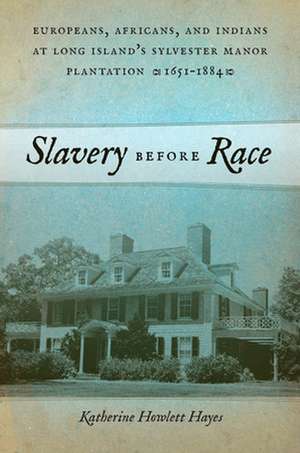
Slavery Before Race
Autor Katherine Howlett Hayesen Limba Engleză Paperback – 22 mai 2014
Preț: 255.53 lei
Puncte Express: 383
Carte tipărită la comandă
Livrare economică 09-23 noiembrie
Livrare prin curier în România Termenul estimat este afișat lângă disponibilitate.
Transport gratuit de la 400.00 lei Plată online sau ramburs, în funcție de opțiunile comenzii.
Retur gratuit în 14 zile Comandă securizată și suport în română.
Specificații
ISBN-13: 9781479802227
ISBN-10: 1479802220
Pagini: 238
Dimensiuni: 153 x 232 x 14 mm
Greutate: 0.37 kg
Editura: NEW YORK UNIVERSITY PRESS
ISBN-10: 1479802220
Pagini: 238
Dimensiuni: 153 x 232 x 14 mm
Greutate: 0.37 kg
Editura: NEW YORK UNIVERSITY PRESS
V-ar putea interesa
-
 Preț: 188.82 lei
 -
 Confront and ConcealDavid E. SangerPreț: 128.63 lei
 -
 Arms and Equipment of the Civil WarJack CogginsPreț: 91.46 lei
 -
 Forgotten Fatherland: The search for Elisabeth NietzscheBen Macintyre-27%Preț: 88.53 lei120.87 lei
 -
 MannahattaEric W SandersonPreț: 328.79 lei
 -
 Empire's CrossroadsCarrie Gibson-33%Preț: 62.81 lei93.26 lei
 -
 A Short History of the American Civil WarPaul Christopher Anderson-23%Preț: 111.23 lei143.89 lei
 -
 -32%Preț: 82.13 lei120.95 lei
 -
 -10%Preț: 124.49 lei138.42 lei
Recenzii
"Hayes offers a skillful and captivating take on some of the big issues in contemporary historical and anthropological scholarship: race, community, material culture, memory, and heritage. This highly readable book will attract and satisfy archaeologists, historians, and general readers alike, and its thoughtful treatment of New York's colonial and 'racial' histories will resonate with researchers of colonialism around the world." Stephen W. Silliman, University of Massachusetts, Boston"Under Katherine Hayes's gifted eye, Shelter Island, NY, becomes the grain of sand within which a whole colonial world may be grasped. Skillfully blending archival and archaeological evidence, she shows Sylvester Manor Plantation to be a crucible of bondage in which Algonquians, Africans, and poor whites labored to provision the Atlantic economy even while beliefs about race drove them apart. Long forgotten (or intentionally suppressed), this colonial history speaks to our present as sharply as it clarifies our past." James F. Brooks, President, School for Advanced Research, Santa Fe
Descriere
Descriere de la o altă ediție sau format:
Addresses the significance of Sylvester Manor's plantation history to American attitudes about diversity, Indian land politics, slavery and Jim Crow, in tension with idealized visions of white colonial community
Addresses the significance of Sylvester Manor's plantation history to American attitudes about diversity, Indian land politics, slavery and Jim Crow, in tension with idealized visions of white colonial community