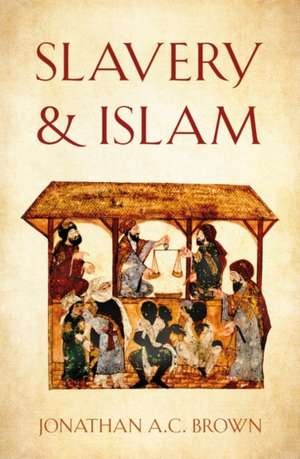
Slavery and Islam
Autor Jonathan A. C. Brownen Limba Engleză Paperback – oct 2020
Preț: 172.39 lei
Puncte Express: 259
Carte disponibilă
Livrare economică 31 octombrie-14 noiembrie
Livrare express 17-23 octombrie pentru 40.50 lei
Livrare prin curier în România Termenul estimat este afișat lângă disponibilitate.
Transport gratuit de la 400.00 lei Plată online sau ramburs, în funcție de opțiunile comenzii.
Retur gratuit în 14 zile Comandă securizată și suport în română.
Specificații
ISBN-13: 9781786078391
ISBN-10: 1786078392
Pagini: 448
Dimensiuni: 145 x 226 x 37 mm
Greutate: 0.52 kg
Editura: Oneworld Publications
ISBN-10: 1786078392
Pagini: 448
Dimensiuni: 145 x 226 x 37 mm
Greutate: 0.52 kg
Editura: Oneworld Publications
V-ar putea interesa
-
 -33%Preț: 576.56 lei854.27 lei
 -
 -20%Preț: 171.72 lei214.63 lei
 -
 Slaves of GodToni AlimiPreț: 254.66 lei
 -
 An African History of AfricaZeinab BadawiPreț: 80.97 lei
 -
 Preț: 76.11 lei
 -
 Islam and BlacknessJonathan A. C. Brown-11%Preț: 250.08 lei279.63 lei
 -
 Friends of God and Slaves of MenKevin BalesPreț: 241.71 lei
 -
 -30%Preț: 99.69 lei142.10 lei
 -
 -19%Preț: 75.29 lei93.27 lei
 -
 God's Book: An Honest Look at the Bible's 7 Toughest TopicsAndrew OllertonPreț: 123.20 lei
 -
 Sexual Ethics and IslamKecia AliPreț: 128.01 lei
 -
 Misquoting MuhammadJonathan A. C. BrownPreț: 109.76 lei
 -
 Slavery and the Scottish EnlightenmentJohn D. O. Fulton-14%Preț: 200.10 lei231.44 lei
 -
 Islam and the Abolition of SlaveryWilliam Gervase Clarence-Smith-24%Preț: 159.71 lei209.28 lei
 -
 Reopening Muslim MindsMustafa AkyolPreț: 93.57 lei
 -
 -17%Preț: 91.76 lei110.30 lei
 -
 The Renewal of Islam: Thinkers and Believers of the Modern EraFitzroy Morrissey-31%Preț: 134.09 lei193.03 lei
 -
 Unbroken ChainsMartin PlautPreț: 222.82 lei
 -
 Islam: An IntroductionCatharina Raudvere-19%Preț: 189.17 lei234.99 lei
 -
 -19%Preț: 92.60 lei114.52 lei
Notă biografică
Jonathan A.C. Brown is Professor and Alwaleed bin Talal Chair of Islamic Civilization in the School of Foreign Service at Georgetown University. He is the author of Slavery & Islam, Misquoting Muhammad and Hadith: Muhammad's Legacy in the Medieval and Modern World, all of which are published by Oneworld. He lives in Virginia.
Cuprins
Preface
Acknowledgments
Notes on transliteration, dates and citation
Introduction: Can We Talk About Slavery?
What I Argue in this Book
Apology for Slavery?
Power and the Study of Slavery
Blackness, Whiteness and Slavery
1 Does 'Slavery' Exist? The Problem of Definition
The Main Argument
Definition: A Creative Process
Definition to Discourse: A Political Process
Defining \¿sl¿-v(¿-)r¿\: We Know It When We See It
Defining Slavery as Status or a Condition
Slavery as Unfreedom
Slavery as Human Property
Patterson & Natal Alienation
Slavery as Distinction: The Lowest Rung & Marginality
Slavery as Coercion & Exploitation under the Threat of Violence
The Problem with Modern-Day Slavery
Slavery & Islam - A Very Political Question
Conclusion: Of Course, Slavery Exists
The Proper Terms for Speaking about 'Slavery'
2 Slavery in the Shariah
What Islam Says about Slavery - Ideals and Reality
Slavery in the Quran & Sunna
Inheriting the Near East - Roman, Jewish and Near Eastern Laws versus Islam
Islam's Reform of Slavery
Basic Principles of Riqq in the Shariah
The Ambiguities of Slavery in the Shariah
Riqq & Rights in the Shariah
Religious Practice
Freedom of Movement
Social and Political Roles
Marriage and Family Life
Right to Property
Rights to Life and Physical Protection
Summary: Law and Ethics
3 Slavery in Islamic Civilization
What is Islamic Civilization?
Is there 'Islamic Slavery'?
The Shariah & Islamic Slavery
Muslims Enslaving Muslims
The Classic Slavery Zone
Consuming People & 'Ascending Miscegenation'
Slave Populations
Routes of the Muslim Slave Trade
Blackness and Slavery in Islamic Civilization
The Roles and Experiences of Slaves in Islamic Civilization
The Slave as Uprooted Person and Commodity
The Slave as Domestic Labor . . . Even Trusted Member of a Household
Slave as Sexual Partner
Slave as Saint, Scholar or Poet
Slave as Elite Administrator & Courtesan
Slave as Soldier - When Soldiers often Ruled
Slave as Rebel
4 The Slavery Conundrum
No Squaring the Circle: The American/Islamic Slavery Conundrum
Slavery is Evil
The Intrinsic Wrongs of Slavery
Religions and Slavery
Minimizing the Unminimizable or Historicizing the Unhistoricizable
Slavery is Slavery: The Problem of Labeling 'Slavery' with One Moral Judgment
The Moral Wrongness of Slavery as Unfreedom
The Moral Wrongness of Slavery as Owning Human Property
The Moral Wrongness of Slavery as Inequality
The Moral Wrongness of Slavery as the Threat of Violence
The Bald Man Fallacy and the Wrongness of Slavery
When Slavery is 'Not that Bad': The Problem with Conditions vs. Formal Categories
Do Some People Deserve to be Enslaved?
Or, Is Freedom a Human Right?
The Past as Moral Authority: Can We Part with the Past?
The Natural Law Tradition and Slavery
Critics of Slavery and the Call for Abolition
The Consequences of Moral Progress
Muslim Efforts to Salvage the Past
5 Abolishing Slavery in Islam
Is Abolition Indigenous to Islam or Not?
Islam as Emancipatory Force - An Alternative History
Abolishing Slavery . . . For Whom? Concentric Circles of Abolition
'The Lawgiver Looks Expectantly Towards Freedom' - Abolition as an Aim of the Shariah
Doubling Down - Progressive Islam & the Axiomatic Evil of Slavery
Prohibited by the Ruler but Not by God: The Crucial Matter of Taqyid al-Mubah
If You Can't Do it Right, You Can't Do it at All - Prohibiting Riqq Poorly Done
Same Shariah, Diff erent Conditions - The Obsolescence or Unfavorability of Slavery
Slavery: A Moot Point & Bad PR
Defending Slavery in Islam
6 The Prophet & ISIS: Evaluating Muslim Abolition
Do Muslim Approaches to Abolition Pass Moral Muster?
A Consensus on Abolition
Could Slavery in Islam ever be Unabolished?
Abolition vs. ISIS
This Author's Opinion
7 Concubines and Consent: Can We Solve the Moral Problem of Slavery?
Species of Moral Change
Moral Disgust at Slavery Today
Conclusion & Crisis: Concubinage and Consent
Consent and Concubines
Disbelief is Unproductive
Appendix 1 - A Slave Saint of Basra
Appendix 2 - Enlightenment Thinkers on Slavery
Appendix 3 - Did the 1926 Muslim World Congress Condemn Slavery?
Appendix 4 - Was M¿riya the Wife or Concubine of the Prophet?
Appendix 5 - Was Freedom a Human Right in the Shariah?
Appendix 6 - Enslavement of Apostate Muslims or Muslims Declared to be Unbelievers
Select Bibliography
Notes
Index
Acknowledgments
Notes on transliteration, dates and citation
Introduction: Can We Talk About Slavery?
What I Argue in this Book
Apology for Slavery?
Power and the Study of Slavery
Blackness, Whiteness and Slavery
1 Does 'Slavery' Exist? The Problem of Definition
The Main Argument
Definition: A Creative Process
Definition to Discourse: A Political Process
Defining \¿sl¿-v(¿-)r¿\: We Know It When We See It
Defining Slavery as Status or a Condition
Slavery as Unfreedom
Slavery as Human Property
Patterson & Natal Alienation
Slavery as Distinction: The Lowest Rung & Marginality
Slavery as Coercion & Exploitation under the Threat of Violence
The Problem with Modern-Day Slavery
Slavery & Islam - A Very Political Question
Conclusion: Of Course, Slavery Exists
The Proper Terms for Speaking about 'Slavery'
2 Slavery in the Shariah
What Islam Says about Slavery - Ideals and Reality
Slavery in the Quran & Sunna
Inheriting the Near East - Roman, Jewish and Near Eastern Laws versus Islam
Islam's Reform of Slavery
Basic Principles of Riqq in the Shariah
The Ambiguities of Slavery in the Shariah
Riqq & Rights in the Shariah
Religious Practice
Freedom of Movement
Social and Political Roles
Marriage and Family Life
Right to Property
Rights to Life and Physical Protection
Summary: Law and Ethics
3 Slavery in Islamic Civilization
What is Islamic Civilization?
Is there 'Islamic Slavery'?
The Shariah & Islamic Slavery
Muslims Enslaving Muslims
The Classic Slavery Zone
Consuming People & 'Ascending Miscegenation'
Slave Populations
Routes of the Muslim Slave Trade
Blackness and Slavery in Islamic Civilization
The Roles and Experiences of Slaves in Islamic Civilization
The Slave as Uprooted Person and Commodity
The Slave as Domestic Labor . . . Even Trusted Member of a Household
Slave as Sexual Partner
Slave as Saint, Scholar or Poet
Slave as Elite Administrator & Courtesan
Slave as Soldier - When Soldiers often Ruled
Slave as Rebel
4 The Slavery Conundrum
No Squaring the Circle: The American/Islamic Slavery Conundrum
Slavery is Evil
The Intrinsic Wrongs of Slavery
Religions and Slavery
Minimizing the Unminimizable or Historicizing the Unhistoricizable
Slavery is Slavery: The Problem of Labeling 'Slavery' with One Moral Judgment
The Moral Wrongness of Slavery as Unfreedom
The Moral Wrongness of Slavery as Owning Human Property
The Moral Wrongness of Slavery as Inequality
The Moral Wrongness of Slavery as the Threat of Violence
The Bald Man Fallacy and the Wrongness of Slavery
When Slavery is 'Not that Bad': The Problem with Conditions vs. Formal Categories
Do Some People Deserve to be Enslaved?
Or, Is Freedom a Human Right?
The Past as Moral Authority: Can We Part with the Past?
The Natural Law Tradition and Slavery
Critics of Slavery and the Call for Abolition
The Consequences of Moral Progress
Muslim Efforts to Salvage the Past
5 Abolishing Slavery in Islam
Is Abolition Indigenous to Islam or Not?
Islam as Emancipatory Force - An Alternative History
Abolishing Slavery . . . For Whom? Concentric Circles of Abolition
'The Lawgiver Looks Expectantly Towards Freedom' - Abolition as an Aim of the Shariah
Doubling Down - Progressive Islam & the Axiomatic Evil of Slavery
Prohibited by the Ruler but Not by God: The Crucial Matter of Taqyid al-Mubah
If You Can't Do it Right, You Can't Do it at All - Prohibiting Riqq Poorly Done
Same Shariah, Diff erent Conditions - The Obsolescence or Unfavorability of Slavery
Slavery: A Moot Point & Bad PR
Defending Slavery in Islam
6 The Prophet & ISIS: Evaluating Muslim Abolition
Do Muslim Approaches to Abolition Pass Moral Muster?
A Consensus on Abolition
Could Slavery in Islam ever be Unabolished?
Abolition vs. ISIS
This Author's Opinion
7 Concubines and Consent: Can We Solve the Moral Problem of Slavery?
Species of Moral Change
Moral Disgust at Slavery Today
Conclusion & Crisis: Concubinage and Consent
Consent and Concubines
Disbelief is Unproductive
Appendix 1 - A Slave Saint of Basra
Appendix 2 - Enlightenment Thinkers on Slavery
Appendix 3 - Did the 1926 Muslim World Congress Condemn Slavery?
Appendix 4 - Was M¿riya the Wife or Concubine of the Prophet?
Appendix 5 - Was Freedom a Human Right in the Shariah?
Appendix 6 - Enslavement of Apostate Muslims or Muslims Declared to be Unbelievers
Select Bibliography
Notes
Index
Descriere
A thorough exploration of slavery from the perspective of Islam's authoritative texts as well as moral and philosophical debates on the subject