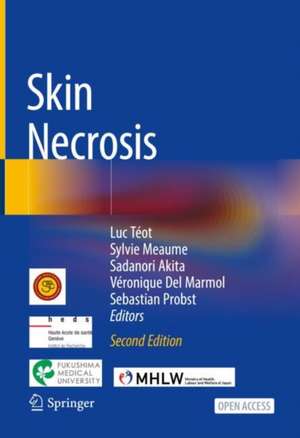
Skin Necrosis
Editat de Luc Téot, Sylvie Meaume, Sadanori Akita, Véronique Del Marmol, Sebastian Probsten Limba Engleză Hardback – 3 dec 2024
Descoperim în Skin Necrosis, ediția a doua (2024), un protocol clinic riguros care tranșează una dintre cele mai dificile decizii în îngrijirea rănilor: distincția dintre necroza uscată și cea umedă, cu algoritmi preciși pentru momentul optim de debridare. Remarcăm o evoluție semnificativă față de prima ediție, volumul fiind acum un manual de referință în chirurgia plastică și reconstructivă, integrând date clinice actualizate conform ghidurilor internaționale recente. Reținem că necroza cutanată nu este tratată doar ca o complicație, ci ca un simptom de pornire într-un spectru vast de patologii, de la traumatisme fizice la etiologii toxice sau infecțioase. Structura volumului este organizată progresiv, pornind de la fiziopatologie și investigații vasculare prin imagistică, avansând spre contexte clinice specifice — arsuri electrice, degerături sau leziuni provocate de radiații. Această ediție extinde expertiza editorului Luc Téot, cunoscut pentru lucrarea sa anterioară Surgery in Wounds, rafinând tranziția de la contextul clinic la cel chirurgical. Manual de referință comparabil cu Acute and Chronic Wounds de Ruth Bryant, Skin Necrosis se diferențiază prin focalizarea chirurgicală mai pronunțată și prin includerea unor capitole inovatoare despre telemedicină și e-Health în monitorizarea pacienților. Fiecare capitol include cazuri clinice detaliate și mesaje esențiale (take-home messages), oferind o perspectivă pragmatică asupra utilizării pansamentelor și a debridării chirurgicale. Abordarea interdisciplinară face legătura între dermatologie, medicină internă și asistență medicală, oferind soluții concrete inclusiv pentru populații speciale, precum pacienții pediatrici și vârstnici.
Preț: 422.60 lei
Preț vechi: 444.84 lei
-5%
Carte disponibilă
Livrare economică 05-19 noiembrie
Specificații
ISBN-10: 3031609530
Pagini: 552
Ilustrații: X, 617 p.
Dimensiuni: 183 x 260 x 34 mm
Greutate: 1.35 kg
Ediția:Second Edition 2024
Editura: Springer
Locul publicării:Cham, Switzerland
V-ar putea interesa
-
 Wound CareKelly Ryan-5%Preț: 96.48 lei101.55 lei
 -
 -21%Preț: 491.35 lei620.85 lei
 -
 DermatopathologyKlaus J. Busam-22%Preț: 1329.06 lei1710.07 lei
 -
 -5%Preț: 690.54 lei726.88 lei
 -
 -27%Preț: 464.71 lei639.77 lei
 -
 DermatopathologyDirk M. Elston-5%Preț: 879.91 lei926.22 lei
 -
 Oh's Intensive Care ManualJonathan M. Handy-29%Preț: 691.97 lei971.74 leiRecomandat
 -
 Sabiston Textbook of Surgery: The Biological Basis of Modern Surgical PracticeDouglas Scott Tyler-29%Preț: 1169.15 lei1645.26 leiRecomandat
 -
 Kumar and Clark's Clinical MedicineDavid Randall-26%Preț: 487.69 lei658.70 leiRecomandat
 -
 Dermatology: An Illustrated Colour TextDavid Gawkrodger-30%Preț: 277.88 lei396.21 lei
 -
 -32%Preț: 376.77 lei556.40 lei
 -
 Essentials of Plastic SurgeryJeffrey Janis-5%Preț: 1171.43 lei1233.08 lei
 -
 -5%Preț: 801.15 lei843.32 lei
 -
 Wound Care EssentialsSharon Baranoski-20%Preț: 547.90 lei688.66 lei
 -
 -20%Preț: 614.04 lei762.97 lei
 -
 -19%Preț: 540.45 lei665.30 lei
 -
 Surgical Intensive Care MedicineJohn M. O'Donnell-5%Preț: 1584.98 lei1668.40 lei
 -
 Burn Care and Treatment: A Practical GuideMarc G. Jeschke-22%Preț: 515.37 lei664.11 lei
 -
 Refractory WoundsJiangning Wang-5%Preț: 726.12 lei764.33 lei
De ce să citești această carte
Recomandăm această lucrare profesioniștilor care gestionează răni complexe, oferind un suport decizional crucial în diagnosticul diferențial al necrozei. Cititorul câștigă acces la algoritmi de tratament validați și la tehnici de ultimă oră în debridare și managementul vascular. Este o resursă esențială pentru chirurgi plasticieni și dermatologi, facilitând o înțelegere profundă a mecanismelor de vindecare și prevenire a complicațiilor tisulare severe.
Despre autor
Luc Téot este un editor și specialist reputat în domeniul îngrijirii rănilor și chirurgiei plastice, cu o activitate academică și clinică prodigioasă. Alături de co-editorii Sylvie Meaume și Sadanori Akita, acesta a contribuit fundamental la recunoașterea managementului rănilor ca specialitate medicală distinctă. Expertiza sa este recunoscută la nivel internațional prin numeroase publicații, printre care și volumul Surgery in Wounds. În această nouă ediție a Skin Necrosis, echipa editorială reunește specialiști de renume pentru a oferi o viziune globală și interdisciplinară asupra patologiilor cutante necrotice.
Descriere scurtă
Richly illustrated, this volume primarily provides therapeutic strategies and treatment algorithms for different clinical contexts, covering topics in distinct part: starting from definitions, physiopathology, vascular and imaging investigations, it then examines skin necrosis in its diverse clinical context, each assigned to a specific part: whether originated from physical injuries, of toxic origin, of medical or infectious nature, the content then shifts from the clinical context to the more specifically surgical context, and the application of existing techniques from dressing to debriding, including sharp and conservative ones. Dedicated sections deal with the pediatric and the elderly patients, closing the volume with a part on debridement education, from the perspective of the nurse and the physician, and finally a chapter on distance skin necrosis management, in the light of e-Health and personalized medicine.
All chapters were written by renowned specialists in their respected fields and include detailed sample cases and essential take-home messages; the topics that require an in-depth approach are extensively covered, whereas clinical chapters are more essential, focusing on practicality. In light of the highly interdisciplinary nature of wound management, this new, updated edition of Skin Necrosis will be a much-valued tool for wound care practitioners and health care professionals across the fields of surgery, dermatology, internal medicine, and nursing.
Cuprins
Notă biografică
Sylvie Meaume, MD, PhD, is specialized in Dermatology and Geriatrics, she is team lead at the Geriatric Unit for Wound and Scarring management, at the Hôpital Rothschild (APHP) in Paris. Vice-president of the French and Francophone Society for Wounds and Healing (SFFPC), she is also a Professor at the Sorbonne University and responsible for the University Diploma in Wounds and Scar Management at the Pierre and Marie Curie Faculty of Medicine in Paris. Sylvie Meume is the author of several books intended for all practitioners dealing with wounds, (such as surgeons, dermatologists, vascular doctors, geriatricians, pharmacists and nurses) as well as more than 150 articles in specialized journals indexed on pubmed. She is a key player in the dissemination of knowledge in the medical and scientific environment; among her contributions are countless lectures at congresses and conferences as well as presentations aimed at the general public.
Sadanori Akita is currently Professor of Fukuoka University, Faculty of Medicine and he did his residency in plastic surgery at Nagasaki University Hospital. He received his PhD from the Graduate School of Nagasaki University specializing in plastic and reconstructive surgery. He later did a research fellowship at Cedars-Sinai Medical Center, University of California, Los Angeles (UCLA) under supervision of Shlomo Melmed MD on a cytokine expression and its regulation in vivo by using a transgenic animal model. He serves as a general secretary of World Union of Wound Healing Societies, which will be held in Yokohama, September 2-6, 2012, and will be president of the world union of wound healing societies, for the years of 2012 to 2016. He is the president of the World Union of Wound Healing Societies (WUWHS) from September 2012 to September 2016 and currently the president of the Asian Wound Care Association (AWCA). His research interests include: cytokines and stem cells in wound healing, difficult wound healing (radiation injury), regenerative tissue enhancement to HIV-drug related-wasting patients, reconstructive surgery, burn and craniofacial surgery. His list of publications includes 110 peer-reviewed English original articles, 20 English overviews and 25 English-book chapters with 8 editorships of the books and lead the two study sectors funded by the Ministry of Health, Labor and Welfare on vascular anomaly and on cybernic medicine.
Veronique del Marmol is Head of the Department of Dermatology at Hospital Erasme, HUB, Université Libre de Bruxelles, Belgium. Skin cancer, inflammatory diseases, wound healing and non-invasive imaging are the main areas of interest for Professor del Marmol. In recognition of her work in these fields, she has been awarded many scholarships and grants, including the Major Roche Dermatology Fundamental Research Award. She authored and co-authored more than 215 137 peer reviewed articles and 7 books (H index 55- 12199 citations) and in particular in Experimental Dermatology, Journal Investigative dermatology, Journal of the European Academy of Dermatology and Venereology (JEADV), Nature and New England Journal of Medicine. Since 2009 she is leading at the European level the European skin cancer prevention campaign EUROMELANOMA. She is a founding member of European Hidradenitis Suppurativa Foundation and leading the European registry for Hidradenitis suppurativa. She is board member of the European dermatology forum (EDF), the European Academy of Dermato-oncology (EADO), the European Pigment cell society (ESPCR), and chair of the project and fellowship committee (PPRC) at EADV . She is actually president of the Belgian society of dermatology and she is member of the Belgian Royal Academy of Medicine since 2014.
Sebastian Probst is Full Professor of Tissue Viability and Wound Care at the Geneva School of Health Sciences, HES-SO University of Applied Sciences and Arts Western Switzerland, the Medical Faculty of the University of Geneva and the University Hospital of Geneva. He is also Adjunct Professor at the Faculty of Medicine Nursing and Health Sciences at Monash University in Melbourne, Australia. Sebastian Probst began his nursing career in Zurich over 20 years ago, and pursued his Master’s in Nursing Science at the University of Basel and attained his Doctorate in Clinical Practice at the University of Guildford in the U.K., and completed his Post-Doctorate at the Zurich University of Applied Sciences. He saw that patients with chronic and palliative wounds needed support and guidance to alleviate their wound related symptoms, to prevent recurrences and ultimately to enhance their quality of life. His research contributes to a person-centered care approach to develop best practice wound care, patient education, social support and self-efficacy in wound patients and their families. Prof. Probst actively lectures and mentors Bachelors, Masters and Ph.D. students. He has collaborative projects in Switzerland and internationally, and is President of the European Wound Management Association, the Vice-President of the Swiss Association for Wound Care and a Council Member of Wound DACH. In all associations he has leading roles in projects & document development.