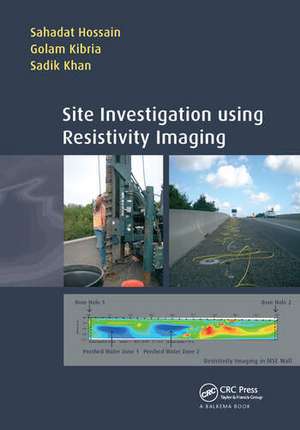
Site Investigation using Resistivity Imaging
Autor Sadik Khan, Sahadat Hossain, Golam Kibriaen Limba Engleză Paperback – 30 iun 2020
Subsurface investigation is the most important phase of any civil engineering construction or development activities. The geologic conditions can be extremely complex, variable, and subject to change with time; soil test borings and in-situ tests are employed to obtain subsoil information. Resistivity Imaging (RI) is a non-destructive, fast and cost-effective method of site investigation and soil characterization.
Site Investigation using Resistivity Imaging aims to summarize pertinent details of RI in site investigation for geotechnical and geo-environmental applications. It aims to bridge the gap that currently exists between the geotechnical/geo-environmental and geophysical engineering community. The geotechnical and geo-environmental engineers will be able to use annd understand geophysical data and utilize the information for their design.
Features:
- First comprehensive handbook aimed at engineers that summarises pertinent details of Resitivity Imaging (RI) in site investigation for geotechnical and geo-environmental applications.
- for geotechnical and geoenvironmental engineers, making it possible to interpret geophysical data and utilize the information for their design.
- explanining the advantages of RI over conventional site investigations: continuous image, large coverage, low cost, quick and easy data processing.
It will be a comprehensive handbook for the application of RI in geotechnical and geo-environmental site investigations.
Preț: 509.56 lei
Preț vechi: 599.48 lei
-15%
Carte tipărită la comandă
Livrare economică 30 noiembrie-14 decembrie
Specificații
ISBN-10: 0367571242
Pagini: 244
Dimensiuni: 174 x 246 x 13 mm
Greutate: 0.82 kg
Ediția:1
Editura: CRC Press
Colecția CRC Press
V-ar putea interesa
-
 Seeing into the EarthBoard On Earth Sciences And Resources-14%Preț: 760.78 lei884.63 lei
 -
 -23%Preț: 1045.80 lei1358.17 lei
 -
 Geotechnical Earthquake EngineeringSteven L. Kramer-9%Preț: 1001.61 lei1100.66 lei
 -
 Remote Sensing and Image InterpretationThomas Lillesand-18%Preț: 1378.98 lei1681.68 lei
 -
 Fundamentals of Soil Behavior, Fourth EditionCatherine O'Sullivan-23%Preț: 1015.18 lei1318.41 lei
 -
 Principles of Geotechnical Engineering, Si EditionBraja M. Das-18%Preț: 687.32 lei838.97 lei
 -
 Risk and Reliability in Geotechnical EngineeringKok-Kwang Phoon-18%Preț: 741.35 lei904.08 lei
 -
 -23%Preț: 1113.39 lei1445.95 lei
 -
 -18%Preț: 734.13 lei895.28 lei
 -
 Manual of Soil Laboratory TestingK H Head-23%Preț: 793.36 lei1030.34 lei
 -
 Soil Behavior and Characterization of GeomaterialsKasinathan Muthukkumaran-24%Preț: 1246.96 lei1640.75 lei
 -
 Advancing Subsurface Imaging, Energy Transition and Digital InnovationNumair Ahmed Siddiqui-18%Preț: 1402.19 lei1709.99 lei
 -
 -18%Preț: 1349.97 lei1646.31 lei
 -
 Ground Engineering and ApplicationsT. Thyagaraj-18%Preț: 1347.55 lei1643.36 lei
 -
 -18%Preț: 1728.43 lei2107.83 lei
 -
 -18%Preț: 1081.54 lei1318.95 lei
 -
 -18%Preț: 1338.49 lei1632.31 lei
 -
 -18%Preț: 820.70 lei1000.85 lei
 -
 Best Practices in Geotechnical and Pavement EngineeringSreevalsa Kolathayar-18%Preț: 1448.15 lei1766.03 lei
Public țintă
Professional Practice & DevelopmentCuprins
2 Background: electrical resistivity of geomaterials and measurement methods
3 Geotechnical properties affecting electrical resistivity
4 Electrical mixing models: bridging the gap between geophysical and geotechnical engineering
5 Electrical resistivity of municipal solid waste (MSW)
6 Case studies on the application of resistivity imaging
Descriere
Subsurface investigation is the most important phase of any civil engineering construction or development activities. The geologic conditions can be extremely complex, variable, and subject to change with time; soil test borings and in-situ tests are employed to obtain subsoil information. Resistivity Imaging (RI) is a non-destructive, fast and cost-effective method of site investigation and soil characterization.
Site Investigation using Resistivity Imaging aims to summarize pertinent details of RI in site investigation for geotechnical and geo-environmental applications. It aims to bridge the gap that currently exists between the geotechnical/geo-environmental and geophysical engineering community. The geotechnical and geo-environmental engineers will be able to use annd understand geophysical data and utilize the information for their design.
Features:
- First comprehensive handbook aimed at engineers that summarises pertinent details of Resitivity Imaging (RI) in site investigation for geotechnical and geo-environmental applications.
- for geotechnical and geoenvironmental engineers, making it possible to interpret geophysical data and utilize the information for their design.
- explanining the advantages of RI over conventional site investigations: continuous image, large coverage, low cost, quick and easy data processing.
It will be a comprehensive handbook for the application of RI in geotechnical and geo-environmental site investigations.