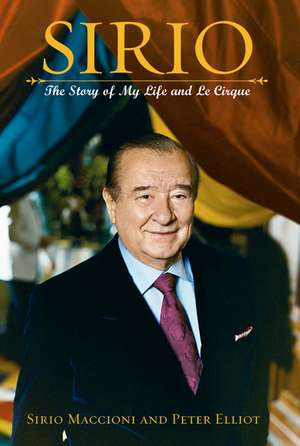
Sirio
Autor Sirio Maccioni, Peter Ellioten Limba Engleză Hardback – 21 mai 2004
Imaginați-vă o seară la începutul anilor '70 în Manhattan, unde la o masă discretă Richard Nixon și Henry Kissinger își pecetluiesc reconcilierea, în timp ce la intrare Frank Sinatra își lasă limuzina în grija personalului. Misterul din spatele succesului fulminant al [Le Cirque](restaurant) nu a stat doar în meniu, ci în aura de exclusivitate creată de un singur om. Găsim în această carte povestea lui Sirio Maccioni, restauratorul care a transformat actul de a mânca în oraș într-un spectacol social de neegalat, în ciuda faptului că a pornit dintr-o Toscană măcinată de privațiunile celui de-al Doilea Război Mondial. Suntem de părere că volumul Sirio reușește să depășească barierele unei simple memorii gastronomice. Reținem o structură narativă cinematică, ce ne poartă din satele italienești până în viața de noapte a Cubei pre-castriste, culminând cu efervescența New York-ului. Narativul amintește de Restaurant Man de Joe Bastianich prin intensitatea cu care reconstituie o epocă și prin modul în care dezvăluie mecanismele interne, adesea dure, ale ospitalității de lux. Spre deosebire de alte biografii, Sirio Maccioni nu se ferește să discute despre conflictele cu bucătari celebri care „au dezertat” sau despre presiunea constantă de a mulțumi o clientelă formată din elite politice și vedete precum Frank Zappa sau Ivana Trump. Stilul este energic, oglindind personalitatea autorului, și integrează detalii fascinante despre cum au devenit globale preparate precum pasta primavera. Este, în esență, o cronică a visului american filtrată prin rafinamentul european.
Preț: 233.59 lei
Carte disponibilă
Livrare economică 06-20 noiembrie
Specificații
ISBN-10: 0471204560
Pagini: 416
Dimensiuni: 157 x 235 x 27 mm
Greutate: 0.69 kg
Editura: HOUGHTON MIFFLIN
Locul publicării:Hoboken, United States
V-ar putea interesa
-
 Preț: 123.67 lei
 -
 Bold Women in Montana HistoryBeth JudyPreț: 113.04 lei
 -
 Prayers of the FaithfulPeter J ElliottPreț: 240.06 lei
 -
 Black ElkJoe JacksonPreț: 186.46 lei
 -
 Hairline FractureEndurance HartPreț: 42.41 lei
 -
 The Ultimate Pirate CollectionCharles River EditorsPreț: 137.50 lei
 -
 Narrative of William W. Brown, an American SlaveWilliam W. BrownPreț: 37.90 lei
 -
 Xcon to IconKali MusclePreț: 138.32 lei
 -
 Memoirs of an Innocent ManSpencer, Dr RayPreț: 104.13 lei
 -
 Preț: 134.84 lei
 -
 To Life L'ChaimBriggs, Dr HenryPreț: 233.83 lei
 -
 The Girl from Scorpions PassFurstenberg, MiriPreț: 67.68 lei
 -
 Through the Eyes of an Innocent ChildHelac, Mrs Mirsada AlemicPreț: 98.49 lei
 -
 Beyond Grief and SorrowDan Emilian TinicaPreț: 90.20 lei
 -
 Along Alien RoadsChen, Tsun YuanPreț: 117.20 lei
 -
 Chrysalis RisingNancy Vorkink MachinPreț: 54.75 lei
 -
 Reverend Doctor Alexander Todd (1842-1932)Michael T. TracyPreț: 118.69 lei
Public țintă
Readers interested in food–related memoirs and biographies of well–known food figures such as Jacques Pepin and Julia Child.De ce să citești această carte
Recomandăm această carte oricui dorește să înțeleagă cum se construiește un brand nemuritor în industria ospitalității. Cititorul câștigă o perspectivă privilegiată asupra istoriei sociale a New York-ului, văzută prin prisma celui mai exclusivist restaurant. Este o lectură despre reziliență și diplomație, ideală pentru cei care au savurat parcursul lui Carlo Molinaro în Hungry For Life, oferind însă un plus de strălucire și context politic internațional.
Despre autor
Sirio Maccioni a fost un restaurator de talie mondială, simbol al eleganței italiene în America. Născut în Toscana, el a urcat toate treptele ierarhice în restaurante celebre din Europa înainte de a deveni o figură centrală la Colony în New York și, ulterior, fondatorul [Le Cirque](restaurant). Peter J. Elliot, co-autorul volumului, este un reputat critic culinar pentru Bloomberg, a cărui expertiză aduce textului o rigoare jurnalistică și o profunzime analitică rar întâlnită în memoriile de acest gen, colaborarea lor fiind premiată cu IACP Crystal Whisk Award.
Descriere scurtă
By 1961, the dashing young Maccioni had become maitre d' at New York's most storied restaurant, the Colony. Within thirteen years, he had the experience and contacts he needed to launch his own restaurant, Le Cirque, which quickly became the hub of cafe society in New York.
From hiring the right chefs and revolutionizing the way top restaurants operate to popularizing now-famous dishes such as pasta primavera and creme brulee, Maccioni reveals how he made Le Cirque such a long-running success - a success that reached new heights when the restaurant moved to a new location in 1997. Along the way, Maccioni explains how he's dealt with defecting chefs and demanding customers. And through it all, he pays tribute to his proud Tuscan roots and to his wife and their three sons, who operate the family's other New York restaurant, Osteria del Circo, as well as restaurants in Las Vegas and Mexico City.
Like Maccioni himself, Sirio is full of passion, energy, and life - the unforgettable story of the world's most extraordinary restaurateur.
Recenzii
His memoir might have been a shallow name-dropper, full of chat about the Kennedy clan and insights into caviar. But that's the last thing "Sirio" is. Indeed, from the first chapter's anecdote of Ronald Reagan tossing off an ethnic joke, the book signals that it's no gladhanding salute to famous people or monied swells. There is barely another mention of a bold-face name for some 60 pages, but the reader won't mind.
This is an immigrant's story. In its opening chapters, it keenly evokes a time and place: Italy during the war. "My father was a very good father," the restaurateur writes. "In those days, there was no bad father." In rural Montecatini, first occupied by Germans and then Americans, the author is desperately poor and loses his mother early to pneumonia. What could be bathetic is instead spare and unflinching: He writes of hating the pity of the villagers and of his impatience, at the age of 10, at their empty assurances that his father will recover after a German mortar attack. ("There was no medicine, and no blood," he writes, dismissing the platitudes.)
With little to eat, Mr. Maccioni knowingly transforms himself into the stock character of war movies: the adorable Italian orphan boy begging for candy from servicemen. "We worked for those chocolates," he notes. He also pays attention as his war-torn city recovers swiftly after the war by marketing itself as a spa for café society. It was a lesson not lost on the young teenager, who was soon making his way in an old-fashioned world of restaurant service, where waiters were timed on how fast they could debone a chicken and the same staff worked breakfast through dinner, taking their breaks in between and sleeping together in a single room.
Pity the poor tourists in Germany who told the young waiter that, if he were ever in Paris, they had a job for him in their restaurant. He showed up with little French and no money and refused to leave, then traded up to the Plaza-Athenée when he was more fluent. He was still a "skinny, stupid spaghetti boy," he writes, desperate not to return to Montecatini until he could look down on all the people who, he says, had looked down on him.
As he moved to different hotels, restaurants and continents, he was careful to let the jet-setting clientele spot him (greeting the Onassis clan, for example, in a variety of venues). By midway through the book, Mr. Maccioni is in New York, having deserted his post on a posh cruise ship. He nabs a waiter's job at the prestigious Colony, gets a promotion and then the maitre d's tales begin.
He tells of the time both agent Swifty Lazar and publisher John Fairchild demanded the same corner table. Mr. Maccioni favored Lazar and was mortified when he found the two were meeting for lunch together. He tells of the pretty women who ate free for decades at Le Cirque, of the politics of sitting Canadian premier Pierre Trudeau nowhere near his wife, and of the betrayal and departure of his best chef, Daniel Boulud.
Mr. Maccioni is at his most interesting when he tackles the delicate issue of class, of being "a servant, but never servile." It is true that, by his own good fortune and entrepreneurial panache, he joined an elite of sorts by starting his own restaurant and making it thrive. But the book seethes with a class tension that will sting true for everyone who has ever worked among the well-to-do. Repeatedly Mr. Maccioni, maestro to the monied, warns of mistaking client friendships for real ones. He came to know Frank Sinatra, for instance, first at the Colony and then at Le Cirque, going around with him after hours to rival restaurants. —