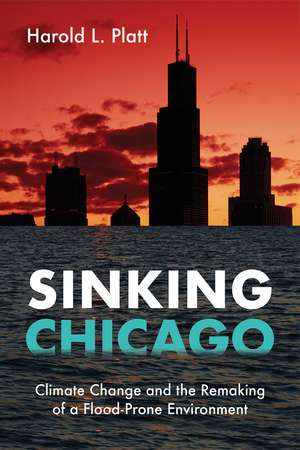
Sinking Chicago: Climate Change and the Remaking of a Flood-Prone Environment: Urban Life, Landscape and Policy
Autor Harold L. Platten Limba Engleză Paperback – 30 mar 2018
In Sinking Chicago, Harold Platt shows how people responded to climate change in one American city over a hundred-and-fifty-year period. During a long dry spell before 1945, city residents lost sight of the connections between land use, flood control, and water quality. Then, a combination of suburban sprawl and a wet period of extreme weather events created damaging runoff surges that sank Chicago and contaminated drinking supplies with raw sewage.
Chicagoans had to learn how to remake a city built on a prairie wetland. They organized a grassroots movement to protect the six river watersheds in the semi-sacred forest preserves from being turned into open sewers, like the Chicago River. The politics of outdoor recreation clashed with the politics of water management. Platt charts a growing constituency of citizens who fought a corrupt political machine to reclaim the region’s waterways and Lake Michigan as a single eco-system. Environmentalists contested policymakers’ heroic, big-technology approaches with small-scale solutions for a flood-prone environment. Sinking Chicago lays out a roadmap to future planning outcomes.
Chicagoans had to learn how to remake a city built on a prairie wetland. They organized a grassroots movement to protect the six river watersheds in the semi-sacred forest preserves from being turned into open sewers, like the Chicago River. The politics of outdoor recreation clashed with the politics of water management. Platt charts a growing constituency of citizens who fought a corrupt political machine to reclaim the region’s waterways and Lake Michigan as a single eco-system. Environmentalists contested policymakers’ heroic, big-technology approaches with small-scale solutions for a flood-prone environment. Sinking Chicago lays out a roadmap to future planning outcomes.
Din seria Urban Life, Landscape and Policy
-
 Preț: 250.93 lei
 -
 Preț: 217.67 lei
 -
 Preț: 441.48 lei
 -
 Preț: 207.57 lei
 -
 Preț: 231.53 lei
 -
 Preț: 231.53 lei
 -
 Preț: 212.01 lei
 -
 Preț: 243.94 lei
 -
 Preț: 229.77 lei
 -
 Preț: 200.17 lei
 -
 Preț: 225.84 lei
 -
 Preț: 247.60 lei
 -
 Preț: 202.73 lei
 -
 Preț: 236.54 lei
 -
 Preț: 227.35 lei
 -
 Preț: 272.15 lei
 -
 Preț: 239.11 lei
 -
 Preț: 208.22 lei
 -
 Preț: 195.96 lei
 -
 Preț: 205.85 lei
 -
 Preț: 219.05 lei
 -
 Preț: 252.10 lei
 -
 Preț: 196.59 lei
 -
 Preț: 270.33 lei
 - 5%
 Preț: 466.30 lei
 - 5%
 Preț: 602.47 lei
 -
 Preț: 286.47 lei
 -
 Preț: 282.55 lei
 -
 Preț: 273.03 lei
 - nou
 Preț: 602.84 lei
 - 9%
 Preț: 697.91 lei
 - 23%
 Preț: 553.61 lei
Preț: 215.51 lei
Puncte Express: 323
Carte tipărită la comandă
Livrare economică 30 noiembrie-14 decembrie
Livrare prin curier în România Termenul estimat este afișat lângă disponibilitate.
Transport gratuit de la 400.00 lei Plată online sau ramburs, în funcție de opțiunile comenzii.
Retur gratuit în 14 zile Comandă securizată și suport în română.
Specificații
ISBN-13: 9781439915493
ISBN-10: 1439915490
Pagini: 342
Ilustrații: 7 figs., 13 maps
Dimensiuni: 152 x 229 x 23 mm
Greutate: 0.48 kg
Ediția:1
Editura: Temple University Press
Colecția Temple University Press
Seria Urban Life, Landscape and Policy
ISBN-10: 1439915490
Pagini: 342
Ilustrații: 7 figs., 13 maps
Dimensiuni: 152 x 229 x 23 mm
Greutate: 0.48 kg
Ediția:1
Editura: Temple University Press
Colecția Temple University Press
Seria Urban Life, Landscape and Policy
Recenzii
"Platt has written the first study of the effects of long-term climate change on the American city of Chicago. It is an important undertaking, and the author is fit for the task.... Platt’s fine study, then, is a model for how other historians might write the history of ongoing climate change—with a critical eye toward crafting policies that will help people weather the storm."--American Historical Review
Notă biografică
Harold L. Platt is Professor of History Emeritus at Loyola University Chicago. He is the author or editor of several books, including Shock Cities: The Environmental Transformation and Reform of Manchester and Chicago, and Building the Urban Environment: Visions of the Organic City in the United States, Europe, and Latin America (Temple ). He has twice won the book-of-the-year award from the American Public Works Association.