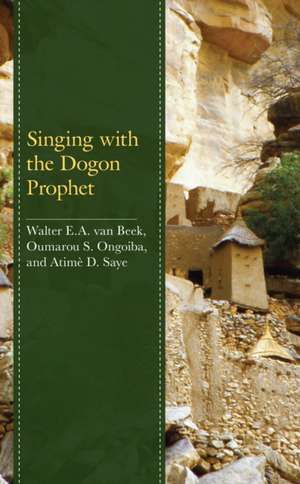
Singing with the Dogon Prophet
Autor Walter E. A. Van Beek, Oumarou S. Ongoiba, Atimè D. Sayeen Limba Engleză Hardback – 25 apr 2022
Preț: 525.80 lei
Preț vechi: 791.56 lei
-34%
Puncte Express: 789
Carte tipărită la comandă
Livrare economică 08-22 iunie
Specificații
ISBN-13: 9781793654250
ISBN-10: 1793654255
Pagini: 266
Ilustrații: 1 b/w illustrations; 36 b/w photos; 3 tables;
Dimensiuni: 160 x 229 x 19 mm
Greutate: 0.53 kg
Editura: Bloomsbury Publishing
Colecția Lexington Books
Locul publicării:New York, United States
ISBN-10: 1793654255
Pagini: 266
Ilustrații: 1 b/w illustrations; 36 b/w photos; 3 tables;
Dimensiuni: 160 x 229 x 19 mm
Greutate: 0.53 kg
Editura: Bloomsbury Publishing
Colecția Lexington Books
Locul publicării:New York, United States
Cuprins
List of Figures
Preface
Acknowledgements
Chapter 1: Singing through the night
Chapter 2: A Dogon heritage
Chapter 3: The blind singer
Chapter 4: The baja ni in Dogon culture
Chapter 5: The songs
Chapter 6: Prophecies
Appendix 1: The singers
Appendix 2: Villages with information on Abire
Appendix 3: List of Jamsay and Toro so terms
Bibliography
Preface
Acknowledgements
Chapter 1: Singing through the night
Chapter 2: A Dogon heritage
Chapter 3: The blind singer
Chapter 4: The baja ni in Dogon culture
Chapter 5: The songs
Chapter 6: Prophecies
Appendix 1: The singers
Appendix 2: Villages with information on Abire
Appendix 3: List of Jamsay and Toro so terms
Bibliography
Recenzii
This fine book does two things. First, it takes us deeply into the philosophical underpinnings of Dogon mortuary rituals. Second, by covering the sequence of songs performed in a single long night as experienced by the lead author, enhanced by excellent photos and drawings, it gives the reader a feeling of having been physically present there. This duality is rare in academic writing. The many comparisons between Dogon and Abrahamic religion make the book as accessible to a general Judeo-Christian readership as to anthropologists.
At a time when Dogon country is going through dark hours and people are forced to reject ancestral cultures in favor of a totalitarian religious thought, the work of Walter van Beek, Oumarou Ongoiba, and Atimè Saye brings us a breath of fresh air. This archival document records and analyzes the chants of the baja ni performed during funeral ceremonies and also evokes the philosophical subtlety and wealth of the Dogon people. The reader will find in this work of great scientific and heritage value the opportunity to dream of the return of peace and wisdom at the foot of the Bandiagara Cliff.
Our interest in these funeral songs and prophecies of a Dogon musician and visionary is drawn initially to the transcription and elucidation of the verses, but greater profundity yet lies in the passages and allusions which confront us with the ultimately unfathomable. In its hesitations and openness to further interpretation, this text offers an intimate and compelling portrait. No outsider, however long their engagement, could confidently make such an analysis unaided, and this collaborative achievement would be a model for future work, if only copying it were not so demanding.
At a time when Dogon country is going through dark hours and people are forced to reject ancestral cultures in favor of a totalitarian religious thought, the work of Walter van Beek, Oumarou Ongoiba, and Atimè Saye brings us a breath of fresh air. This archival document records and analyzes the chants of the baja ni performed during funeral ceremonies and also evokes the philosophical subtlety and wealth of the Dogon people. The reader will find in this work of great scientific and heritage value the opportunity to dream of the return of peace and wisdom at the foot of the Bandiagara Cliff.
Our interest in these funeral songs and prophecies of a Dogon musician and visionary is drawn initially to the transcription and elucidation of the verses, but greater profundity yet lies in the passages and allusions which confront us with the ultimately unfathomable. In its hesitations and openness to further interpretation, this text offers an intimate and compelling portrait. No outsider, however long their engagement, could confidently make such an analysis unaided, and this collaborative achievement would be a model for future work, if only copying it were not so demanding.